Results by title
2 books match the query 'Hidden Costs'
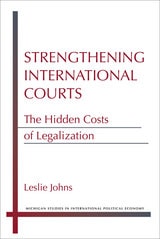
Strengthening International Courts
The Hidden Costs of LegalizationLeslie Johns
University of Michigan Press, 2015
As all manner of commerce becomes increasingly global, states must establish laws to protect property rights, human rights, and national security. In many cases, states delegate authority to resolve disputes regarding these laws to an independent court, whose power depends upon its ability to enforce its rulings.
Examining detailed case studies of the International Court of Justice and the transition from the General Agreement on Tariffs and Trade to the World Trade Organization, Leslie Johns finds that a court’s design has nuanced and mixed effects on international cooperation. A strong court is ideal when laws are precise and the court is nested within a political structure like the European Union. Strong courts encourage litigation but make states more likely to comply with agreements when compliance is easy and withdraw from agreements when it is difficult. A weak court is optimal when law is imprecise and states can easily exit agreements with minimal political or economic repercussions. Johns concludes the book with recommendations for promoting cooperation by creating more precise international laws and increasing both delegation and obligation to international courts.
[more]
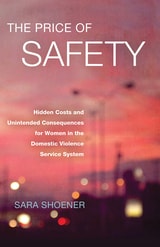
The Price of Safety
Hidden Costs and Unintended Consequences for Women in the Domestic Violence Service SystemSara Shoener
Vanderbilt University Press, 2017
Specialized public resources for survivors of intimate partner violence (IPV) are increasingly common and diverse--from protection order courts and dedicated domestic violence units in police precincts to a vast network of community-based emergency shelters and counseling services. Yet little consensus exists regarding which resources actually work to reduce violence and help survivors lead the lives they would like to live. This book is an account of these resources and IPV survivors' experiences with them in three communities in the United States.
Through detailed observations of services such as court procedures, public benefits processes, and community-based IPV programs as well as in-depth interviews with dozens of IPV survivors and practitioners, Shoener describes how our current institutional response to IPV is often not useful--and sometimes quite harmful--for IPV survivors with the least material, social, and cultural capital to spare. For these women, as the interviews vividly record, IPV has long-term economic and social consequences, disrupting career paths and creating social isolation.
Through detailed observations of services such as court procedures, public benefits processes, and community-based IPV programs as well as in-depth interviews with dozens of IPV survivors and practitioners, Shoener describes how our current institutional response to IPV is often not useful--and sometimes quite harmful--for IPV survivors with the least material, social, and cultural capital to spare. For these women, as the interviews vividly record, IPV has long-term economic and social consequences, disrupting career paths and creating social isolation.
[more]