Results by title
3 books match the query 'Hide'

Hide and Seek
The Child between Psychoanalysis and FictionVirginia L. Blum
University of Illinois Press, 1995
Concentrating on the "go-between" function of the child in nineteenth- and twentieth-century American and British fiction, Virginia Blum shows how selected children in the works of L. P. Hartley, Charles Dickens, Henry James, and Vladimir Nabokov were actually fictional messengers who ultimately were unsuccessful at reconciling impasses in the adult world.
Throughout her book Blum draws on pop images of real and fictional children, ranging from the Baby Jessica case, in which the idea of "real" paternity and family bonds comes to the mythic fore, to the film Home Alone, in which the abandoned child becomes protector of his family's hearth and home. Hide and Seek raises provocative questions about the ways in which our culture fetishizes the idea of the child at the same time that we treat with comparative indifference the conditions under which many real children actually live.
"A work of striking originality and consistent intellectual honesty, forcing us into genuinely profound and darkly uncomfortable areas of speculation." -- James R. Kincaid, author of Child-Loving: The Erotic Child and Victorian
Culture
Hide, Horn, Fish, and Fowl
Texas Hunting and Fishing LoreKenneth L. Untiedt
University of North Texas Press, 2011
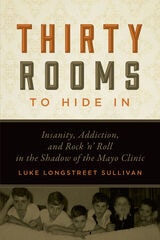
Thirty Rooms to Hide In
Insanity, Addiction, and Rock ‘n’ Roll in the Shadow of the Mayo ClinicLuke Longstreet Sullivan
University of Minnesota Press, 2014
Author Luke Longstreet Sullivan has a simple way of describing his new memoir: “It’s like The Shining . . . only funnier.” Thirty Rooms to HideIn tells the astonishing story of Sullivan’s father and his descent from one of the world’s top orthopedic surgeons at the Mayo Clinic to a man who is increasingly abusive, alcoholic, and insane, ultimately dying alone on the floor of a Georgia motel room. For his wife and six sons, the years prior to his death were characterized by turmoil, anger, and family dysfunction; but somehow they were also a time of real happiness for Sullivan and his brothers, full of dark humor and much laughter.
Through the 1950s and 1960s, the six brothers had a wildly fun and thoroughly dysfunctional childhood living in a forbidding thirty-room mansion, known as the Millstone, on the outskirts of Rochester, Minnesota. The many rooms of the immense home, as well as their mother’s loving protection, allowed the Sullivan brothers to grow up as normal, mischievous boys. Against a backdrop of the times—the Cold War, the Cuban Missile Crisis, fallout shelters, JFK’s assassination, and the Beatles—the cracks in their home life and their father’s psyche continue to widen. When their mother decides to leave the Millstone and move the family across town, the Sullivan boys are able to find solace in each other and in rock ’n’ roll.
As Thirty Rooms to HideIn follows the story of the Sullivan family—at times grim, at others poignant—a wonderful, dark humor lifts the narrative. Tragic, funny, and powerfully evocative of the 1950s and 1960s, Thirty Rooms to Hide In is a tale of public success and private dysfunction, personal and familial resilience, and the strange power of humor to give refuge when it is needed most, even if it can’t always provide the answers.