Results by title
4 books match the query 'Higgins, Scott'
Editing and Special/Visual Effects
Keil, Charlie
Rutgers University Press, 2016
Harnessing the Technicolor Rainbow
Color Design in the 1930sBy Scott Higgins
University of Texas Press, 2007
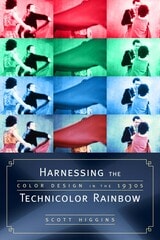
Like Dorothy waking up over the rainbow in the Land of Oz, Hollywood discovered a vivid new world of color in the 1930s. The introduction of three-color Technicolor technology in 1932 gave filmmakers a powerful tool with which to guide viewers' attention, punctuate turning points, and express emotional subtext. Although many producers and filmmakers initially resisted the use of color, Technicolor designers, led by the legendary Natalie Kalmus, developed an aesthetic that complemented the classical Hollywood filmmaking style while still offering innovative novelty. By the end of the 1930s, color in film was thoroughly harnessed to narrative, and it became elegantly expressive without threatening the coherence of the film's imaginary world.
Harnessing the Technicolor Rainbow is the first scholarly history of Technicolor aesthetics and technology, as well as a thoroughgoing analysis of how color works in film. Scott Higgins draws on extensive primary research and close analysis of well-known movies, including Becky Sharp, A Star Is Born, Adventures of Robin Hood, and Gone with the Wind, to show how the Technicolor films of the 1930s forged enduring conventions for handling color in popular cinema. He argues that filmmakers and designers rapidly worked through a series of stylistic modes based on the demonstration, restraint, and integration of color—and shows how the color conventions developed in the 1930s have continued to influence filmmaking to the present day. Higgins also formulates a new vocabulary and a method of analysis for capturing the often-elusive functions and effects of color that, in turn, open new avenues for the study of film form and lay a foundation for new work on color in cinema.
Matinee Melodrama
Playing with Formula in the Sound SerialHiggins, Scott
Rutgers University Press, 2016
Matinee Melodrama is the first book about the adventure serial as a distinct artform, one that uniquely encouraged audience participation and imaginative play. Media scholar Scott Higgins proposes that the serial’s incoherent plotting and reliance on formula, far from being faults, should be understood as some of its most appealing attributes, helping to spawn an active fan culture. Further, he suggests these serials laid the groundwork not only for modern-day cinematic blockbusters like Star Wars and Raiders of the Lost Ark, but also for all kinds of interactive media that combine spectacle, storytelling, and play.
As it identifies key elements of the serial form—from stock characters to cliffhangers—Matinee Melodrama delves deeply into questions about the nature of suspense, the aesthetics of action, and the potentials of formulaic narrative. Yet it also provides readers with a loving look at everything from Zorro’s Fighting Legion to Daredevils of the Red Circle, conveying exactly why these films continue to thrill and enthrall their fans.
Observing Film Art
Themes from the Work of David BordwellCharlie Keil
Rutgers University Press, 2027
When David Bordwell died in 2024, he left behind a legacy of film scholarship and criticism whose influence is unmatched. Coauthor of a pair of textbooks adopted across the globe and the main force behind a blog read by thousands, Bordwell has influenced generations of film students, filmmakers, and film critics. Observing Film Art examines the breadth of Bordwell’s work through the perspectives of those who knew him best, collaborators, former students, and critics among them. This is the first collection devoted to the work of Bordwell, and it gives equal attention to each facet of his prodigious scholarship, structured to highlight his interest in theory, history, and analysis and criticism. The cornerstones of his approach to film study, including formalism, cognitivism, and historical poetics, are all examined in detail, as are key works, including The Classical Hollywood Cinema (coauthored with Kristin Thompson and Janet Staiger) and Narration in the Fiction Film.