Results by title
9 books match the query 'High technology industries'

Canaries in the Code Mine
Precarity and the Future of Tech WorkMax Papadantonakis
Temple University Press, 2025
Interviewing 120 software developers from leading tech firms, Papadantonakis shows how temporary contracts, project cancellations, and company downsizing undermine the security of even highly skilled professionals. He also highlights the systemic inequalities that shape the tech industry, showing how age, race, and gender often dictate the opportunities and responsibilities software developers have—or are denied.
Canaries in the Code Mine highlights a disturbing reality of privilege and vulnerability within the tech industry. Papadantonakis engages in a critical discourse on the evolving nature of work in the digital era, emphasizing the need to shape an equitable future in the rapidly evolving landscape.

Cyber-Marx
Cycles and Circuits of Struggle in High Technology CapitalismNick Dyer-Witheford
University of Illinois Press, 1999
Dyer-Witheford maps the dynamics of modern capitalism, showing how capital depends for its operations not just on exploitation in the immediate workplace, but on the continuous integration of a whole series of social sites and activities, from public health and maternity to natural resource allocation and the geographical reorganization of labor power. He also shows how these sites and activities may become focal points of subversion and insurgency, as new means of communication vital for the smooth flow of capital also permit otherwise isolated and dispersed points of resistance to connect and combine with one another.
Cutting through the smokescreen of high-tech propaganda, Dyer-Witheford predicts the advent of a reinvented, "autonomist" Marxism that will rediscover the possibility of a collective, communist transformation of society. Refuting the utopian promises of the information revolution, he discloses the real potentialities for a new social order in the form of a twenty-first-century communism based on the common sharing of wealth.

Designing Businesses
How to develop and lead a high technology companyGeorge Young
The Institution of Engineering and Technology, 1997

Divine Meets Digital
Tech Workers and Religion in the U.S. and ChinaDi Di
Rutgers University Press, 2026
What role does religion play in the tech industry? Based on nearly one hundred interviews, Divine Meets Digital uncovers the ways tech workers engage with religion and make sense of their work through religious and spiritual worldviews. While most identify as nonreligious, they are far from antireligious. Instead, they navigate competing religious and nonreligious views, often distinguishing between what they see as the controversial elements of religion—such as belief in the supernatural in China and its politicized and dogmatic aspects in the United States—and its more noncontroversial aspects. In doing so, they justify their religious engagement by embracing religion's noncontroversial elements while distancing themselves from its controversial features. This book offers a powerful new lens for understanding one of the most influential industries of our time, inviting readers to better understand the people who live and work at the intersection between science, religion, and technology.
Engineering Culture
Control and Commitment in a High-Tech CorporationGideon Kunda
Temple University Press, 2006
Miracle Road
The Story of Research Triangle ParkAllen Paul and Mack Paul
Duke University Press, 2026
Research Triangle Park in North Carolina (RTP) emerged under the unique circumstances of a poor Southern state that needed to find a way to offset the declining industries of tobacco, furniture, and textiles in the 1950s. Through the sustained commitment of nearby universities, business leaders, and local and state officials, state leaders established the largest science and research park in the United States in an area that was nothing but “possums and pines.” Miracle Road tells this story through the eyes of those at the center of it, like the local black leaders who convinced white officials to desegregate public schools with the justification that it would make the area more appealing to tech companies, or how a chance meeting between the governor and a Danish executive led to North Carolina becoming an epicenter for weight loss drugmakers decades later. Allen Paul and Mack Paul organize the story around major periods in RTP’s growth, showing how RTP came to define the region and the state by the 1990s as well as the major setbacks it encountered in the early 2000s. Breaking down the strategies that led to RTP’s success, like creating new institutions in targeted tech areas to spur activity and factoring quality of life into the regional planning of the area, Miracle Road demonstrates how the story of Research Triangle Park is a fascinating and important case study of urban development in the twenty-first century.

Play to Submission
Gaming Capitalism in a Tech FirmTongyu Wu
Temple University Press, 2024
Play to Submission shows how Behemoth’s games undermined and manipulated workers. They lost their work-life balance and the constant competition made labor organizing difficult. Nonetheless, many workers embraced management’s games as a chance to show off their “gamer” identities and create a workplace culture with privileged insiders and exiled outsiders, with female and migrant workers usually in the latter group. Moreover, Wu indicates this may be the future of work for high- and low-skilled and, creative workers in an environment where capitalists have heightened demands for technology and creativity.
Drawing from 13 months of ethnographic work, Wu presents a persistent reality in which the company reaps the reward of surplus productivity, leaving employees themselves in a highly competitive and sometimes precarious work position.
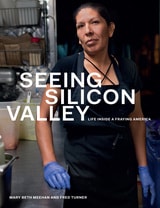
Seeing Silicon Valley
Life inside a Fraying AmericaMary Beth Meehan and Fred Turner
University of Chicago Press, 2021
It’s hard to imagine a place more central to American mythology today than Silicon Valley. To outsiders, the region glitters with the promise of extraordinary wealth and innovation. But behind this image lies another Silicon Valley, one segregated by race, class, and nationality in complex and contradictory ways. Its beautiful landscape lies atop underground streams of pollutants left behind by decades of technological innovation, and while its billionaires live in compounds, surrounded by redwood trees and security fences, its service workers live in their cars.
With arresting photography and intimate stories, Seeing Silicon Valley makes this hidden world visible. Instead of young entrepreneurs striving for efficiency in minimalist corporate campuses, we see portraits of struggle—families displaced by an impossible real estate market, workers striving for a living wage, and communities harmed by environmental degradation. If the fate of Silicon Valley is the fate of America—as so many of its boosters claim—then this book gives us an unvarnished look into the future.
The Digital Factory
The Human Labor of AutomationMoritz Altenried
University of Chicago Press, 2022
The workers of today’s digital factory include those in Amazon warehouses, delivery drivers, Chinese gaming workers, Filipino content moderators, and rural American search engine optimizers. Repetitive yet stressful, boring yet often emotionally demanding, these jobs require little formal qualification, but can demand a large degree of skills and knowledge. This work is often hidden behind the supposed magic of algorithms and thought to be automated, but it is in fact highly dependent on human labor.
The workers of today’s digital factory are not as far removed from a typical auto assembly line as we might think. Moritz Altenried takes us inside today’s digital factories, showing that they take very different forms, including gig economy platforms, video games, and Amazon warehouses. As Altenried shows, these digital factories often share surprising similarities with factories from the industrial age. As globalized capitalism and digital technology continue to transform labor around the world, Altenried offers a timely and poignant exploration of how these changes are restructuring the social division of labor and its geographies as well as the stratifications and lines of struggle.