Results by title
73 books match the query 'Higher Education' and 6 start with a
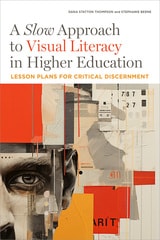
A Slow Approach to Visual Literacy in Higher Education
Lesson Plans for Critical DiscernmentDana Statton Thompson and Stephanie Beene
American Library Association, 2024
The principles of “slow librarianship”—which prioritizes reflection, collaboration, solidarity, and valuing all kinds of contributions—can also support deeper and more sustained learning and understanding. This book emphasizes the importance of attention and focus to the process of visual literacy, demonstrating how this approach supports ACRL’s Visual Literacy Competency Standards for Higher Education and the Framework for Visual Literacy in Higher Education. Library workers, educators, and instructors will discover
- dozens of flexible lesson plans for teaching visual literacy, scaffolded by competency levels: novice, intermediate, and advanced;
- ways to integrate slow looking into the classroom, emphasizing careful observation and the sustained act of looking;
- techniques for showing learners how to select images with intention, as well as carefully determine when and how to share those images;
- reasons why slow creating is essential to understanding and applying visual literacy in the twenty-first century; and
- a look at how increasing access to internet connectivity, generative artificial intelligence (AI), and new ethics for sharing and using information online will affect the future of visual literacy.
[more]
Academic Ableism
Disability and Higher EducationJay Timothy Dolmage
University of Michigan Press, 2017
Academic Ableism brings together disability studies and institutional critique to recognize the ways that disability is composed in and by higher education, and rewrites the spaces, times, and economies of disability in higher education to place disability front and center. For too long, argues Jay Timothy Dolmage, disability has been constructed as the antithesis of higher education, often positioned as a distraction, a drain, a problem to be solved. The ethic of higher education encourages students and teachers alike to accentuate ability, valorize perfection, and stigmatize anything that hints at intellectual, mental, or physical weakness, even as we gesture toward the value of diversity and innovation. Examining everything from campus accommodation processes, to architecture, to popular films about college life, Dolmage argues that disability is central to higher education, and that building more inclusive schools allows better education for all.
[more]
Academic Ableism
Disability and Higher EducationJay Timothy Dolmage
University of Michigan Press, 2017
Academic Ableism brings together disability studies and institutional critique to recognize the ways that disability is composed in and by higher education, and rewrites the spaces, times, and economies of disability in higher education to place disability front and center. For too long, argues Jay Timothy Dolmage, disability has been constructed as the antithesis of higher education, often positioned as a distraction, a drain, a problem to be solved. The ethic of higher education encourages students and teachers alike to accentuate ability, valorize perfection, and stigmatize anything that hints at intellectual, mental, or physical weakness, even as we gesture toward the value of diversity and innovation. Examining everything from campus accommodation processes, to architecture, to popular films about college life, Dolmage argues that disability is central to higher education, and that building more inclusive schools allows better education for all.
[more]
Academic Science, Higher Education, and the Federal Government, 1950-1983
John T. Wilson
University of Chicago Press, 1983
Since World War II, the federal government and institutions of higher education have shared an unprecedented association. John T. Wilson is among the relatively few people who have played roles on both sides of this relationship. In this essay, he examines the substance of the relationship with an eye to the future, reviewing the policies and programs that have governed federal support of academic science and higher education during the past thirty years.
[more]
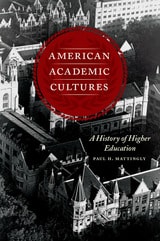
American Academic Cultures
A History of Higher EducationPaul H. Mattingly
University of Chicago Press, 2017
At a time when American higher education seems ever more to be reflecting on its purpose and potential, we are more inclined than ever to look to its history for context and inspiration. But that history only helps, Paul H. Mattingly argues, if it’s seen as something more than a linear progress through time. With American Academic Cultures, he offers a different type of history of American higher learning, showing how its current state is the product of different, varied generational cultures, each grounded in its own moment in time and driven by historically distinct values that generated specific problems and responses.
Mattingly sketches out seven broad generational cultures: evangelical, Jeffersonian, republican/nondenominational, industrially driven, progressively pragmatic, internationally minded, and the current corporate model. What we see through his close analysis of each of these cultures in their historical moments is that the politics of higher education, both inside and outside institutions, are ultimately driven by the dominant culture of the time. By looking at the history of higher education in this new way, Mattingly opens our eyes to our own moment, and the part its culture plays in generating its politics and promise.
Mattingly sketches out seven broad generational cultures: evangelical, Jeffersonian, republican/nondenominational, industrially driven, progressively pragmatic, internationally minded, and the current corporate model. What we see through his close analysis of each of these cultures in their historical moments is that the politics of higher education, both inside and outside institutions, are ultimately driven by the dominant culture of the time. By looking at the history of higher education in this new way, Mattingly opens our eyes to our own moment, and the part its culture plays in generating its politics and promise.
[more]
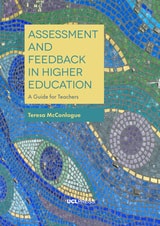
Assessment and Feedback in Higher Education
A Guide for TeachersTeresa McConlogue
University College London, 2020
Teachers spend much of their time on assessment, yet many higher education teachers have received minimal guidance on assessment design and marking. This means assessment can often be a source of stress and frustration. Offering a concise overview of assessment theory and practice, this guide provides teachers with the help they need. In education, theory and practice are often poorly linked. In this guide, Teresa McConlogue presents theoretical ideas and research findings and links them to practice. She considers recent theoretical work on feedback and suggests ways of developing evaluative judgment. Throughout the book, teachers are encouraged to examine their practice critically, and there are ideas for small-scale educational investigations, involving teachers, their colleagues, and students, such as using the Assessment Review Questionnaire to adapt assessments. This guide explores the concept of academic standards and proposes methods of co-constructing shared standards within a teaching team and with students through calibration activities.
[more]