Results by title
5 books match the query 'Hindutva'
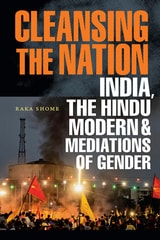
Cleansing the Nation
India, the Hindu Modern, and Mediations of GenderRaka Shome
Duke University Press, 2025
In Cleansing the Nation, Raka Shome explores the logics of governmentality of contemporary Hindu nationalism in India by advancing the concept of the “Hindu modern.” Analyzing a national cleanliness program and other development projects, Shome shows how the Hindu modern—a form of national governmentality that disciplines and regulates individual subjects to create desirable “clean” citizens—inscribes Hindu nationalism in India. Focused on security, progress, and development while celebrating and protecting the figure of the upper-caste Hindu woman, the Hindu modern works toward a religious and casteist cleansing of the nation that rewrites Indian modernity as a purified and cleansed Hindu modernity. It shores up caste and religious inequalities around who is authentically Indian, reproducing historical violence against and exclusions of caste, gender, and religion, especially toward Muslims, Dalits, and Adivasis. By outlining how the Hindu modern sutures Hindu-ness to the contemporary Indian national project of modernity, Shome helps us further understand projects of national purification and cleanliness within global populist authoritarian movements.
[more]
Hindutva as Political Monotheism
Anustup Basu
Duke University Press, 2020
In Hindutva as Political Monotheism, Anustup Basu offers a genealogical study of Hindutva—Hindu right-wing nationalism—to illustrate the significance of Western anthropology and political theory to the idea of India as a Hindu nation. Connecting Nazi jurist Carl Schmitt's notion of political theology to traditional theorems of Hindu sovereignty and nationhood, Basu demonstrates how Western and Indian theorists subsumed a vast array of polytheistic, pantheistic, and henotheistic cults featuring millions of gods into a singular edifice of faith. Basu exposes the purported “Hindu Nation” as itself an orientalist vision by analyzing three crucial moments: European anthropologists’ and Indian intellectuals’ invention of a unified Hinduism during the long nineteenth century; Indian ideologues’ adoption of ethnoreligious nationalism in pursuit of a single Hindu way of life in the twentieth century; and the transformations of this project in the era of finance capital, Bollywood, and new media. Arguing that Hindutva aligns with Enlightenment notions of nationalism, Basu foregrounds its significance not just to Narendra Modi's right-wing, anti-Muslim government but also to mainstream Indian nationalism and its credo of secularism and tolerance.
[more]
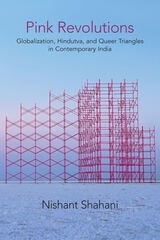
Pink Revolutions
Globalization, Hindutva, and Queer Triangles in Contemporary IndiaNishant Shahani
Northwestern University Press, 2021
Pink Revolutions describes how queer politics in India occupies an uneasy position between the forces of neoliberal globalization, on the one hand, and the nationalist Hindu fundamentalism that has emerged since the 1990s, on the other. While neoliberal forces use queerness to highlight India’s democratic credentials and stature within a globalized world, nationalist voices claim that queer movements in the country pose a threat to Indian national identity. Nishant Shahani argues that this tension implicates queer politics within messy entanglements and knotted ideological triangulations, geometries of power in which local understandings of “authentic” nationalism brush up against global agendas of multinational capital.
Eschewing structures of absolute complicity or abject alterity, Pink Revolutions pays attention to the logics of triangulation in various contexts: gay tourism, university campus politics, diasporic cultural productions, and AIDS activism. The book articulates a framework through which queer politics can challenge rather than participate in neoliberal imperatives, an approach that will interest scholars engaged with queer studies and postcolonial scholarship, as well as activists and academics wrestling with global capitalism and right-wing regimes around the world.
Eschewing structures of absolute complicity or abject alterity, Pink Revolutions pays attention to the logics of triangulation in various contexts: gay tourism, university campus politics, diasporic cultural productions, and AIDS activism. The book articulates a framework through which queer politics can challenge rather than participate in neoliberal imperatives, an approach that will interest scholars engaged with queer studies and postcolonial scholarship, as well as activists and academics wrestling with global capitalism and right-wing regimes around the world.
[more]
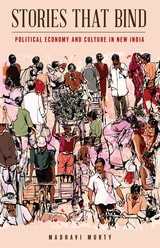
Stories That Bind
Political Economy and Culture in New IndiaMadhavi Murty
Rutgers University Press, 2022
Stories that Bind: Political Economy and Culture in New India examines the assertion of authoritarian nationalism and neoliberalism; both backed by the authority of the state and argues that contemporary India should be understood as the intersection of the two. More importantly, the book reveals, through its focus on India and its complex media landscape that this intersection has a narrative form, which author, Madhavi Murty labels spectacular realism. The book shows that the intersection of neoliberalism with authoritarian nationalism is strengthened by the circulation of stories about “emergence,” “renewal,” “development,” and “mobility” of the nation and its people. It studies stories told through film, journalism, and popular non-fiction along with the stories narrated by political and corporate leaders to argue that Hindu nationalism and neoliberalism are conjoined in popular culture and that consent for this political economic project is crucially won in the domain of popular culture.
Moving between mediascapes to create an archive of popular culture, Murty advances our understanding of political economy through material that is often seen as inconsequential, namely the popular cultural story. These stories stoke our desires (e.g. for wealth), scaffold our instincts (e.g. for a strong leadership) and shape our values.
Moving between mediascapes to create an archive of popular culture, Murty advances our understanding of political economy through material that is often seen as inconsequential, namely the popular cultural story. These stories stoke our desires (e.g. for wealth), scaffold our instincts (e.g. for a strong leadership) and shape our values.
[more]
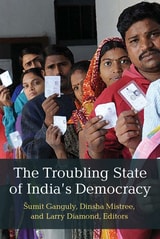
The Troubling State of India's Democracy
Šumit Ganguly, Dinsha Mistree, and Larry Diamond, Editors
University of Michigan Press, 2024
As India’s power and prominence rise on the international stage, its longstanding tradition of democracy is under threat. Since establishing a secular and democratic constitution in 1950, India has held elections at the local, state, and national levels with frequent transitions of power between opposing parties. This commitment to democracy has provided political order to a country that is twice the size of Europe and with a stunning array of social and economic divides.
Despite this rich tradition, India’s democracy faces an unprecedented threat with the rise of Narendra Modi and his Hindu nationalist party, the Bharatiya Janata Party. After decisively winning general elections in 2014, Modi and the BJP have pursued a range of anti-democratic policies in which the state and society are used to undermine the opposition, to stifle free speech, and to harass religious minorities. The Troubling State of India’s Democracy brings together leading scholars from around the world to assess the conditions of India’s democracy across three important dimensions: politics, specifically the state of political parties and the party system; the state, including the condition of federalism and the health of various institutions; and society, including NGOs, ethnic and religious tensions, and control of the media. Even though elements of India’s democracy seem to function—like its commitment to elections—the contributors document a disturbing trajectory, one that not only threatens to undermine India’s own stability, but could also affect the global order.
Despite this rich tradition, India’s democracy faces an unprecedented threat with the rise of Narendra Modi and his Hindu nationalist party, the Bharatiya Janata Party. After decisively winning general elections in 2014, Modi and the BJP have pursued a range of anti-democratic policies in which the state and society are used to undermine the opposition, to stifle free speech, and to harass religious minorities. The Troubling State of India’s Democracy brings together leading scholars from around the world to assess the conditions of India’s democracy across three important dimensions: politics, specifically the state of political parties and the party system; the state, including the condition of federalism and the health of various institutions; and society, including NGOs, ethnic and religious tensions, and control of the media. Even though elements of India’s democracy seem to function—like its commitment to elections—the contributors document a disturbing trajectory, one that not only threatens to undermine India’s own stability, but could also affect the global order.
[more]