Results by title
8 books match the query 'Hip - Hop'
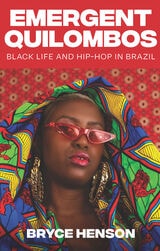
Emergent Quilombos
Black Life and Hip-Hop in BrazilBryce Henson
University of Texas Press, 2023
2024 Best Book Award, National Communication Association, Ethnography Division
2024 Roberto Reis Book Prize, First Book category, Brazilian Studies Association
2024 Outstanding Book Award, National Communication Association, Critical and Cultural Studies Division
2024 International and Intercultural Best Book Award, National Communication Association, International and Intercultural Division
How disenfranchised Black Brazilians use hip-hop to reinvigorate the Black radical tradition.
Known as Black Rome, Salvador da Bahia, Brazil, is a predominantly Black city. The local art, food, and dance are closely linked to the population’s African roots. Yet many Black Brazilian residents are politically and economically disenfranchised. Bryce Henson details a culture of resistance and activism that has emerged in response, expressed through hip-hop and the social relations surrounding it.
Based on years of ethnographic research, Emergent Quilombos illuminates how Black hip-hop artists and their circles contest structures of anti-Black racism by creating safe havens and alternative social, cultural, and political systems that serve Black people. These artists valorize and empower marginalized Black peoples through song, aesthetics, media, visual art, and community action that emphasize diasporic connections, ancestrality, and Black identifications in opposition to the anti-Black Brazilian nation. In the process, Henson argues, the Salvador hip-hop scene has reinvigorated and reterritorialized a critical legacy of Black politicocultural resistance: the quilombo, maroon communities of Black fugitives who refused slavery as a way of life, gathered away from the spaces of their oppression, protected their communities, and nurtured Black life in all its possibilities.
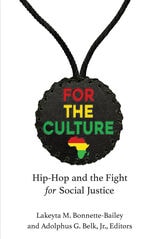
For the Culture
Hip-Hop and the Fight for Social JusticeLakeyta M. Bonnette-Bailey and Adolphus G. Belk, Jr., Editors
University of Michigan Press, 2022
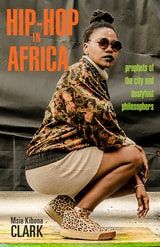
Hip-Hop in Africa
Prophets of the City and Dustyfoot PhilosophersMsia Kibona Clark
Ohio University Press, 2018
Throughout Africa, artists use hip-hop both to describe their lives and to create shared spaces for uncensored social commentary, feminist challenges to patriarchy, and resistance against state institutions, while at the same time engaging with the global hip-hop community. In Hip-Hop in Africa, Msia Kibona Clark examines some of Africa’s biggest hip-hop scenes and shows how hip-hop helps us understand specifically African narratives of social, political, and economic realities.
Clark looks at the use of hip-hop in protest, both as a means of articulating social problems and as a tool for mobilizing listeners around those problems. She also details the spread of hip-hop culture in Africa following its emergence in the United States, assessing the impact of urbanization and demographics on the spread of hip-hop culture.
Hip-Hop in Africa is a tribute to a genre and its artists as well as a timely examination that pushes the study of music and diaspora in critical new directions. Accessibly written by one of the foremost experts on African hip-hop, this book will easily find its place in the classroom.
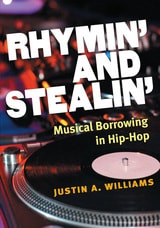
Rhymin' and Stealin'
Musical Borrowing in Hip-HopJustin A. Williams
University of Michigan Press, 2014
Rhymin’ and Stealin’begins with a crucial premise: the fundamental element of hip-hop culture and aesthetics is the overt use of preexisting material to new ends. Whether it is taking an old dance move for a breakdancing battle, using spray paint to create street art, quoting from a famous speech, or sampling a rapper or 1970s funk song, hip-hop aesthetics involve borrowing from the past. By appropriating and reappropriating these elements, they become transformed into something new, something different, something hip-hop. Rhymin’ and Stealin’ is the first book-length study of musical borrowing in hip-hop music, which not only includes digital sampling but also demonstrates a wider web of references and quotations within the hip-hop world. Examples from Nas, Jay-Z, A Tribe Called Quest, Eminem, and many others show that the transformation of preexisting material is the fundamental element of hip-hop aesthetics. Although all music genres use and adapt preexisting material in different ways, hip-hop music celebrates and flaunts its “open source” culture through highly varied means. It is this interest in the web of references, borrowed material, and digitally sampled sounds that forms the basis of this book—sampling and other types of borrowing becomes a framework with which to analyze hip-hop music and wider cultural trends.
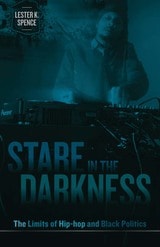
Stare in the Darkness
The Limits of Hip-hop and Black PoliticsLester K. Spence
University of Minnesota Press, 2010
A growing number of black activists and artists claim that rap and hip-hop are the basis of an influential new urban social movement. Simultaneously, black citizens evince concern with the effect that rap and hip-hop culture exerts on African American communities. According to a recent Pew survey conducted on the opinions of Black Americans, 71 percent of blacks think that rap is a bad influence. To what extent are African American hopes and fears about hip-hop’s potential political power justified? In Stare in the Darkness, Lester K. Spence answers this question using a blend of neoliberal analysis, survey data, experiments, and case studies.
Spence finds that rap does in fact influence black political attitudes. However, rap also reproduces rather than critiques neoliberal ideology. Furthermore, black activists seeking to create an innovative model of hip-hop politics are hamstrung by their reliance on outmoded forms of organizing. By considering the possibilities inherent in the most prolific and prominent activities of hip-hop politics, Stare in the Darkness reveals, in a clear and practical manner, the political consequences of rap culture for black publics.
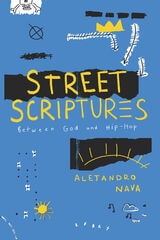
Street Scriptures
Between God and Hip-HopAlejandro Nava
University of Chicago Press, 2022
The world of hip-hop is saturated with religion, but rarely is that element given serious consideration. In Street Scriptures, Alejandro Nava focuses our attention on this aspect of the music and culture in a fresh way, combining his profound love of hip-hop, his passion for racial and social justice, and his deep theological knowledge. Street Scriptures offers a refreshingly earnest and beautifully written journey through hip-hop’s deep entanglement with the sacred.
Nava reveals a largely unheard religious heartbeat in hip-hop, exploring crosscurrents of the sacred and profane in rap, reggaeton, and Latinx hip-hop today. Ranging from Kendrick Lamar, Chance the Rapper, Lauryn Hill, Cardi B, and Bad Bunny to St. Augustine and William James, Nava examines the ethical-political, mystical-prophetic, and theological qualities in hip-hop, probing the pure sonic and aesthetic signatures of music, while also diving deep into the voices that invoke the spirit of protest. The result is nothing short of a new liberation theology for our time, what Nava calls a “street theology.”

The University of Hip-Hop
PoemsMayda Del Valle, foreword by Chris Abani
Northwestern University Press, 2017
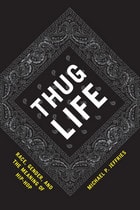
Thug Life
Race, Gender, and the Meaning of Hip-HopMichael P. Jeffries
University of Chicago Press, 2010
Hip-hop has come a long way from its origins in the Bronx in the 1970s, when rapping and DJing were just part of a lively, decidedly local scene that also venerated b-boying and graffiti. Now hip-hop is a global phenomenon and, in the United States, a massively successful corporate enterprise predominantly controlled and consumed by whites while the most prominent performers are black. How does this shift in racial dynamics affect our understanding of contemporary hip-hop, especially when the music perpetuates stereotypes of black men? Do black listeners interpret hip-hop differently from white fans?
These questions have dogged hip-hop for decades, but unlike most pundits, Michael P. Jeffries finds answers by interviewing everyday people. Instead of turning to performers or media critics, Thug Life focuses on the music’s fans—young men, both black and white—and the resulting account avoids romanticism, offering an unbiased examination of how hip-hop works in people’s daily lives. As Jeffries weaves the fans’ voices together with his own sophisticated analysis, we are able to understand hip-hop as a tool listeners use to make sense of themselves and society as well as a rich, self-contained world containing politics and pleasure, virtue and vice.