Results by title

4 books match the query 'His Contemporaries'

cover of Althusser and His Contemporaries: Philosophy's Perpetual War

Althusser and His Contemporaries

Philosophy's Perpetual War

Warren Montag

Duke University Press, 2013

Althusser and His Contemporaries alters and expands understanding of Louis Althusser and French philosophy of the 1960s and 1970s. Thousands of pages of previously unpublished work from different periods of Althusser's career have been made available in French since his death in 1990. Based on meticulous study of the philosopher's posthumous publications, as well as his unpublished manuscripts, lecture notes, letters, and marginalia, Warren Montag provides a thoroughgoing reevaluation of Althusser's philosophical project. Montag shows that the theorist was intensely engaged with the work of his contemporaries, particularly Foucault, Derrida, Deleuze, and Lacan. Examining Althusser's philosophy as a series of encounters with his peers' thought, Montag contends that Althusser's major philosophical confrontations revolved around three themes: structure, subject, and beginnings and endings. Reading Althusser reading his contemporaries, Montag sheds new light on structuralism, poststructuralism, and the extraordinary moment of French thought in the 1960s and 1970s.
[more]
cover of Bach Perspectives, Volume 9: J.S. Bach and His Contemporaries in Germany

Bach Perspectives, Volume 9

J.S. Bach and His Contemporaries in Germany

Edited by Andrew Talle

University of Illinois Press, 2013

This provocative addition to the Bach Perspectives series offers a counternarrative to the isolated genius status that J. S. Bach and his music currently enjoy. Contributors contextualize Bach by examining the output, reputation, and compositional practices of his contemporaries in Germany whose work was widely played and enjoyed in his time, including Georg Philipp Telemann, Christoph Graupner, Gottlieb Muffat, and Johann Adolf Scheibe. Essays place Bach and his work in relation to his peers, examining avenues of composition they took while he did not and showing how differing treatments of the same subjects or texts resulted in markedly different compositional results and legacies. By looking closely at how Bach's contemporaries addressed the tasks and challenges of their time, this project provides a more nuanced view of the musical world of Bach's time while revealing in more specific terms than ever how and why Bach's own music remains fresh and compelling.

In this volume, Wolfgang Hirschmann proposes an ethnographic approach that contextualizes Bach's works, addressing the aesthetic paths he took as well as those he did not pursue. Steven Zohn's essay considers Telemann's contribution to the orchestral Ouverture genre, observering how Telemann's approach to integrating the national styles of his time was quite different from, but no less rich than, Bach's. Andrew Talle compares settings and strategies of Vergnügte Ruh, beliebte Seelenlust by Bach and Graupner. Alison Dunlop presents valuable primary research on Muffat, the most commonly cited keyboard music composer in Vienna during Bach's lifetime. Finally, Michael Maul sheds new light on the Scheibe-Birnbaum controversy, contextualizing the most famous critique of J. S. Bach's compositional style by discussing the other composers that Scheibe critiqued.

[more]
cover of Descartes and His Contemporaries: Meditations, Objections, and Replies

Descartes and His Contemporaries

Meditations, Objections, and Replies

Edited by Roger Ariew and Marjorie Grene

University of Chicago Press, 1995

Before publishing his landmark Meditations in 1641, Rene Descartes sent his manuscript to many leading thinkers to solicit their objections to his arguments. He included these objections, along with his own detailed replies, as part of the first edition. This unusual strategy gave Descartes a chance to address criticisms in advance and to demonstrate his willingness to consider diverse viewpoints—critical in an age when radical ideas could result in condemnation by church and state, or even death.

Descartes and his Contemporaries recreates the tumultuous intellectual community of seventeenth-century Europe and provides a detailed, modern analysis of the Meditations in its historical context. The book's chapters examine the arguments and positions of each of the objectors—Hobbes, Gassendi, Arnauld, Morin, Caterus, Bourdin, and others whose views were compiled by Mersenne. They illuminate Descartes' relationships to the scholastics and particularly the Jesuits, to Mersenne's circle with its debates about the natural sciences, to the Epicurean movements of his day, and to the Augustinian tradition. Providing a glimpse of the interactions among leading 17th-century intellectuals as they grappled with major philosophical issues, this book sheds light on how Descartes' thought developed and was articulated in opposition to the ideas of his contemporaries.
[more]
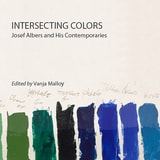
cover of Intersecting Colors: Josef Albers and His Contemporaries

Intersecting Colors

Josef Albers and His Contemporaries

Vanja Malloy, editor

Amherst College Press, 2015

Josef Albers (1888–1976) was an artist, teacher, and seminal thinker on the perception of color. A member of the Bauhaus who fled to the U.S. in 1933, his ideas about how the mind understands color influenced generations of students, inspired countless artists, and anticipated the findings of neuroscience in the latter half of the twentieth century. With contributions from the disciplines of art history, the intellectual and cultural significance of Gestalt psychology, and neuroscience, Intersecting Colors offers a timely reappraisal of the immense impact of Albers’s thinking, writing, teaching, and art on generations of students. It shows the formative influence on his work of non-scientific approaches to color (notably the work of Johann Wolfgang von Goethe) and the emergence of Gestalt psychology in the first decades of the twentieth century. The work also shows how much of Albers’s approach to color—dismissed in its day by a scientific approach to the study and taxonomy of color driven chiefly by industrial and commercial interests—ultimately anticipated what neuroscience now reveals about how we perceive this most fundamental element of our visual experience. Edited by Vanja Malloy, with contributions from Brenda Danilowitz, Sarah Lowengard, Karen Koehler, Jeffrey Saletnik, and Susan R. Barry.
[more]