Results by title
5 books match the query 'His Critics'
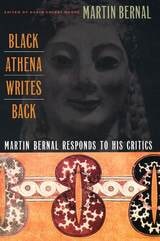
Black Athena Writes Back
Martin Bernal Responds to His CriticsMartin Bernal
Duke University Press, 2001
In Black Athena Writes Back Martin Bernal responds to the passionate debates set off by the 1987 publication of his book Black Athena. Producing a shock wave of reaction from scholars, Black Athena argued that the development of Greek civilization was heavily influenced by Afroasiatic civilizations. Moreover, Bernal asserted that this knowledge had been deliberately obscured by the rampant racism of nineteenth-century Europeans who could not abide the notion that Greek society—for centuries recognized as the originating culture of Europe—had its origins in Africa and Southwest Asia.
The subsequent rancor among classicists over Bernal’s theory and accusations was picked up in the popular media, and his suggestion that Greek culture had its origin in Africa was widely derided. In a report on 60 Minutes, for example, it was suggested that Bernal’s hypothesis was essentially an attempt to provide blacks with self-esteem so that they would feel included in the march of progress.
In Black Athena Writes Back Bernal provides additional documentation to back up his thesis, as well as offering persuasive explanations of why traditional scholarship on the subject remains inaccurate and why specific arguments lobbed against his theories are themselves faulty.
Black Athena Writes Back requires no prior familiarity with either the Black Athena hypothesis or with the arguments advanced against it. It will be essential reading for those who have been following this long-running debate, as well as for those just discovering this fascinating subject.
[more]

Milton Friedman's Monetary Framework
A Debate with His CriticsEdited by Robert J. Gordon, with essays by Milton Friedman, Karl Brunner and All
University of Chicago Press, 1975
In response to widespread interest in a formal complete statement analyzing aspects of the money-income relationship and clarification of his quantity theory, Milton Friedman in 1970 published "A Theoretical Framework for Monetary Analysis," and a year later "A Monetary Theory of Nominal Income," both in the Journal of Political Economy. A combined version of these essays, first published by the National Bureau of Economic Research, begins this volume.
Because his statement was important and controversial both as a commentary on the history of economic thought and as a theoretical contribution in its own right, the Journal of Political Economy in 1972 presented critical reviews from noted monetary theorists, including Karl Brunner and Allan H. Meltzer, James Tobin, Paul Davidson, and Don Patinkin. Their studies, which are printed in the present volume, focus on substantive issues, covering a variety of topics. All of their major points are discussed in Friedman's reply, which clarifies and expands upon his original themes and introduces interesting new material. Thus the synthesis of his two articles, the critical comments, and his response, together with an introduction by Robert J. Gordon, are combined in one volume for the convenience of scholars and students.
Because his statement was important and controversial both as a commentary on the history of economic thought and as a theoretical contribution in its own right, the Journal of Political Economy in 1972 presented critical reviews from noted monetary theorists, including Karl Brunner and Allan H. Meltzer, James Tobin, Paul Davidson, and Don Patinkin. Their studies, which are printed in the present volume, focus on substantive issues, covering a variety of topics. All of their major points are discussed in Friedman's reply, which clarifies and expands upon his original themes and introduces interesting new material. Thus the synthesis of his two articles, the critical comments, and his response, together with an introduction by Robert J. Gordon, are combined in one volume for the convenience of scholars and students.
[more]
Mr. Justice Black and His Critics
Tinsley E. Yarbrough
Duke University Press, 1988
Many jurists give lip service to the idea that judicial interpretation of constitutional provisions should be based on the intent of the framers. Few, if any, have been as faithful to that conception as Hugo Black. As U.S. senator from Alabama, Black was a vigorous critic of the Supreme Court's use of the Constitution as a weapon against the Roosevelt New Deal. Once on the court he played a leading role in overturning those decisions and in attempting to establish for freedom of speech and other guarantees the interpretation he (and others) believe was warranted by the language and intent of the framers.
Late in his career, however, Black's commitment to literalism and intent led him to assume apparently conservative positions in civil liberties cases. In an era characterized by growing acceptance of the belief that judges should adapt the Constitution to changing social and ethical perceptions, many came to regard Black's position as unrealistic and irrelevant.
Tinsley E. Yarbrough analyzes Black's judicial and constitutional philosophy, as well as his approach to specific cases, through the eyes of Black's critics (such as Justices Frankfurter and Harlan) and through an assessment of scholarly opinion of his jurisprudence. The result is a stimulating and provocative addition to the study of Justice Black and the Supreme Court.
[more]
Rorty and Pragmatism
The Philosopher Responds to His CriticsHerman Saatkamp
Vanderbilt University Press, 1995
A penetrating and illuminating exchange of views between Richard Rorty, a highly influential and sometimes controversial philosopher, and seven of his most thoughtful critics, providing new insights into the impact of his work on contemporary American philosophy.
Richard Rorty, William R. Kenan Professor and University Professor of Humanities at the University of Virginia, is a frequent and influential contributor to major literary magazines and professional journals in this country and abroad. Among his best-known book publications are The Linguistic Turn (1967 and 1992), Philosophy and the Mirror of Nature (1979), The Consequences of Pragmatism (1982), and Contingency, Irony and Solidarity (1989).
Richard Rorty, William R. Kenan Professor and University Professor of Humanities at the University of Virginia, is a frequent and influential contributor to major literary magazines and professional journals in this country and abroad. Among his best-known book publications are The Linguistic Turn (1967 and 1992), Philosophy and the Mirror of Nature (1979), The Consequences of Pragmatism (1982), and Contingency, Irony and Solidarity (1989).
[more]
Saint Augustine and the Fall of the Soul
Beyond O'Connell & His CriticsRonnie J. Rombs
Catholic University of America Press, 2006
Saint Augustine and the Fall of the Soul: Beyond O'Connell and His Critics provides first a critical examination of O'Connell's theses in a readable summary of his work that spanned over thirty years.
[more]