Results by title
7 books match the query 'His Own Words'
Americo Paredes
In His Own Words, an Authorized BiographyManuel F. Medrano
University of North Texas Press, 2010
Augustine in His Own Words
William Harmless
Catholic University of America Press, 2010
Gandhi in India
In His Own WordsMahatma Gandhi and Martin Green
Brandeis University Press, 1987
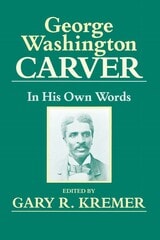
George Washington Carver
In His Own WordsEdited by Gary R. Kremer
University of Missouri Press, 1987
George Washington Carver (1864-1943), best known for his work as a scientist and a botanist, was an anomaly in his own time—a black man praised by white America.
This selection of his letters and other writings reveals both the human side of Carver and the forces that shaped his creative genius. They show us a Carver who was both manipulated and manipulative who had inner tensions and anxieties. But perhaps more than anything else, these letters allow us to see Carver's deep love for his fellow man, whether manifested in his efforts to treat polio victims in the 1930s or in his incredibly intense and emotionally charged friendships that lasted a lifetime.
The editor has furnished commentary between letters to set them in context.
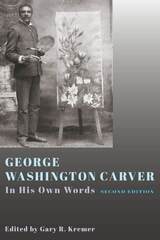
George Washington Carver
In His Own Words, Second EditionGary R. Kremer
University of Missouri Press, 2017
With a new chapter on the oral history interviews Dr. Kremer conducted (several years after publication of the first edition) with people who knew Carver personally, and the addition of newly uncovered documents and a bank of impressive photographs of Carver and some of his friends, this second edition of our classic title commemorates the 75th anniversary of Carver’s death on January 5, 2018.
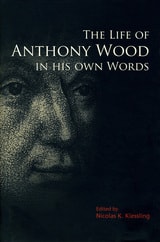
The Life of Anthony Wood in His Own Words
Edited by Nicolas K. Kiessling
Bodleian Library Publishing, 2009
Anthony Wood (1632–95) was an English historian and antiquary best known for his books on the history and antiquities of the University of Oxford as well as Athenae Oxonienses: an Exact History of all the Writers and Bishops who have had their Education in the University of Oxford from 1500 to 1690. Some of the revelations in Athenae Oxonienses were considered scandalous at the time, and a copy of the manuscript was famously burned in protest in front of the Bodleian Library in 1693. Wood’s autobiography reflects his life-long devotion to historiography, and consequently it paints a lively picture of many well known figures in seventeenth century England.
Wood made more contributions to biography, bibliography, and the history of the University and city of Oxford than any other writer before that time. As a result, The Autobiography of Anthony Wood is brimming with information of all kinds, from famous people—including Christopher Wren, John Locke, the physician John Lower, the defiant Catholic Ralph Sheldon, the mathematician John Wallis, and a host of Oxford heads of colleges, vice-chancellors and chancellors—to descriptions of significant events—such as skirmishes between parliamentarian and royalist forces in the 1640s, the atmosphere of Oxford during the parliamentarian occupation, the return of King Charles II in 1660, and the anti-Catholic movement of the 1670s. Based directly upon original sources, this critical edition of Wood’s autobiography offers an entertaining and revealing look at one of the most interesting and turbulent periods in Oxford’s past.
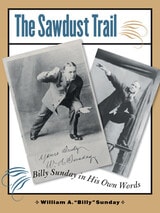
The Sawdust Trail
Billy Sunday in His Own WordsWilliam A. Sunday
University of Iowa Press, 2005
Published serially in the Ladies’ Home Journal in 1932 and 1933 and now in book form for the first time, The Sawdust Trail is the only autobiography that this hugely popular and hugely controversial preacher ever wrote. From his childhood days in Iowa to the early days of his conversion in Illinois, from his baseball career with the National League teams in Chicago, Pittsburgh, and Philadelphia to the challenges of preaching in New York City during his heyday, the sections of Sunday’s autobiography roll out like so many exuberant sermons, yet the sympathetic reader can hear echoes of the loneliness and misery of his early years.
In The Sawdust Trail the sometimes appalling but always appealing Billy Sunday creates a usable past for himself, notable for what he omits as well as for what he includes, which gives us insight not just into his own life and career but also into the peculiar history of evangelism in America.