Results by title
5 books match the query 'Hispanic American women in literature'
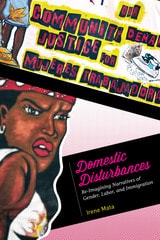
Domestic Disturbances
Re-Imagining Narratives of Gender, Labor, and ImmigrationBy Irene Mata
University of Texas Press, 2014
The issue of immigration is one of the most hotly debated topics in the national arena, with everyone from right-wing pundits like Sarah Palin to alternative rockers like Zack de la Rocha offering their opinion. The traditional immigrant narrative that gained popularity in the nineteenth and twentieth centuries continues to be used today in describing the process of the “Americanization” of immigrants. Yet rather than acting as an accurate representation of immigrant experiences, this common narrative of the “American Dream” attempts to ideologically contain those experiences within a story line that promotes the idea of achieving success through hard work and perseverance.
In Domestic Disturbances, Irene Mata dispels the myth of the “shining city on the hill” and reveals the central truth of hidden exploitation that underlies the great majority of Chicana/Latina immigrant stories. Influenced by the works of Latina cultural producers and the growing interdisciplinary field of scholarship on gender, immigration, and labor, Domestic Disturbances suggests a new framework for looking at these immigrant and migrant stories, not as a continuation of a literary tradition, but instead as a specific Latina genealogy of immigrant narratives that more closely engage with the contemporary conditions of immigration. Through examination of multiple genres including film, theatre, and art, as well as current civil rights movements such as the mobilization around the DREAM Act, Mata illustrates the prevalence of the immigrant narrative in popular culture and the oppositional possibilities of alternative stories.
Intersections of Harm
Narratives of Latina Deviance and DefianceHalperin, Laura
Rutgers University Press, 0
New Latina Narrative
The Feminine Space of Postmodern EthnicityEllen McCracken
University of Arizona Press, 1999
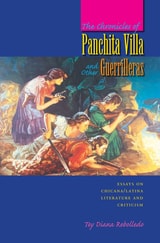
The Chronicles of Panchita Villa and Other Guerrilleras
Essays on Chicana/Latina Literature and CriticismBy Tey Diana Rebolledo
University of Texas Press, 2006
Although there have been substantial contributions to Chicana literature and criticism over the past few decades, Chicanas are still underrepresented and underappreciated in the mainstream literary world and virtually nonexistent in the canon. Writers like Sandra Cisneros, Ana Castillo, and Gloria Anzaldúa have managed to find larger audiences and critical respect, but there are legions of Chicana writers and artists who have been marginalized and ignored despite their talent. Even in Chicano anthologies, the focus has tended to be more on male writers. Chicanas have often found themselves without a real home in the academic world.
Tey Diana Rebolledo has been writing about Chicana/Latina identity, literature, discrimination, and feminism for more than two decades. In this collection of essays, she brings together both old and new works to give a state-of-the-moment look at the still largely unanswered questions raised by vigilant women of color throughout the last half of the twentieth century. An intimate introductory essay about Rebolledo's personal experiences as the daughter of a Mexican mother and a Peruvian father serves to lay the groundwork for the rest of the volume. The essays delve into the historical development of Chicana writing and its early narratives, the representation of Chicanas as seen on book covers, Chicana feminism, being a Chicana critic in the academy, Chicana art history, and Chicana creativity. Rebolledo encourages "guerrillera" warfare against academia in order to open up the literary canon to Chicana/Latina writers who deserve validation.
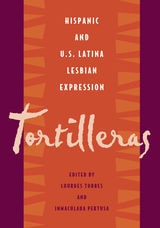
Tortilleras
Hispanic & U.S. Latina Lesbian ExpressionLourdes Torres
Temple University Press, 2003