Results by title
7 books match the query 'Historic districts'
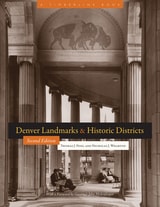
Denver Landmarks and Historic Districts
Thomas J. Noel
University Press of Colorado, 2016
A Timberline Book
Denver Landmarks and Historic Districts, Second Edition is the newest, most thorough guide to Denver’s 51 historic districts and more than 331 individually landmarked properties. This lavishly illustrated volume celebrates Denver’s oldest banks, churches, clubs, hotels, libraries, schools, restaurants, mansions, and show homes.
Denver is unusually fortunate to retain much of its significant architectural heritage. The Denver Landmark Preservation Commission (1967), Historic Denver, Inc. (1970), Colorado Preservation, Inc. (1984), and History Colorado (1879) have all worked to identify and preserve Denver buildings notable for architectural, geographical, or historical significance. Since the 1970s, Denver has designated more landmarks than any other US city of comparable size. Many of these landmarks, both well-known and obscure, are open to the public. These landmarks and districts have helped make Denver one of the healthiest and most attractive core cities in the United States, transforming what was once Skid Row into the Lower Downtown Historic District of million-dollar lofts and $7 craft beers.
Entries include the Daniels & Fisher Tower, the Brown Palace Hotel, Red Rocks Outdoor Amphitheatre, Elitch Theatre, Fire Station No. 7, the Richthofen Castle, the Washington Park Boathouse and Pavilion, and the Capitol Hill, Five Points, and Highlands historic districts. Denver Landmarks and Historic Districts highlights the many officially designated buildings and neighborhoods of note. This crisply written guide serves as a great starting point for rubbernecking around Denver, whether by motor vehicle, by bicycle, or afoot.
[more]

HISTORY IN URBAN PLACES
THE HISTORIC DISTRICTS OF THE UNITED STADAVID HAMER
The Ohio State University Press, 1998
[more]
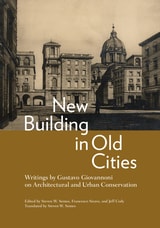
New Building in Old Cities
Writings by Gustavo Giovannoni on Architectural and Urban ConservationGustavo Giovannoni
J. Paul Getty Trust, The, 2024
The highly influential writings by an important early advocate for the conservation of historic cities are made available for the first time in English.
The Italian architect, historian, and restorer Gustavo Giovannoni (1873–1947) was a key figure in the fields of architecture, urbanism, and conservation during the first half of the twentieth century. A traditionalist largely neglected by the proponents of modernist architecture following World War II, he remains little known internationally. His writings, however, until now unavailable in English, represent a significant step toward the full appreciation of the historic city and are directly relevant today to the protection of urban historic resources worldwide.
This abundantly illustrated critical anthology is a representative sample of Giovannoni’s seminal texts related to the appreciation, understanding, and planning of historic cities. The thirty readings, which appear with their original illustrations, are grouped into six parts organized around key concepts in Giovannoni’s conservation theory—urban building, respect for the setting or context, a thinning out of the urban fabric, conservation and restoration treatments, the grafting of the new upon the old, and reconstruction. Each part is preceded by an introduction, and each reading is prefaced by succinct remarks explaining the rationale for its selection and the principal matters covered. Six plate sections further illustrate the readings’ main concepts and themes.
[more]
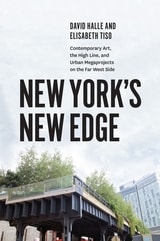
New York's New Edge
Contemporary Art, the High Line, and Urban Megaprojects on the Far West SideDavid Halle and Elisabeth Tiso
University of Chicago Press, 2014
The story of New York’s west side no longer stars the Sharks and the Jets. Instead it’s a story of urban transformation, cultural shifts, and an expanding contemporary art scene. The Chelsea Gallery District has become New York’s most dominant neighborhood for contemporary art, and the streets of the west side are filled with gallery owners, art collectors, and tourists. Developments like the High Line, historical preservation projects like the Gansevoort Market, the Chelsea galleries, and plans for megaprojects like the Hudson Yards Development have redefined what is now being called the “Far West Side” of Manhattan.
David Halle and Elisabeth Tiso offer a deep analysis of the transforming district in New York’s New Edge, and the result is a new understanding of how we perceive and interpret culture and the city in New York’s gallery district. From individual interviews with gallery owners to the behind-the-scenes politics of preservation initiatives and megaprojects, the book provides an in-depth account of the developments, obstacles, successes, and failures of the area and the factors that have contributed to them.
David Halle and Elisabeth Tiso offer a deep analysis of the transforming district in New York’s New Edge, and the result is a new understanding of how we perceive and interpret culture and the city in New York’s gallery district. From individual interviews with gallery owners to the behind-the-scenes politics of preservation initiatives and megaprojects, the book provides an in-depth account of the developments, obstacles, successes, and failures of the area and the factors that have contributed to them.
[more]
Patina
A Profane ArchaeologyShannon Lee Dawdy
University of Chicago Press, 2016
When Hurricane Katrina struck New Orleans, the world reacted with shock on seeing residents of this distinctive city left abandoned to the floodwaters. After the last rescue was completed, a new worry arose—that New Orleans’s unique historic fabric sat in ruins, and we had lost one of the most charming old cities of the New World.
In Patina, anthropologist Shannon Lee Dawdy examines what was lost and found through the destruction of Hurricane Katrina. Tracking the rich history and unique physicality of New Orleans, she explains how it came to adopt the nickname “the antique city.” With innovative applications of thing theory, Patina studies the influence of specific items—such as souvenirs, heirlooms, and Hurricane Katrina ruins—to explore how the city’s residents use material objects to comprehend time, history, and their connection to one another. A leading figure in archaeology of the contemporary, Dawdy draws on material evidence, archival and literary texts, and dozens of post-Katrina interviews to explore how the patina aesthetic informs a trenchant political critique. An intriguing study of the power of everyday objects, Patina demonstrates how sharing in the care of a historic landscape can unite a city’s population—despite extreme divisions of class and race—and inspire civil camaraderie based on a nostalgia that offers not a return to the past but an alternative future.
In Patina, anthropologist Shannon Lee Dawdy examines what was lost and found through the destruction of Hurricane Katrina. Tracking the rich history and unique physicality of New Orleans, she explains how it came to adopt the nickname “the antique city.” With innovative applications of thing theory, Patina studies the influence of specific items—such as souvenirs, heirlooms, and Hurricane Katrina ruins—to explore how the city’s residents use material objects to comprehend time, history, and their connection to one another. A leading figure in archaeology of the contemporary, Dawdy draws on material evidence, archival and literary texts, and dozens of post-Katrina interviews to explore how the patina aesthetic informs a trenchant political critique. An intriguing study of the power of everyday objects, Patina demonstrates how sharing in the care of a historic landscape can unite a city’s population—despite extreme divisions of class and race—and inspire civil camaraderie based on a nostalgia that offers not a return to the past but an alternative future.
[more]
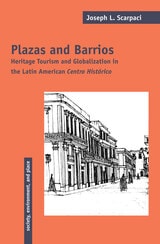
Plazas and Barrios
Heritage Tourism and Globalization in the Latin American Centro HistóricoJoseph L. Scarpaci
University of Arizona Press, 2004
In recent years the travel industry has promoted trips to cultural landscapes that contain great historical and symbolic landmarks, and Latin American towns and cities are anything but isolated from this trend. Many historic city centers in Latin America have been preserved intact from the colonial era and today may serve institutional, commercial, or residential needs. Now economic forces from outside the region have created a demand for the preservation of historically "authentic" districts.
This book explores how heritage tourism and globalization are reshaping the Latin American centro histórico, analyzing the transformation of the urban core from town plaza to historic center in nine cities: Bogotá, Colombia; Buenos Aires, Argentina; Cartagena, Colombia; Cuenca, Ecuador; Havana, Cuba; Montevideo, Uruguay; Puebla, Mexico; Quito, Ecuador; and Trinidad, Cuba. It tells how these pressures, combined with the advantage of a downtown location, have raised the potential of redeveloping these inner city areas but have also created the dilemma of how to restore and conserve them while responding to new economic imperatives.
In an eclectic and interdisciplinary study, Joseph Scarpaci documents changes in far-flung corners of the Latin American metropolis using a broad palette of tools: urban morphology profiles, an original land-use survey of 30,000 doorways in nine historic districts, numerous photographs, and a review of the political, economic, and globalizing forces at work in historic districts. He examines urban change as reflected in architectural styles, neighborhood growth and decline, real estate markets, and local politics in order to show the long reach of globalization and modernity.
Plazas and Barrios spans all of Spanish-speaking America to address the socio-political dimensions of urban change. It offers a means for understanding the tensions between the modern and traditional aspects of the built environment in each city and provides a key resource for geographers, urban planners, architectural historians, and all concerned with the implications of the emerging global economy.
[more]
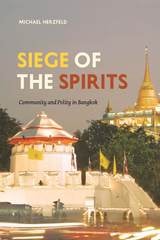
Siege of the Spirits
Community and Polity in BangkokMichael Herzfeld
University of Chicago Press, 2016
What happens when three hundred alleged squatters go head-to-head with an enormous city government looking to develop the place where they live? As anthropologist Michael Herzfeld shows in this book, the answer can be surprising. He tells the story of Pom Mahakan, a tiny enclave in the heart of old Bangkok whose residents have resisted authorities’ demands to vacate their homes for a quarter of a century. It’s a story of community versus government, of old versus new, and of political will versus the law.
Herzfeld argues that even though the residents of Pom Mahakan have lost every legal battle the city government has dragged them into, they have won every public relations contest, highlighting their struggle as one against bureaucrats who do not respect the age-old values of Thai/Siamese social and cultural order. Such values include compassion for the poor and an understanding of urban space as deeply embedded in social and ritual relations. In a gripping account of their standoff, Herzfeld—who simultaneously argues for the importance of activism in scholarship—traces the agile political tactics and styles of the community’s leadership, using their struggle to illuminate the larger difficulties, tensions, and unresolved debates that continue to roil Thai society to this day.
Herzfeld argues that even though the residents of Pom Mahakan have lost every legal battle the city government has dragged them into, they have won every public relations contest, highlighting their struggle as one against bureaucrats who do not respect the age-old values of Thai/Siamese social and cultural order. Such values include compassion for the poor and an understanding of urban space as deeply embedded in social and ritual relations. In a gripping account of their standoff, Herzfeld—who simultaneously argues for the importance of activism in scholarship—traces the agile political tactics and styles of the community’s leadership, using their struggle to illuminate the larger difficulties, tensions, and unresolved debates that continue to roil Thai society to this day.
[more]