Results by title
4 books match the query 'Historical Consciousness'
Dreaming and Historical Consciousness in Island Greece
Charles Stewart
University of Chicago Press, 2017
Charles Stewart tells the story of the inhabitants of Kóronos, on the Greek island of Naxos, who, in the 1830s, began experiencing dreams in which the Virgin Mary instructed them to search for buried Christian icons nearby and build a church to house the ones they found. Miraculously, they dug and found several icons and human remains, and at night the ancient owners of them would speak to them in dreams. The inhabitants built the church and in the years since have experienced further waves of dreams and startling prophesies that shaped their understanding of the past and future and often put them at odds with state authorities. Today, Kóronos is the site of one of the largest annual pilgrimages in the Mediterranean. Telling this fascinating story, Stewart draws on his long-term fieldwork and original historical sources to explore dreaming as a mediator of historical change, while widening the understanding of historical consciousness and history itself.
Hierarchy, History, and Human Nature
The Social Origins of Historical ConsciousnessDonald E. Brown
University of Arizona Press, 1988
"This is an intriguing and stimulating study of historical differences in the indigenous historiography of parts of Asia, the Middle East, and Europe."—American Anthropologist.
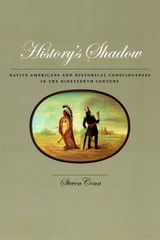
History's Shadow
Native Americans and Historical Consciousness in the Nineteenth CenturySteven Conn
University of Chicago Press, 2004
History's Shadow traces the struggle of Americans trying to understand the people who originally occupied the continent claimed as their own. Steven Conn considers how the question of the Indian compelled Americans to abandon older explanatory frameworks for sovereignty like the Bible and classical literature and instead develop new ones. Through their engagement with Native American language and culture, American intellectuals helped shape and define the emerging fields of archaeology, ethnology, linguistics, and art. But more important, the questions posed by the presence of the Indian in the United States forced Americans to confront the meaning of history itself, both that of Native Americans and their own: how it should be studied, what drove its processes, and where it might ultimately lead. The encounter with Native Americans, Conn argues, helped give rise to a distinctly American historical consciousness.
A work of enormous scope and intellect, History's Shadow will speak to anyone interested in Native Americans and their profound influence on our cultural imagination.
LOST CAUSES
Historical Consciousness in Victorian LiteratureJason B. Jones
The Ohio State University Press, 2006
What if we didn’t always historicize when we read Victorian fiction?
Lost Causes shows that Victorian writers frequently appear to have a more supple and interesting understanding of the relationship between history, causality, and narrative than the one typically offered by readers who are burdened by the new historicism. As a return to these writers emphasizes, the press of modern historicism deforms Victorian novels, encouraging us to read deviations from strict historical accuracy as ideological bad faith. By contrast, Jason B. Jones argues through readings of works ranging from The French Revolution to Middlemarch that literature’s engagement with history has to be read otherwise.Perhaps perversely, Lost Causes suggests simultaneously that psychoanalysis speaks pressingly to the vexed relationship between history and narrative, and that the theory is neither a- nor anti-historical. Through his readings of Victorian fiction addressing the recent past, Jones finds in psychoanalysis not a set of truths, but rather a method for rhetorical reading, ultimately revealing how its troubled account of psychic causality can help us follow literary language’s representation of the real. Victorian narratives of the recent past and psychoanalytic interpretation share a fascination with effects that persist despite baffling, inexplicable, or absent causes.
In chapters focusing on Thomas Carlyle, Charles Dickens, Charlotte Brontë, and George Eliot, Lost Causes demonstrates that history can carry an ontological, as well as an epistemological, charge—one that suggests a condition of being in the world as well as a way of knowing the world as it really is. From this point of view, Victorian fiction that addresses the recent past is not a failed realism, as it is so frequently claimed, but rather an exploration of possibility in history.