Results by title

5 books match the query 'Historical Essays'
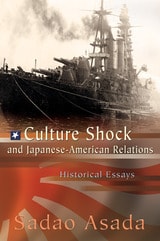
cover of Culture Shock and Japanese-American Relations: Historical Essays

Culture Shock and Japanese-American Relations

Historical Essays

Sadao Asada

University of Missouri Press, 2007

Ever since Commodore Perry sailed into Uraga Channel, relations between the United States and Japan have been characterized by culture shock. Now a distinguished Japanese historian critically analyzes contemporary thought, public opinion, and behavior in the two countries over the course of the twentieth century, offering a binational perspective on culture shock as it has affected their relations.

            In these essays, Sadao Asada examines the historical interaction between these two countries from 1890 to 2006, focusing on naval strategy, transpacific racism, and the atomic bomb controversy. For each topic, he offers a rigorous analysis of both American and Japanese perceptions, showing how cultural relations and the interchange of ideas have been complex—and occasionally destructive.

            Culture Shock and Japanese-American Relations contains insightful essays on the influence of Alfred Mahan on the Japanese navy and on American images of Japan during the 1920s. Other essays consider the progressive breakdown of relations between the two countries and the origins of the Pacific War from the viewpoint of the Japanese navy, then tackle the ultimate shock of the atomic bomb and Japan’s surrender, tracing changing perceptions of the decision to use the bomb on both sides of the Pacific over the course of sixty years. In discussing these subjects, Asada draws on Japanese sources largely inaccessible to Western scholars to provide a host of eye-opening insights for non-Japanese readers.

            After studying in America for nine years and receiving degrees from both Carleton College and Yale University, Asada returned to Japan to face his own reverse culture shock. His insights raise important questions of why people on opposite sides of the Pacific see things differently and adapt their perceptions to different purposes. This book marks a major effort toward reconstructing and understanding the conflicted course of Japanese-American relations during the first half of the twentieth century.
[more]
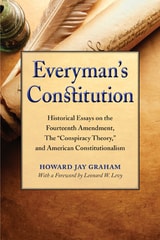
cover of Everyman's Constitution: Historical Essays on the Fourteenth Amendment, the "Conspiracy Theory," and American Constitutionalism

Everyman's Constitution

Historical Essays on the Fourteenth Amendment, the "Conspiracy Theory," and American Constitutionalism

Howard Jay Graham

Wisconsin Historical Society Press, 1968
In 1938, Howard Jay Graham, a deaf law librarian, successfully argued that the authors of the Fourteenth Amendment--ratified after the American Civil War to establish equal protection under the law for all American citizens regardless of race--were motivated by abolitionist fervor, debunking the notion of a corporate conspiracy at the heart of the amendment's wording. For over half a century, the amendment had been used to endow corporations with rights as individuals and thus protect them from state legislation. By 1968, when Everyman's Constitution was first published, the Fourteenth Amendment had become a tool for the incorporation of the Bill of Rights to apply to all American citizens. The essays in this reprinted edition are still relevant as the nation continues to interpret our framing legislation in light of the concerns of today and to balance citizens' rights against those of corporations. Howard Jay Graham was a law librarian brought in by the NAACP's legal team to write a brief on the Fourteenth Amendment for the Supreme Court case Brown v. Board of Education. Though the Supreme Court justices ruled in favor of the NAACP based on the sociological rather than historical evidence it provided, Graham's work, published in various law journals over several decades, contributed greatly to the ongoing interpretation of the Fourteenth Amendment.
[more]
cover of Forms of Discovery: Critical and Historical Essays on the Forms of the Short Poem in English

Forms of Discovery

Critical and Historical Essays on the Forms of the Short Poem in English

Yvor Winters

Ohio University Press, 1967
With Forms of Discovery, Yvor Winters completes his critical canon. The distinguished poet-critic defines by analysis and example the development of the method that he has called “post-Symbolist.” Starting with the styles of the English Renaissance, Winters discusses at length the felicities and shortcomings of these traditions, the main defect being that sensory imagery was little more than ornament. This sets the problem: to discover a style wherein both the conceptual and the perceptual are given their fullest expression In the work of Charles Churchill, Winters explores the development of a complexly controlled associational procedure. Here is a richly varied conceptual method, though the sensory is still almost totally absent. Churchill’s methods and those of the Renaissance masters are then contrasted with the work of the Romantics, who wrote a great deal about nature without bothering to look at it, and whose most lasting contribution would appear to be pathetically sentimental fallacies. The turn of the century, in France, Britain, and America, sees the beginning of the post-Symbolist methods, while Yeats continues the retrograde movement of the Romantics. It is in the work of poets like Tuckerman, Hardy, Bridges, Stevens, T. Sturge Moore, and Paul Valéry that rational discourse combines richly with the perceptual universe in which we live: the particular perception is enhanced by reference to general concepts, the general given substance by the particular exemplifying it. The post-Symbolist methods result in a poetry that unifies the diverse fields of human experience and employs all aspects of language. Style in Winters’ sense is not simply a way of gracefully combining words. It is the way a man lives, the method or art wherein he discovers to the best of his ability the real nature of the world in which he lives. It is in this sense that Forms of Discovery is a philosophical work, not a miscellaneous collection of essays; this book is, as Winters remarks, “an act of piety, not an act of destruction.”
[more]
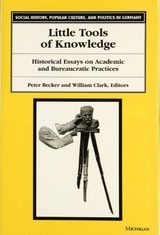
cover of Little Tools of Knowledge: Historical Essays on Academic and Bureaucratic Practices

Little Tools of Knowledge

Historical Essays on Academic and Bureaucratic Practices

Peter Becker and William Clark, Editors

University of Michigan Press, 2001
This volume brings historians of science and social historians together to consider the role of "little tools"--such as tables, reports, questionnaires, dossiers, index cards--in establishing academic and bureaucratic claims to authority and objectivity. From at least the eighteenth century onward, our science and society have been planned, surveyed, examined, and judged according to particular techniques of collecting and storing knowledge. Recently, the seemingly self-evident nature of these mundane epistemic and administrative tools, as well as the prose in which they are cast, has demanded historical examination. The essays gathered here, arranged in chronological order by subject from the late seventeenth to the late twentieth century, involve close readings of primary texts and analyses of academic and bureaucratic practices as parts of material culture. The first few essays, on the early modern period, largely point to the existence of a "juridico-theological" framework for establishing authority. Later essays demonstrate the eclipse of the role of authority per se in the modern period and the emergence of the notion of "objectivity." Most of the essays here concern the German cultural space as among the best exemplars of the academic and bureaucratic practices described above. The introduction to the volume, however, is framed at a general level; the closing essays also extend the analyses beyond Germany to broader considerations on authority and objectivity in historical practice. The volume will interest scholars of European history and German studies as well as historians of science. Peter Becker is Professor of Central European History, European University Institute. William Clark is Lecturer in History and Philosophy of Science, Cambridge University.
[more]
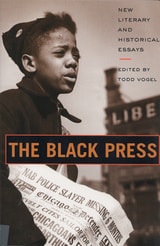
cover of The Black Press: New Literary and Historical Essays

The Black Press

New Literary and Historical Essays

Edited by Todd Vogel

Rutgers University Press, 2001

In a segregated society in which black scholars, writers, and artists could find few ways to reach an audience, journalism was a means of dispersing information to communities throughout the United States. The black press has offered incisive critiques of such issues as racism, identify, class, and economic injustice, but that contribution to public discourse has remained largely unrecognized until now. The original essays in this volume broaden our understanding of the “public sphere” and show how marginalized voices attempted to be heard in the circles of debate and dissent that existed in their day.

The Black Press progresses chronologically from slavery to the impact and implications of the Internet to reveal how the press’s content and its very form changed with evolving historical and cultural conditions in America. The first papers fought for rights for free blacks in the North. The early twentieth-century black press sought to define itself and its community amidst American modernism. Writers in the 1960s took on the task of defining revolution in that decade’s ferment. It was not been until the mid-twentieth century that African American cultural study began to achieve intellectual respectability.

The Black Press addresses the production, distribution, regulation, and reception of black journalism in order to illustrate a more textured public discourse, one that exchanges ideas not just within the black community, but also within the nation at large. The essays demonstrate that the black press redefined class, restaged race and nationhood, and reset the terms of public conversation, providing a fuller understanding of not just African American culture, but also the varied cultural battles fought throughout our country’s history.


[more]