Results by title
3 books match the query 'Historical fiction, Spanish American'
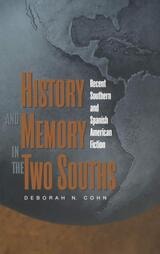
History and Memory in the Two Souths
Recent Southern and Spanish American FictionDeborah Cohn
Vanderbilt University Press, 1999
First, Cohn proposes that Faulkner's appeal derives from Spanish American authors' perception of similarities between the South's history and the experiences of their own respective nations. She delineates historical experiences common to the South and Spanish America, including civil wars, defeat and dispossession, regional marginalization, and socio-economic hardship. She also suggests that Spanish American authors found in Faulkner a set of concerns with which they could identify and that, as a result, they were inspired to take up the stylistic innovations characteristic of his writing. The resulting assimilation and adaptation of Euro-American modernism through Faulkner has been an indispensable part of what is known as la nueva narrativa, "the new narrative," as well as of successive movements in Spanish American literature.
From another perspective, Cohn's book shows points of contact between works by other southern and Spanish American novelists without positing relations of influence. Specifically, after identifying common, recurrent themes in modern southern and Spanish American literature in general, Cohn reveals levels of a shared understanding of regional history in Faulkner and Mario Vargas Llosa, in Ralph Ellison and Isabel Allende, as well as in Katherine Anne Porter and Juan Rulfo. Her analyses compare and contrast these authors' shared attempts to provide correctives to official, mainstream historical discourse through alternate, parallel strategies for reconstructing, recording, and reclaiming the past.
In yoking together the South and Spanish America as neighboring spaces with similar personalities, Cohn advances a daring and controversial thesis that both narrows and enhances the frame of comparison between the literatures of the South and Spanish America.
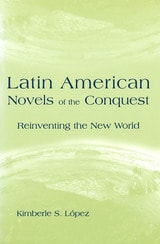
Latin American Novels of the Conquest
Reinventing the New WorldKimberle S. López
University of Missouri Press, 2002

Pirate Novels
Fictions of Nation Building in Spanish AmericaNina Gerassi-Navarro
Duke University Press, 1999
Beginning with an overview of the history of piracy, Gerassi-Navarro traces the historical icon of the pirate through colonial-era chronicles before exploring a group of nineteenth-century Mexican, Colombian, and Argentine novels. She argues that the authors of these novels, in their reconstructions of the past, were less interested in accurate representations than in using their narratives to discuss the future of their own countries. In reading these pirate narratives as metaphors for the process of nation building in Spanish America, Gerassi-Navarro exposes the conflicting strains of a complex culture attempting to shape that future. She shows how these pirate stories reflect the on-going debates that marked the consolidation of nationhood, as well as the extent to which the narratives of national identity in Spanish America are structured in relation to European cultures, and the ways in which questions of race and gender were addressed.
Providing new readings of the cultural and political paradigms that marked the literary production of nineteenth-century Spanish America, Pirate Novels uniquely expands the range of texts usually examined in the study of nation-building. It will interest literary scholars generally as well as those engaged in Latin American, colonial, and postcolonial studies.