Results by title
61 books match the query 'Histories' and 4 start with a
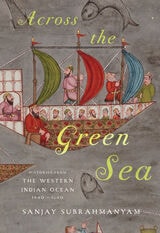
Across the Green Sea
Histories from the Western Indian Ocean, 1440-1640Sanjay Subrahmanyam
University of Texas Press, 2024
A history of two centuries of interactions among the areas bordering the western Indian Ocean, including India, Iran, and Africa.
Beginning in the mid-fifteenth century, the regions bordering the western Indian Ocean—“the green sea,” as it was known to Arabic speakers—had increasing contact through commerce, including a slave trade, and underwent cultural exchange and transformation. Using a variety of texts and documents in multiple Asian and European languages, Across the Green Sea looks at the history of the ocean from a variety of shifting viewpoints: western India; the Red Sea and Mecca; the Persian Gulf; East Africa; and Kerala.
Sanjay Subrahmanyam sets the scene for this region starting with the withdrawal of China's Ming Dynasty and explores how the western Indian Ocean was transformed by the growth and increasing prominence of the Ottoman Empire and the continued spread of Islam into East Africa. He examines how several cities, including Mecca and the vital Indian port of Surat, grew and changed during these centuries, when various powers interacted until famines and other disturbances upended the region in the seventeenth century. Rather than proposing an artificial model of a dominant center and its dominated peripheries, Across the Green Sea demonstrates the complexity of a truly dynamic and polycentric system through the use of connected histories, a method pioneered by Subrahmanyam himself.
Anthropologies and Histories
Essays in Culture, History, and Political EconomyRoseberry, William
Rutgers University Press, 1989
"An extremely stimulating volume . . . rich and provocative, and codifies a new depature point."--Choice
"As a critic . . . Roseberry writes with sustained force and clarity. . . . his principal points emerge with a directness that will make this book attractive to a wide range of readers."--American Anthropologist
"Roseberry in among the most astute, careful, and theoretically cogent of the anthropologists of his generation. . . . [This book] illustrates well the breadth and coherence of his thinking and guides the reader through the complicated intersections of anthropology with history, political economy, Marxism, and Latin American studies."--Jane Schneider, CUNY In Anthropologies and Histories,
William Roseberry explores some of the cultural and political implications of an anthropological political economy. In his view, too few of these implications have been explored by authors who dismiss the very possibility of a political economic understanding of culture. Within political economy, readers are offered sophisticated treatments of uneven development, but when authors turn to culture and politics, they place contradictory social experiences within simplistic class or epochal labels. Within cultural anthropology, history is often little more than new terrain for extending anthropological practice. Roseberry places culture and history in relation to each other, in the context of a reflection on the political economy of uneven development. In the first half of this books, he looks at and critiques a variety of anthropological understandings of culture, arguing for an approach that sees culture as socially constituted and socially constitutive. Beginning with a commentary on Clifford Geertz's seminal essay on the Balinese cockfight, Roseberry argues that Geertz and his followers pay insufficient attention to cultural differentiation, to social and political inequalities that affect actors' different understandings of the world, other people, and of themselves. Sufficient attention to such questions, Roseberry argues, requires a concern for political economy. In the second half of the book, Roseberry explores the assumptions and practices of political economy, indicates the kind of problems that should be central to such an approach, and reviews some of the inadequacies of anthropological studies. William Roseberry is a professor of anthropology at the New School for Social Research.
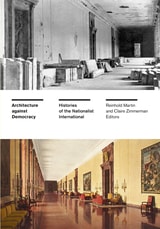
Architecture against Democracy
Histories of the Nationalist InternationalReinhold Martin
University of Minnesota Press, 2024
Examining architecture’s foundational role in the repression of democracy
Reinhold Martin and Claire Zimmerman bring together essays from an array of scholars exploring the troubled relationship between architecture and antidemocratic politics. Comprising detailed case studies throughout the world spanning from the early nineteenth century to the present, Architecture against Democracy analyzes crucial occasions when the built environment has been harnessed as an instrument of authoritarian power.
Alongside chapters focusing on paradigmatic episodes from twentieth-century German and Italian fascism, the contributors examine historic and contemporary events and subjects that are organized thematically, including the founding of the Smithsonian Institution, Ellis Island infrastructure, the aftermath of the Paris Commune, Cold War West Germany and Iraq, Frank Lloyd Wright’s domestic architecture, and Istanbul’s Taksim Square. Through the range and depth of these accounts, Architecture against Democracy presents a selective overview of antidemocratic processes as they unfold in the built environment throughout Western modernity, offering an architectural history of the recent “nationalist international.”
As new forms of nationalism and authoritarian rule proliferate across the globe, this timely collection offers fresh understandings of the role of architecture in the opposition to democracy.
Contributors: Esra Akcan, Cornell U; Can Bilsel, U of San Diego; José H. Bortoluci, Getulio Vargas Foundation; Charles L. Davis II, U of Texas at Austin; Laura diZerega; Eve Duffy, Duke U; María González Pendás, Cornell U; Paul B. Jaskot, Duke U; Ana María León, Harvard U; Ruth W. Lo, Hamilton College; Peter Minosh, Northeastern U; Itohan Osayimwese, Brown U; Kishwar Rizvi, Yale U; Naomi Vaughan; Nader Vossoughian, New York Institute of Technology and Columbia U; Mabel O. Wilson, Columbia U.

Art to Come
Histories of Contemporary ArtTerry Smith
Duke University Press, 2019