Results by title
11 books match the query 'Hmong (Asian people)'
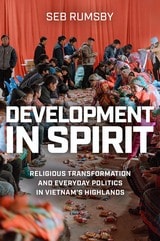
Development in Spirit
Religious Transformation and Everyday Politics in Vietnam’s HighlandsSeb Rumsby
University of Wisconsin Press, 2023
Following state-led market reforms in the 1980s, Vietnam experienced stunning economic transformation. But for the Hmong communities of the country’s north and central highlands, the benefits proved elusive. Instead, the Hmong people have pursued their own alternative paths to development. Rumsby shows how mass conversion to Christianity led to a case of “unplanned development” that put the Hmong on a trajectory of simultaneous integration into the market economy and resistance to state authority.
Many of the strategies community members employ are tied to the Christianization of everyday life. Religious actors play complex and often contradictory roles in facilitating networks of exchange, challenging or enforcing gender norms, promoting communalism and enforcing discipline, and shaping local ideas about progress. They are influenced by national and transnational religious networks, especially US-produced radio broadcasts by Hmong American Christians and local converts.
This compelling account provides fresh theoretical and empirical insights into the interplay of religion, neoliberal development, and marketization across the world.
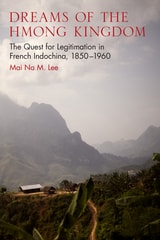
Dreams of the Hmong Kingdom
The Quest for Legitimation in French Indochina, 1850–1960Mai Na M. Lee
University of Wisconsin Press, 2015
In China, Vietnam, and Laos, the Hmong continuously negotiated with these states and with the French to maintain political autonomy in a world of shifting boundaries, emerging nation-states, and contentious nationalist movements and ideologies. Often divided by clan rivalries, the Hmong placed their hope in finding a leader who could unify them and recover their sovereignty. In a compelling analysis of Hmong society and leadership throughout the French colonial period, Mai Na M. Lee identifies two kinds of leaders—political brokers who allied strategically with Southeast Asian governments and with the French, and messianic resistance leaders who claimed the Mandate of Heaven. The continuous rise and fall of such leaders led to cycles of collaboration and rebellion. After World War II, the powerful Hmong Ly clan and their allies sided with the French and the new monarchy in Laos, but the rival Hmong Lo clan and their supporters allied with Communist coalitions.
Lee argues that the leadership struggles between Hmong clans destabilized French rule and hastened its demise. Martialing an impressive array of oral interviews conducted in the United States, France, and Southeast Asia, augmented with French archival documents, she demonstrates how, at the margins of empire, minorities such as the Hmong sway the direction of history.
Best books for public & secondary school libraries from university presses, American Library Association
History on the Run
Secrecy, Fugitivity, and Hmong Refugee EpistemologiesMa Vang
Duke University Press, 2021
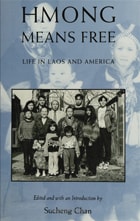
Hmong Means Free
Life in Laos and AmericaSucheng Chan
Temple University Press, 1994
This collection of evocative personal testimonies by three generations of Hmong refugees is the first to describe their lives in Laos as slash-and-burn farmers, as refugees after a Communist government came to power in 1975, and as immigrants in the United States. Reflecting on the homes left behind, their narratives chronicle the difficulties of forging a new identity.
From Jou Yee Xiong's Life Story:
"I stopped teaching my sons many of the Hmong ways because I felt my ancestors and I had suffered enough already. I thought that teaching my children the old ways would only place a burden on them."
From Ka Pao Xiong's (Jou Yee Xiong's son) Life Story:
"It has been very difficult for us to adapt because we had no professions or trades and we suffered from culture shock. Here in America, both the husband and wife must work simultaneously to earn enough money to live on. Many of our children are ignorant of the Hmong way of life…. Even the old people are forgetting about their life in Laos, as they enjoy the prosperity and good life in America."
From Xang Mao Xiong's Life Story:
"When the Communists took over Laos and General Vang Pao fled with his family, we, too, decided to leave. Not only my family, but thousands of Hmong tried to flee. I rented a car for thirty thousand Laotian dollars, and it took us to Nasu…. We felt compelled to leave because many of us had been connected to the CIA…. Thousands of Hmong were traveling on foot. Along the way, many of them were shot and killed by Communist soldiers. We witnessed a bloody massacre of civilians."
From Vue Vang's Life Story:
"Life was so hard in the [Thai refugee] camp that when we found out we could go to the United States, we did not hesitate to grasp the chance. We knew that were we to remain in the camp, there would be no hope for a better future. We would not be able to offer our children anything better than a life of perpetual poverty and anguish."
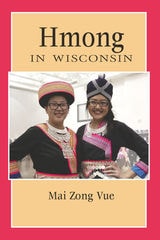
Hmong in Wisconsin
Mai Zong Vue
Wisconsin Historical Society Press, 2020
Many of these families found homes in Wisconsin, which now has the third largest Hmong population in the country, following California and Minnesota. As one of the most recent cultural groups to arrive in the Badger State, the Hmong have worked hard to establish a new life here, building support systems to preserve traditions and to help one another as they enrolled in schools, started businesses, and strived for independence.
Told with a mixture of scholarly research, interviews, and personal experience of the author, this latest addition to the popular People of Wisconsin series shares the Hmong’s varied stories of survival and hope as they have become an important part of Wisconsin communities.
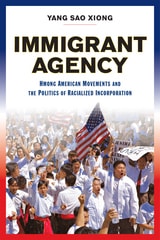
Immigrant Agency
Hmong American Movements and the Politics of Racialized IncorporationYang Sao Xiong
Rutgers University Press, 2022
Minority Rules
The Miao and the Feminine in China's Cultural PoliticsLouisa Schein
Duke University Press, 2000
Posing questions about gender, cultural politics, and identity, Schein examines how non-Miao people help to create Miao ethnicity by depicting them as both feminized keepers of Chinese tradition and as exotic others against which dominant groups can assert their own modernity. In representing and consuming aspects of their own culture, Miao distance themselves from the idea that they are less than modern. Thus, Schein explains, everyday practices, village rituals, journalistic encounters, and tourism events are not just moments of cultural production but also performances of modernity through which others are made primitive. Schein finds that these moments frequently highlight internal differences among the Miao and demonstrates how not only minorities but more generally peasants and women offer a valuable key to understanding China as it renegotiates its place in the global order.
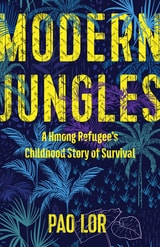
Modern Jungles
A Hmong Refugee’s Childhood Story of SurvivalPao Lor
Wisconsin Historical Society Press, 2021
Born in a small farming village, Pao was destined to be a Hmong clan leader, wedding negotiator, or shaman. But the course of his life changed dramatically in the 1970s, when the Hmong faced persecution for their role in helping US forces fighting communism in the region. After more than two years in Thai refugee camps, Pao and his surviving family members boarded the belly of an “iron eagle” bound for the United States, where he pictured a new life of comfort and happiness. Instead, Pao found himself navigating a frightening and unfamiliar world, adjusting to a string of new schools and living situations while struggling to fulfill the hopes his parents had once held for his future. Now in Modern Jungles, Pao Lor shares his inspiring coming-of-age tale about perseverance, grit, and hope.
Included are discussion questions for use by book clubs, in classrooms, or around the dinner table.
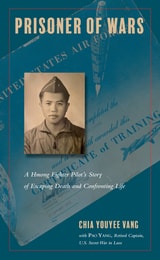
Prisoner of Wars
A Hmong Fighter Pilot's Story of Escaping Death and Confronting LifeChia Youyee Vang
Temple University Press, 2021
Retired Captain Pao Yang was a Hmong airman trained by the U.S. Air Force and CIA to fly T-28D aircraft for the U.S. Secret War in Laos. However, his plane was shot down during a mission in June 1972. Yang survived, but enemy forces captured him and sent him to a POW camp in northeastern Laos. He remained imprisoned for four years after the United States withdrew from Vietnam because he fought on the American side of the war.
Prisoner of Wars shows the impact the U.S Secret War in Laos had on Hmong combatants and their families. Chia Vang uses oral histories thatpoignantly recount Yang’s story and the deeply personal struggles his loved ones—who feared he had died—experienced in both Southeast Asia and the United States. As Yang eventually rebuilt his life in America, he grappled with issues of freedom and trauma.
Yang’s life provides a unique lens through which to better understand the lasting impact of the wars in Southeast Asia and the diverse journeys that migrants from Asia made over the last two centuries. Prisoner of Wars makes visible an aspect of the collateral damage that has been left out of dominant Vietnam War narratives.
Re-membering Culture
Erasure and Renewal in Hmong American EducationBic Ngo
University of Minnesota Press, 2024
The untold stories of resilience in Hmong American education
Re-membering Culture is a deep exploration of the intricate dynamics of cultural memory and education, centering the experiences of Hmong American students and educators. Arguing that the school, as a product of coloniality, perpetuates the marginalization and erasure of non-Western epistemologies, author Bic Ngo sheds light on the subtle yet impactful process of structured forgetting within the American education system. This politics of forgetting, in turn, contributes to the fragmentation of Hmong cultural heritage, identity, and community.
Based on a high school in an urban center with a considerable Hmong immigrant community, Ngo’s work draws on extensive ethnographic research with Hmong American community leaders, school administrators, parents, teachers, staff, and high school students to understand how they navigate the terrain of Western pedagogy while attempting to retain and preserve Hmong knowledge systems. Exploring a range of school experiences, Ngo traverses students’ challenges in balancing school with family life and the everyday cultural racism encountered in the classroom as well as grassroots efforts to preserve culture, including the establishment of a Hmong Cultural Club.
Highlighting these experiences and voices, Ngo provides a nuanced understanding of the challenges Hmong Americans face within an assimilationist society while contesting the dominant anti-immigrant narratives of refugee suffering and poverty. Through these practices of (re)storytelling, resurgence, and refusal, she underscores the agency of the Hmong American community, illuminating how the critical consciousness fostered by re-membering serves as a powerful tool in confronting white hegemonic ideologies in education.
Retail e-book files for this title are screen-reader friendly.
Reclaiming Diasporic Identity
Transnational Continuity and National Fragmentation in the Hmong DiasporaSangmi Lee
University of Illinois Press, 2024
In-depth and interdisciplinary, Reclaiming Diasporic Identity blends ethnography and history to provide a fresh consideration of Hmong life today.