Results by title
2 books match the query 'Hoaxes'
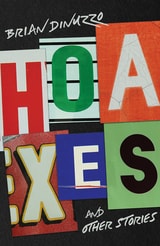
Hoaxes and Other Stories
Brian DiNuzzo
University of Wisconsin Press, 2022
A small-time celebrity keeps dying. A Bigfoot hunter and his grandson give presentations on the elusive beast. A disgruntled office drone reaches his breaking point and quits, in the middle of a zip-line trust fall.
The characters populating Brian DiNuzzo’s debut short story collection may be eccentrics, but at their core they are struggling to get through life, dealing with unmanageable bosses and tedious jobs, and trying to maintain their interpersonal and romantic relationships. These are people seeking to improve their circumstances, people striving for utopia but willing to accept much less. Frustrated and weary, downtrodden and misguided, they still hold out for the dim light of hope.
DiNuzzo navigates ordinary settings—Southern California, South Philadelphia, suburban and city streets, office buildings, derelict apartment complexes, the public library, the airport, the shopping mall—with quirky characters and odd situations. These stories ask us to wonder how falsehoods pervade private life. Through his twelve distinct tales, DiNuzzo asks: What’s real? What’s fake? Does it matter?
[more]
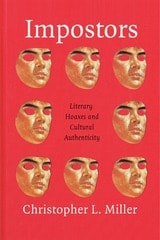
Impostors
Literary Hoaxes and Cultural AuthenticityChristopher L. Miller
University of Chicago Press, 2018
Writing a new page in the surprisingly long history of literary deceit, Impostors examines a series of literary hoaxes, deceptions that involved flagrant acts of cultural appropriation. This book looks at authors who posed as people they were not, in order to claim a different ethnic, class, or other identity. These writers were, in other words, literary usurpers and appropriators who trafficked in what Christopher L. Miller terms the “intercultural hoax.”
In the United States, such hoaxes are familiar. Forrest Carter’s The Education of Little Tree and JT LeRoy’s Sarah are two infamous examples. Miller’s contribution is to study hoaxes beyond our borders, employing a comparative framework and bringing French and African identity hoaxes into dialogue with some of their better-known American counterparts. In France, multiculturalism is generally eschewed in favor of universalism, and there should thus be no identities (in the American sense) to steal. However, as Miller demonstrates, this too is a ruse: French universalism can only go so far and do so much. There is plenty of otherness to appropriate. This French and Francophone tradition of imposture has never received the study it deserves. Taking a novel approach to this understudied tradition, Impostors examines hoaxes in both countries, finding similar practices of deception and questions of harm.
In the United States, such hoaxes are familiar. Forrest Carter’s The Education of Little Tree and JT LeRoy’s Sarah are two infamous examples. Miller’s contribution is to study hoaxes beyond our borders, employing a comparative framework and bringing French and African identity hoaxes into dialogue with some of their better-known American counterparts. In France, multiculturalism is generally eschewed in favor of universalism, and there should thus be no identities (in the American sense) to steal. However, as Miller demonstrates, this too is a ruse: French universalism can only go so far and do so much. There is plenty of otherness to appropriate. This French and Francophone tradition of imposture has never received the study it deserves. Taking a novel approach to this understudied tradition, Impostors examines hoaxes in both countries, finding similar practices of deception and questions of harm.
[more]