Results by title
9 books match the query 'Hoban, Wieland'
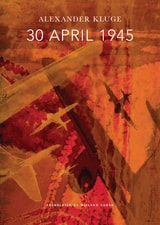
30 April 1945
The Day Hitler Shot Himself and Germany's Integration with the West BeganAlexander Kluge
Seagull Books, 2015
April 30, 1945, marked an end of sorts in the Third Reich. The last business day before a national holiday and then a series of transfers of power, April 30 was a day filled with contradictions and bewildering events that would forever define global history. It was on this day that while the Red Army occupied Berlin, Hitler committed suicide in his underground bunker, and, in San Francisco, the United Nations was being founded.
Alexander Kluge’s latest book, 30 April 1945, covers this single historic day and unravels its passing hours across the different theaters of the Second World War. Translated by Wieland Hoban, the book delves into the events happening around the world on one fateful day, including the life of a small German town occupied by American forces and the story of two SS officers stranded on the forsaken Kerguelen Islands in the South Indian Sea. Kluge is a master storyteller, and as he unfolds these disparate tales, one unavoidable question surfaces: What is the appropriate reaction to the total upheaval of the status quo?
Presented here with an afterword by Reinhard Jirgl, translated by Iain Galbraith, 30 April 1945 is a riveting collection of lives turned upside down by the deadliest war in history. The collective experiences Kluge paints here are jarring, poignant, and imbued with meaning. Seventy years later, we can still see our own reflections on the upheaval of a single day in 1945.
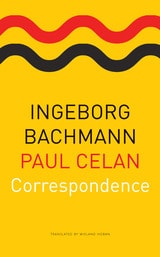
Correspondence
Paul Celan and Ingeborg Bachmann
Seagull Books, 2019
Collected here for the first time in English are their letters written between 1948 and 1961. Their correspondence forms a moving testimony of the discourse of love in the age after Auschwitz, with all the symptomatic disturbances and crises caused by their conflicting backgrounds and their hard-to-reconcile designs for living—as a woman, as a man, as writers. In addition to the almost 200 letters, the volume includes an important exchange between Bachmann and Gisèle Celan-Lestrange, who married Celan in 1951, as well as the letters between Paul Celan and Swiss writer Max Frisch.
“Scarcely more breathlessly and desperately can two lovers ever have struggled for words. Little known among German literary historians, the relationship between these two poets amounts to one of the most dramatic and momentous occurrences in German literature.”—FAZ, on the German edition
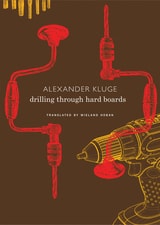
Drilling through Hard Boards
133 Political StoriesAlexander Kluge
Seagull Books, 2019
In the book, Kluge masterfully unspools more than one hundred vignettes, through which it becomes clear that the political is more often than not personal. Politics are everywhere in our everyday lives, so along with the stories of major political figures, we also find here the small, mostly unknown ones: Elfriede Eilers alongside Pericles, Chilean miners next to Napoleon, a three-month-old baby beside Alexander the Great. Drilling through Hard Boards is not just Kluge’s newest fiction, it is a masterpiece of political thought.
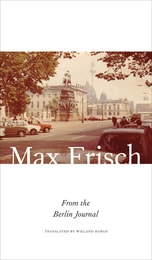
From the Berlin Journal
Max Frisch
Seagull Books, 2017
Max Frisch (1911–91) was a giant of twentieth-century German literature. When Frisch moved into a new apartment in Berlin’s Sarrazinstrasse, he began keeping a journal, which he came to call the Berlin Journal. A few years later, he emphasized in an interview that this was by no means a “scribbling book,” but rather a book “fully composed.” The journal is one of the great treasures of Frisch’s literary estate, but the author imposed a retention period of twenty years from the date of his death because of the “private things” he noted in it. From the Berlin Journal now marks the first publication of excerpts from Frisch’s journal. Here, the unmistakable Frisch is back, full of doubt, with no illusions, and with a playfully sharp eye for the world.
From the Berlin Journal pulls from the years 1946–49 and 1966–71. Observations about the writer’s everyday life stand alongside narrative and essayistic texts, as well as finely-drawn portraits of colleagues like Günter Grass, Uwe Johnson, Wolf Biermann, and Christa Wolf, among others. Its foremost quality, though, is the extraordinary acuity with which Frisch observed political and social conditions in East Germany while living in West Berlin.
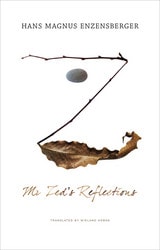
Mr Zed’s Reflections
Hans Magnus Enzensberger
Seagull Books, 2015
Collected in this thought-provoking and unique work are the considerations and provocations of this squat, park-bench philosopher, giving us a volume of truths and conversations that are clear-cut, skeptical, and fiercely illuminating.
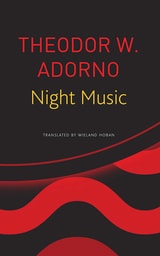
Night Music
Essays on Music 1928-1962Theodor W. Adorno
Seagull Books, 2009
Although Theodor W. Adorno is best known for his association with the Frankfurt School of Critical Theory, he began his career as a composer and successful music critic. Night Music presents the first complete English translations of two collections of texts compiled by German philosopher and musicologist Adorno—Moments musicaux, containing essays written between 1928 and 1962, and Theory of New Music, a group of texts written between 1929 and 1955.
In Moments musicaux, Adorno echoes Schubert’s eponymous cycle, with its emphasis on aphorism, and offers lyrical reflections on music of the past and his own time. The essays include extended aesthetic analyses that demonstrate Adorno’s aim to apply high philosophical standards to the study of music. Theory of New Music, as its title indicates, presents Adorno’s thoughts and theories on the composition, reception, and analysis of the music that was being written around him. His extensive philosophical writing ultimately prevented him from pursuing the compositional career he had once envisaged, but his view of the modern music of the time is not simply that of a theorist, but clearly also that of a composer. Though his advocacy of the Second Viennese School, comprising composer Arnold Schoenberg and his pupils, is well known, many of his writings in this field have remained obscure. Collected in their entirety for the first time in English, the insightful texts in Night Music show the breadth of Adorno’s musical understanding and reveal an overlooked side to this significant thinker.
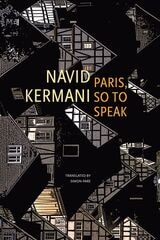
Paris, So to Speak
Navid Kermani
Seagull Books, 2022
A writer has penned a novel about the great love of his youth. After a public reading, he is approached by a woman he doesn’t recognize—but it’s his lover. He is the author; she, the figure in his novel. The young girl from back then has turned into an interesting and attractive woman—but she’s also married. Soon the situation becomes a little strange: they sit down together, have a glass of wine, talk about French romantic novels, ask each other what one expects of love when one grows older. And all the while her husband is sitting in the next room. How is this going to end? Navid Kermani has written a romantic novel like no other—surprising, witty, profound—and one can barely put it down.
The Fire Above, the Mountain Below
Reinhard Jirgl
Seagull Books, 2020
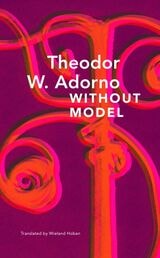
Without Model
Parva AestheticaTheodor W. Adorno
Seagull Books, 2023
Essays by Theodor W. Adorno on art and cinema.
In Without Model, Theodor W. Adorno strikingly demonstrates the intellectual range for which he is known. Taking the premise of the title as his guiding principle, that artistic and philosophical thought must eschew preconceptions and instead adapt itself to its time, circumstances, and object, Adorno presents a series of essays reflecting on culture at different levels, from the details of individual products to the social conditions of their production. He shows his more nostalgic side in the childhood reminiscences of ‘Amorbach’, but also his acute sociocultural analysis of the central topic of the culture industry. He criticizes attempts to maintain tradition in music and visual art, arguing against a restorative approach by stressing the modernity and individuality of historical works in the context of their time. In all of these essays, available for the first time in English, Adorno displays the remarkable thinking of one both steeped in tradition and dedicated to seeing beyond it.