Results by title
4 books match the query 'Hofling, Charles A'
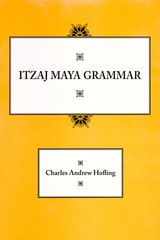
Itzaj Maya Grammar
Charles A Hofling
University of Utah Press, 2000
The Itzaj Maya language is a member of the Yukatekan Maya language family spoken in the lowlands of Guatemala, Mexico, and Belize, a family that includes Maya, Mopan, and Lakantum. Many classic Maya hieroglyphic texts were written in an earlier form of these languages, as were many important colonial documents. In addition to being a valuable record of ancient language, Andrew Hofling’s Itzaj Maya Grammar contributes greatly to the study of these older documents.
This exemplary grammar completes a basic documentation that began with Itzaj Maya Texts and Itzaj Maya-Spanish-English Dictionary. It’s coverage of the linguistic structures of Itzaj includes the phonological, morphophonological, and syntactic structures. Each morphological and grammatical construction is carefully explained, with additional examples of each construction included.
Itzaj Maya Grammar is a landmark contribution to the study of discourse in Maya language. When used with Hofling’s previous texts, it provides a thoroughly dynamic documentation of the language, useful to all interested in the study of Yukatejan languages or linguistics.
Itzaj Maya Spanish English Dictionary
Charles A Hofling
University of Utah Press, 1997
•More than twenty-thousand entries
•In trilingual format with extensive Spanish-Itzaj Maya and English Itzaj indexes
•Includes a grammatical sketch describing morphological and syntactic processes of Itzaj Maya words
•Three appendixes present flora and fauna taxonomy and an overview of body parts
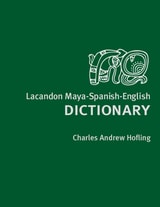
Lacandon Maya-Spanish-English Dictionary
Charles A Hofling
University of Utah Press, 2014
Following the same trilingual format as Hofling’s Mopan Maya-Spanish-English Dictionary, this reference contains pronunciation and grammatical information. It is a hybrid of a root dictionary and one with words in alphabetical order; words can be looked up in these two different ways, making it easy to use for both native and nonnative speakers. It also accommodates Spanish speakers who wish to learn Lacandon, and in the future is likely to be helpful to Lacandon-speaking children, who increasingly use Spanish outside the home, while preserving a record of this indigenous language.
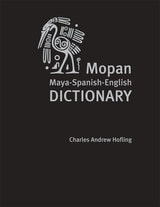
Mopan Maya-Spanish-English Dictionary
Charles A Hofling
University of Utah Press, 2011
Charles Andrew Hofling
Smithsonian-Utah Publications in American Indian Languages
Lyle Campbell and Ives Goddard
Linguistics
This is highly valuable dictionary of the Mopan (Mayan) language. In addition to its many entries, it also provides an introductory grammatical description, as well as general dictionary features such as parts of speech, examples, cross-references, variant forms, homophones, and indexes. The book also contains special sections on orthography and pronunciation unique to this important Mayan language, as well as translations into English and Spanish.
The dictionary has the merits well known from other dictionaries of indigenous languages of the Americas, preserving knowledge systems as they are encoded in vocabulary and providing valuable information for numerous fields, including Mayanists, Mesoamericanists, American Indian scholars, anthropologists, historians, linguists, students of Mayan hieroglyphic writing, and members of modern Mayan communities, among others.
This is the second book in the new Smithsonian-Utah Publications in American Indian Languages (SUPAIL) series, a joint venture of the University of Utah Press and the Smithsonian Institution.