Results by title
3 books match the query 'Hofmeyr, Isabel'
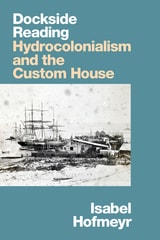
Dockside Reading
Hydrocolonialism and the Custom HouseIsabel Hofmeyr
Duke University Press, 2022
In Dockside Reading Isabel Hofmeyr traces the relationships among print culture, colonialism, and the ocean through the institution of the British colonial Custom House. During the late nineteenth and early twentieth centuries, dockside customs officials would leaf through publications looking for obscenity, politically objectionable materials, or reprints of British copyrighted works, often dumping these condemned goods into the water. These practices, echoing other colonial imaginaries of the ocean as a space for erasing incriminating evidence of the violence of empire, informed later censorship regimes under apartheid in South Africa. By tracking printed matter from ship to shore, Hofmeyr shows how literary institutions like copyright and censorship were shaped by colonial control of coastal waters. Set in the environmental context of the colonial port city, Dockside Reading explores how imperialism colonizes water. Hofmeyr examines this theme through the concept of hydrocolonialism, which puts together land and sea, empire and environment.
[more]
Postcolonial Air and Atmospheres
Elemental life and environmental crisisEdited by Sarah Nuttall and Isabel Hofmeyr
University College London, 2026
This study expands the traditional scope of air and atmosphere studies to explore atmospheres and aesthetics in postcolonial contexts.
This volume puts two traditions of scholarship into conversation: Euro-American work on air and atmospheres, and emergent postcolonial debates on these themes. Drawing on the strengths of the first, this collection probes its limits, while mapping an emergent field of postcolonial research on air and atmospheres.
Postcolonial Air and Atmospheres recontextualizes debates on atmospheres and aesthetics, exploring these themes in relation to the uneven hemispheric terrains of material decay and toxicity. It extends the narrow spatial purview of the Euro-American scholarship by taking an empire-wide perspective, considering historical questions of air and enslavement alongside South Asian histories of air conditioning and the toxic atmospheres of extractive industries. It develops a phenomenology of breathing in a range of postcolonial settings to revisit the theorizations of air and breath in Western critical theoretical scholarship. The collection comprises three sections. “Affective Atmospheres” explores the materialities of air while foregrounding atmospheres as sites of affect, politics, and power in the postcolony. “Unfree and Impure Airs” foregrounds clean and toxic air and who breathes them, along with the politics and technologies of how these unequal forms of air were and are produced. “Breathing In” centers practices of breath as a means of analyzing air and atmospheres.
[more]
Ten Books That Shaped the British Empire
Creating an Imperial CommonsAntionette Burton and Isabel Hofmeyr, eds.
Duke University Press, 2014
Combining insights from imperial studies and transnational book history, this provocative collection opens new vistas on both fields through ten accessible essays, each devoted to a single book. Contributors revisit well-known works associated with the British empire, including Charlotte Brontë's Jane Eyre, Thomas Macaulay's History of England, Charles Pearson's National Life and Character, and Robert Baden-Powell's Scouting for Boys. They explore anticolonial texts in which authors such as C. L. R. James and Mohandas K. Gandhi chipped away at the foundations of imperial authority, and they introduce books that may be less familiar to students of empire. Taken together, the essays reveal the dynamics of what the editors call an "imperial commons," a lively, empire-wide print culture. They show that neither empire nor book were stable, self-evident constructs. Each helped to legitimize the other.
Contributors. Tony Ballantyne, Elleke Boehmer, Catherine Hall, Isabel Hofmeyr, Aaron Kamugisha, Marilyn Lake, Charlotte Macdonald, Derek Peterson, Mrinalini Sinha, Tridip Suhrud, André du Toit
Contributors. Tony Ballantyne, Elleke Boehmer, Catherine Hall, Isabel Hofmeyr, Aaron Kamugisha, Marilyn Lake, Charlotte Macdonald, Derek Peterson, Mrinalini Sinha, Tridip Suhrud, André du Toit
[more]