Results by title
5 books match the query 'Hole, Frank'
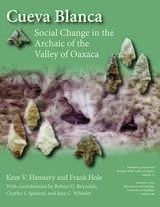
Cueva Blanca
Social Change in the Archaic of the Valley of OaxacaKent V. Flannery and Frank Hole
University of Michigan Press, 2019
Cueva Blanca lies in a volcanic tuff cliff some 4 km northwest of Mitla, Oaxaca, Mexico. It is one of a series of Archaic sites excavated by Kent Flannery and Frank Hole as part of a project on the prehistory and human ecology of the Valley of Oaxaca. The oldest stratigraphic level in Cueva Blanca yielded Late Pleistocene fauna, including some species no longer present in southern Mexico. The second oldest level, Zone E, produced Early Archaic material with calibrated dates as old as 11,000–10,000 BC . Zones D and C provided a rich Late Archaic assemblage whose closest ties are with the Abejas phase of Puebla’s Tehuacán Valley (fourth millennium BC). Spatial analyses undertaken on the Archaic living floors include (1) the drawing of density contours for tools and animal bones; (2) a search for Archaic tool kits using rank-order and cluster analysis; and (3) an attempt to define Binfordian “drop zones” using an approach drawn from computer vision.
[more]
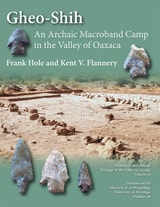
Gheo-Shih
An Archaic Macroband Camp in the Valley of OaxacaFrank Hole and Kent V. Flannery
University of Michigan Press, 2024
Gheo-Shih, an Archaic site in the Valley of Oaxaca, was a 1.5-hectare open-air macroband camp near the Mitla River. It was repeatedly occupied in the summer rainy season during the period (cal.) 7500–4000 BC, possibly by 25–50 people. At other times of the year the local population dispersed in smaller, family-sized groups, occupying microband camps in caves and rockshelters. The available macrofossil and palynological data suggest that between 5000 and 4000 BC, the inhabitants were cultivating maize, squash, gourds, and (possibly) runner beans, while continuing to collect wild plants and hunt deer, rabbit, and mud turtle. This site report describes the discovery of Gheo-Shih and the subsequent research carried out there: a systematic surface pickup, a series of test pits, targeted excavations, and analysis of the materials recovered.
[more]
Prehistory and Human Ecology of the Deh Luran Plain
An Early Village Sequence from Khuzistan, IranFrank Hole, Kent V. Flannery, and James A. Neely
University of Michigan Press, 1969
In the early 1960s, archaeologists Frank Hole, Kent V. Flannery, and James A. Neely surveyed the prehistoric mounds in Deh Luran and then excavated at two sites: Ali Kosh and Tepe Sabz. The researchers found evidence that the sites dated to between 7500 and 3500 BC, during which time the residents domesticated plants and animals. This volume, published in 1969, was the first in the Museum’s Memoir series—designed for data-rich, heavily illustrated archaeological monographs.
[more]
Studies in the Archeological History of the Deh Luran Plain
The Excavation of Chagha SefidFrank Hole
University of Michigan Press, 1977
In 1968 and 1969, Frank Hole directed the excavation of Chagha Sefid, a prehistoric site on the Deh Luran plain in Iran occupied from about 7000 to 3500 BC. This volume contains an analysis of the architecture, burials, and artifacts uncovered on the site. Contributions by M. J. Kirkby and Colin Renfrew.
[more]
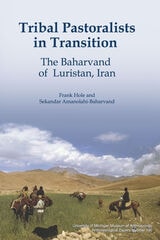
Tribal Pastoralists in Transition
The Baharvand of Luristan, IranFrank Hole and Sekandar Amanolahi-Baharvand
University of Michigan Press, 2021
In the spring of 1973, the Baharvand tribe from the Luristan province of central western Iran prepared to migrate from their winter pastures to their summer camp in the mountains. Seasonal migration in spring and fall had been their way of life for as long as anyone in the camp could remember. They moved their camp and their animals—sheep, goats, horses, donkeys, and chickens—in order to find green pastures and suitable temperatures. That year, one migrating family in the tribe allowed an outsider to make the trip with them. Anthropology professor Frank Hole, accompanied by his graduate student, Sekandar Amanolahi-Baharvand, traveled with the family of Morad Khan as they migrated into the mountains. In this volume, Hole describes the journey, the modern and prehistoric sites along the way, and the people he traveled with. It is a portrait of people in transition—even as the family follows the ancient migration path, there are signs of economic and social change everywhere. Illustrated.
Supplementary videos (on the migration, weaving, harvesting, and the bazaars) can be found on Fulcrum (fulcrum.org/UMMAA).
Supplementary videos (on the migration, weaving, harvesting, and the bazaars) can be found on Fulcrum (fulcrum.org/UMMAA).
[more]