Results by title
12 books match the query 'Holloway, John'
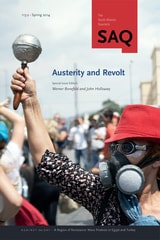
Austerity and Revolt, Volume 113
Werner Bonefeld and John Holloway, special issue editors
Duke University Press, 0
By combining insider knowledge with sophisticated theoretical scrutiny, the contributors to this issue approach eruptions of rebellion from a variety of historical, economic, and methodological perspectives. Writing not only about but also within such forces of progressive resistance around the world, they investigate the complex, hopeful, and contradictory process of creating new social, economic, and political structures through negation.
Beyond Money
A Postcapitalist StrategyAnitra Nelson
Pluto Press, 2022
What would a world without money look like? This book is a lively thought experiment that deepens our understanding of how money is the driver of political power, environmental destruction and social inequality today, arguing that it has to be abolished rather than repurposed to achieve a postcapitalist future.
Grounded in historical debates about money, Anitra Nelson draws on a spectrum of political and economic thought and activism, including feminism, ecoanarchism, degrowth, permaculture, autonomism, Marxism and ecosocialism. Looking to Indigenous rights activism and the defense of commons, an international network of activists engaged in a fight for a money-free society emerges.
Beyond Money shows that, by organizing around post-money versions of the future, activists have a hope of creating a world that embodies their radical values and visions.

Beyond Money
A Postcapitalist StrategyAnitra Nelson
Pluto Press, 2022
'A fascinating portal into arguments about why we need to get beyond money' - Harry Cleaver
What would a world without money look like? This book is a lively thought experiment that deepens our understanding of how money is the driver of political power, environmental destruction and social inequality today, arguing that it has to be abolished rather than repurposed to achieve a postcapitalist future.
Grounded in historical debates about money, Anitra Nelson draws on a spectrum of political and economic thought and activism, including feminism, ecoanarchism, degrowth, permaculture, autonomism, Marxism and ecosocialism. Looking to Indigenous rights activism and the defense of commons, an international network of activists engaged in a fight for a money-free society emerges.
Beyond Money shows that, by organizing around post-money versions of the future, activists have a hope of creating a world that embodies their radical values and visions.
Change the World Without Taking Power
The Meaning of Revolution TodayJohn Holloway
Pluto Press, 2019
After a century of failed attempts by radical projects, the concept of revolution itself is in crisis. By asking the deepest questions about the nature of humanity, work, capitalism, organisation and resistance, John Holloway looks sharply at modern protest movements and provides tools for creating new strategies.
First published in 2002, this book marked a shift in the understanding of Autonomism, Anarchism and Marxism, addressing the doubts activists had in their own political history and work, and helped form the perspectives of a new generation who are today changing the world.
Crack Capitalism
John Holloway
Pluto Press, 2010
Crack Capitalism, argues that radical change can only come about through the creation, expansion and multiplication of 'cracks' in the capitalist system. These cracks are ordinary moments or spaces of rebellion in which we assert a different type of doing.
John Holloway's previous book, Change the World Without Taking Power, sparked a world-wide debate among activists and scholars about the most effective methods of going beyond capitalism. Now Holloway rejects the idea of a disconnected array of struggles and finds a unifying contradiction - the opposition between the capitalist labour we undertake in our jobs and the drive towards doing what we consider necessary or desirable.
Clearly and accessibly presented in the form of 33 theses, Crack Capitalism is set to reopen the debate among radical scholars and activists seeking to break capitalism now.
Hope in Hopeless Times
John Holloway
Pluto Press, 2022
Hope lies in our richness, in the joy of our collective creativity. But that richness exists in the peculiar form of money. The fact that we relate to one another through money causes tremendous social pain and destruction and is dragging us through pandemics and war towards extinction.
Richness against money: this battle will decide the future of humanity. If we cannot emancipate richness from money-capital profit, there is probably no hope. Money seems invincible but the constant expansion of debt shows that its rule is fragile. The fictitious expansion of money through debt is driven by fear, fear of us, fear of the rabble. Money contains, but richness overflows.
Negativity and Revolution
Adorno and Political ActivismEdited by John Holloway, Fernando Matamoros, and Sergio Tischler
Pluto Press, 2009
How can activists combat the political paralysis that characterises the anti-dialectical Marxism of Foucault, Derrida and Deleuze, without reverting to a dogmatic orthodoxy? This book explores solutions in the 'negative dialectics' of Theodor Adorno.
The poststructuralist shift from dialectics to 'difference' has been so popular that it becomes difficult to create meaningful revolutionary responses to neoliberalism. The contributors to this volume come from within the anti-capitalist movement, and close to the concerns expressed in Negri and Hardt's Empire and Multitude. However, they argue forcefully and persuasively for a return to dialectics so a real-world, radical challenge to the current order can be constructed.
This is a passionate call to arms for the anti-capitalist movement. It should be read by all engaged activists and students of political and critical theory.
Open Marxism 3
Emancipating MarxKosmas Psychopedis
Pluto Press, 1995
The contributors argue that sociological heritage which grew up under the banner of scientific Marxism has had a detrimental effect on the movement of socialist thinking. The 'emancipation of Marx' implies both freeing Marx from the understanding of the 20th century and the freeing of the human spirit from the control of capital.
Open Marxism 4
Against a Closing WorldAna Cecilia Dinerstein
Pluto Press, 2019
Open Marxism 4
Against a Closing WorldAna Cecilia Dinerstein
Pluto Press, 2019
Subalternity, Antagonism, Autonomy
Constructing the Political SubjectMassimo Modonesi
Pluto Press, 2013
In this bold and innovative book, Massimo Modonesi weaves together theory and political practice by relating the concepts of subalternity, antagonism and autonomy to contemporary movements in Latin America and elsewhere.
In a sophisticated account, Modonesi reconstructs the debates between Marxist authors and schools of thought in order to sketch out informed strategies of resistance. He reviews the works of Gramsci, Negri, Castoriadis and Lefort, and engages with the arguments made by E. P. Thompson, Spivak, Laclau and Mouffe.
Subalternity, Antagonism, Autonomy firmly roots key theoretical arguments from a range of critical thinkers within specific political movements in order to recover these concepts as analytical instruments which can help to guide contemporary struggles.
Zapatista!
Reinventing Revolution in MexicoEdited by John Holloway and Eloina Pelaez
Pluto Press, 1998