Results by title
3 books match the query 'Holmes, Oliver Wendell'
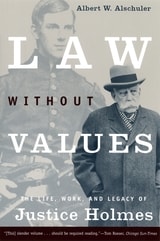
Law Without Values
The Life, Work, and Legacy of Justice HolmesAlbert W. Alschuler
University of Chicago Press, 2000
In recent decades, Oliver Wendell Holmes has been praised as "the only great American legal thinker" and "the most illustrious figure in the history of American law." But in Albert Alschuler's critique of both Justice Holmes and contemporary legal scholarship, a darker portrait is painted—that of a man who, among other things, espoused Social Darwinism, favored eugenics, and, as he himself acknowledged, came "devilish near to believing that might makes right."
[more]
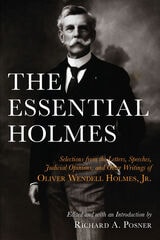
The Essential Holmes
Selections from the Letters, Speeches, Judicial Opinions, and Other Writings of Oliver Wendell Holmes, Jr.Oliver Wendell Holmes
University of Chicago Press, 1992
Oliver Wendell Holmes, Jr., has been called the greatest jurist and legal scholar in the history of the English-speaking world. In this collection of his speeches, opinions, and letters, Richard Posner reveals the fullness of Holmes' achievements as judge, historian, philosopher, and master of English style. Thematically arranged, the volume covers a rich variety of subjects from aging and death to themes in politics, personalities, and law. Posner's substantial introduction firmly places this wealth of material in its proper biographical and historical context.
"A first-rate prose stylist, [Holmes] was perhaps the most quotable of all judges, as this ably edited volume shows."—Washington Post Book World
"Brilliantly edited, lucidly organized, and equipped with a compelling introduction by Judge Posner, [this book] is one of the finest single-volume samplers of any author's work I have seen. . . . Posner has fully captured the acrid tang of him in this masterly anthology."—Terry Teachout, National Review
"Excellent. . . . A worthwhile contribution to current American political/legal discussions."—Library Journal
"The best source for the reader who wants a first serious acquaintance with Holmes."—Thomas C. Grey, New York Review of Books
[more]
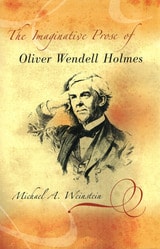
The Imaginative Prose of Oliver Wendell Holmes
Michael A. Weinstein
University of Missouri Press, 2006
One of the most popular serious writers of the mid-nineteenth century, Oliver Wendell Holmes, Sr., was a major figure of the New England Renaissance and wrote seven volumes of imaginative prose that were hybrids of essay and fiction. His four table-talk books initiated the form of the dramatized essay, and his three novels—styled as romances “medicated” by intellectual discourse—were among the first examples of ideologically didactic fiction.
Michael A. Weinstein now traces Holmes’s intellectual trajectory across these works to show how his thought evolved over the course of his life and in response to America’s transition from an agrarian to an industrial society. Through close readings of this eclectic ouevre—including such lesser-known late works as A Mortal Antipathy and Over the Teacups—he offers a comprehensive interpretation of Holmes’s thought concerning the American national character, showing him to have had a far richer understanding of human experience than other scholars have previously supposed.
This is the first book to consider Holmes’s imaginative prose as a whole and to defend its systematic structure against critics who have branded him a dilettante lacking system or seriousness. Through a careful explication of characters and themes, Weinstein finds at the core of these works a high regard for self-determination as a quintessential American value: an affirmation of the freedom of individuals to decide for themselves how to respond to a human condition that can be as perilous as it is promising. In the course of his analysis, Weinstein engages the spectrum of Holmes criticism and also shows how Holmes anticipated the cultural problems of modernity, pluralism, psychoanalysis, and existentialism, as well as postmodern literary expression.
Through his insightful assessment, Weinstein gives us an author whose respect for individual judgment is as relevant in today’s society, torn by cultural politics, as it was in his own time. His book restores Holmes to his place in the canon while introducing a wider readership to a perceptive writer who offers not only insight into the moral possibilities of American identity but also genuine wit and wisdom about the art of living.
[more]