Results by title
260 books match the query 'Holocaust' and 24 start with a
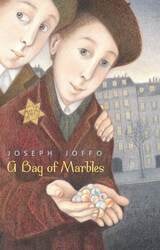
A Bag of Marbles
Joseph Joffo
University of Chicago Press, 2000
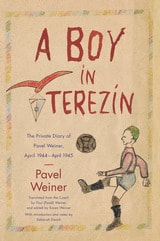
A Boy in Terezín
The Private Diary of Pavel Weiner, April 1944–April 1945Pavel Weiner
Northwestern University Press, 2011
The Germans claimed that Theresienstadt was "the town the Führer gave the Jews," and they temporarily transformed it into a Potemkin village for an International Red Cross visit in June 1944, the only Nazi camp opened to outsiders. But the Germans lied. Theresienstadt was a holding pen for Jews to be shipped east to annihilation camps.
While famous and infamous figures and historical events flit across the pages, they form the background for Pavel's life. Assigned to the now-famous Czech boys' home, L417, Pavel served as editor of the magazine Ne?ar. Relationships, sports, the quest for food, and a determination to continue their education dominate the boys' lives. Pavel's father and brother were deported in September 1944; he turned thirteen (the age for his bar mitzvah) in November of that year, and he grew in his ability to express his observations and reflect on them. A Boy in Terezín registers the young boy's insights, hopes, and fears and recounts a passage into maturity during the most horrifying of times.
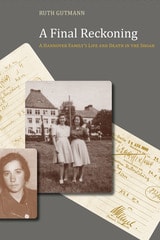
A Final Reckoning
A Hannover Family's Life and Death in the ShoahRuth Gutmann, Foreword by Kenneth Waltzer
University of Alabama Press, 2013
A work of both childhood memory and adult reflection undergirded with scholarly research
Ruth Herskovits Gutmann’s powerful memoir recounts her life not only as a concentration camp inmate and survivor, but also as a sister and daughter. Born in 1928, Gutmann and her twin sister, Eva, escaped the growing Nazi threat in Germany on a Kindertransport to Holland in 1939.
Gutmann’s compelling story captures many facets of the Jewish experience in Nazi Germany. She describes her early life in Hannover as the daughter of a prominent and patriotic member of the Jewish community. Her flight on the Kindertransport offers a vivid, firsthand account of that effort to save the children of Jewish families. Her memories of the camps include coming to the attention of Josef Mengele, who often used twins in human experiments. Gutmann writes with moving clarity and nuance about the complex feelings of survivorship.
A Final Reckoning provides not only insights into Gutmann’s own experience as a child in the midst of the atrocities of the Holocaust, but also a window into the lives of those, like her father, who were forced to carry on and comply with the regime that would ultimately bring about their demise.
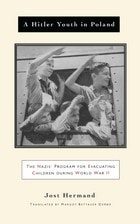
A Hitler Youth in Poland
The Nazi Children's Evacuation Program During World War IIJost Hermand
Northwestern University Press, 1997
During the Nazi era, millions of German children between the ages of seven and sixteen were taken from their homes and sent to Hitler Youth paramilitary camps to be toughened up and taught how to be "German." Separated from their families and sent to the far-flung corners of Europe, these children often endured incredible abuse by the adults in charge. In this memoir, Jost Hermand, a cultural critic and historian who spent much of his youth in five different camps, writes about his experiences as a small, unathletic boy thrown into a "wolf pack" governed by brutalization, dreary routine, and sadism.
Intelligent and persuasive, A Hitler Youth in Poland should be read by anyone interested in psychology or the history of everyday life in Hitler's Germany and the mental scars of adults born during the Nazi regime.
A Jewish Kapo in Auschwitz
History, Memory, and the Politics of SurvivalTuvia Friling
Brandeis University Press, 2014
A Match Made in Hell
The Jewish Boy and the Polish Outlaw Who Defied the NazisLarry Stillman, from the testimony of Morris Goldner
University of Wisconsin Press, 2003
When Moniek (Morris) Goldner and his family were uprooted from their Polish farming village during a German action, the child-sized sixteen-year-old fled into the forests. He eventually met up with his father, who had also escaped, and together they managed to survive until a former friend betrayed the pair. Wounded and left for dead beneath his father’s murdered body, Goldner was rescued by the enigmatic outlaw Jan Kopec, who was also in hiding, looking for ways to profit from his criminal expertise.
For eighteen months Kopec hid the boy with him, moving from one area to another, often staying in hideouts he had fashioned years earlier. At first Kopec trained Goldner simply to serve as his accomplice in robberies and black market activities. But before long he pushed the training to a whole new level, making it possible for him to sell Goldner’s services to a shadowy resistance group which was becoming interested in the daring young saboteur.
And through it all, these two disparate personalities—the quiet, small-framed boy and the stocky, callous mercenary—forged an remarkable friendship and co-dependency born of need and desperation in a hellish time and place.
A Promise at Sobibór
A Jewish Boy’s Story of Revolt and Survival in Nazi-Occupied PolandPhilip “Fiszel” Bialowitz, with Joseph Bialowitz; Foreword by Wladyslaw Bartoszewski
University of Wisconsin Press, 2012
A Promise at Sobibór is the story of Fiszel Bialowitz, a teenaged Polish Jew who escaped the Nazi gas chambers. Between April 1942 and October 1943, about 250,000 Jews from European countries and the Soviet Union were sent to the Nazi death camp at Sobibór in occupied Poland. Sobibór was not a transit camp or work camp: its sole purpose was efficient mass murder. On October 14, 1943, approximately half of the 650 or so prisoners still alive at Sobibór undertook a daring and precisely planned revolt, killing SS officers and fleeing through minefields and machine-gun fire into the surrounding forests, farms, and towns. Only about forty-two of them, including Fiszel, are known to have survived to the end of the war.
Philip (Fiszel) Bialowitz, now an American citizen, tells his eyewitness story here in the real-time perspective of his own boyhood, from his childhood before the war and his internment in the brutal Izbica ghetto to his harrowing six months at Sobibór—including his involvement in the revolt and desperate mass escape—and his rescue by courageous Polish farmers. He also recounts the challenges of life following the war as a teenaged displaced person, and his eventual efforts as a witness to the truth of the Holocaust.
In 1943 the heroic leaders of the revolt at Sobibór, Sasha Perchersky and Leon Feldhendler, implored fellow prisoners to promise that anyone who survived would tell the story of Sobibór: not just of the horrific atrocities committed there, but of the courage and humanity of those who fought back. Bialowitz has kept that promise.
Best Books for General Audiences, selected by the American Association for School Libraries
Best Books for High Schools, selected by the American Association for School Libraries
Best Books for Special Interests, selected by the Public Library Association
A Rescuer's Story
Pastor Pierre-Charles Toureille in Vichy FranceTela Zasloff
University of Wisconsin Press, 2014
This is the story of a Holocaust rescuer, Pierre Toureille, a French Protestant pastor whose efforts resulted in the rescue of hundreds of refugees, most of them Jewish. Inspired by his Huguenot heritage, Pastor Toureille participated in international Protestant church efforts to combat Nazism during the 1930s and headed a major refugee aid organization in Vichy France during World War II. After the war, Pastor Toureille was honored by the Jewish organization Yad Vashem as one of the "Righteous Among the Nations."
In telling Toureille’s story, Tela Zasloff also depicts the wide-ranging network of Protestant pastors and lay people in southern French villages who participated in an aggressive rescue effort. She delves into their motivations, including their heritage as members of a religious minority. Toureille’s rescue work under the Vichy regime, partly official and then increasingly clandestine as the war progrressed. was a crucial part of the French non-violent "spiritual resistance" against Nazism.
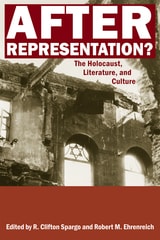
After Representation?
The Holocaust, Literature, and CultureSpargo, R. Clifton
Rutgers University Press, 2010
As experts in the study of literature and culture, the scholars in this collection examine the shifting cultural contexts for Holocaust representation and reveal how writersùwhether they write as witnesses to the Holocaust or at an imaginative distance from the Nazi genocideùarticulate the shadowy borderline between fact and fiction, between event and expression, and between the condition of life endured in atrocity and the hope of a meaningful existence. What imaginative literature brings to the study of the Holocaust is an ability to test the limits of language and its conventions. After Representation? moves beyond the suspicion of representation and explores the changing meaning of the Holocaust for different generations, audiences, and contexts.
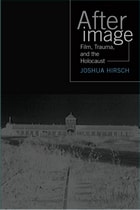
Afterimage
Film, Trauma And The HolocaustJoshua Hirsch
Temple University Press, 2003
Joshua Hirsch explores the changes in documentary brought about by cinema verite, culminating in Shoah. He then turns to teh appearance of a fictional posttraumatic cinema, tracing its development through the vivid flashbacks in Resnais' Hiroshima, mon amour to the portrayal of pain and memory in Pawnbroker. He excavates a posttraumatic autobiography in three early films by the Hungarian Istvan Szabo. Finally, Hirsch examines the effects of postmodernism on posttraumatic cinema, looking at Schindler's List and a work about a different form of historical trauma, History and Memory, a videotape dealing with the internment of Japanese Americans during the Second World War.
Sweeping in its scope, Afterimage presents a new way of thinking about film and history, trauma and its representation.
Agents of Liberations
Holocaust Memory in Contemporary Art and Documentary FilmZoltán Kékesi
Central European University Press, 2015
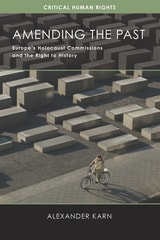
Amending the Past
Europe's Holocaust Commissions and the Right to HistoryAlexander Karn
University of Wisconsin Press, 2017
Alexander Karn analyzes more than a dozen Holocaust commissions—in Germany, Switzerland, France, Poland, Austria, Latvia, Lithuania, and elsewhere—in a comparative framework, situating each in the context of past and present politics, to evaluate their potential for promoting justice and their capacity for bringing the perspectives of rival groups more closely together. Karn also evaluates the media coverage these commissions received and probes their public reception from multiple angles.
Arguing that historical commissions have been underused as a tool for conflict management, Karn develops a program for historical mediation and moral reparation that can deepen democratic commitment and strengthen human rights in both transitional regimes and existing liberal states.
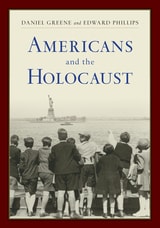
Americans and the Holocaust
A ReaderDaniel Greene
Rutgers University Press, 2021
Americans and the Holocaust explores these enduring questions by gathering together more than one hundred primary sources that reveal how Americans debated their responsibility to respond to Nazism. Drawing on groundbreaking research conducted for the United States Holocaust Memorial Museum’s Americans and the Holocaust exhibition, these carefully chosen sources help readers understand how Americans’ responses to Nazism were shaped by the challenging circumstances in the United States during the 1920s, 1930s, and 1940s, including profound economic crisis, fear of communism, pervasive antisemitism and racism, and widespread isolationism.
Collecting newspaper and magazine articles, popular culture materials, and government records, Americans and the Holocaust is a valuable resource for students and historians seeking to shed light on this dark era in world history.
To explore further, visit the United States Holocaust Memorial Museum's digital exhibit, available here: https://exhibitions.ushmm.org/americans-and-the-holocaust
Published in association with the United States Holocaust Memorial Museum.
And Sadly Teach
Teacher Education and Professionalization in American CultureJurgen Herbst
University of Wisconsin Press, 1991
To lend weight to his charge that the public school teacher has been betrayed and gravity to his indictment of the educational establishment for that betrayal, Jurgen Herbst goes back to the beginnings of teacher education in America in the 1830s and traces its evolution up to the 1920s, by which time the essential damage had been done.
Initially, attempts were made to upgrade public school teaching to a genuine profession, but that ideal was gradually abandoned. In its stead, with the advent of newly emerging graduate schools of education in the early decades of the twentieth century, came the so-called professionalization of public education. At the expense of the training of elementary school teachers (mostly women), teacher educators shifted their attention to the turning out of educational "specialists" (mostly men)—administrators, faculty members at normal schools and teachers colleges, adult education teachers, and educational researchers.
Ultimately a history of the neglect of the American public school teacher, And Sadly Teach ends with a plea and a message that ring loud and clear. The plea: that the current reform proposals for American teacher education—the Carnegie and the Holmes reports—be heeded. The message: that the key to successful school reform lies in educating teacher’s true professionals and in acknowledging them as such in their classrooms.
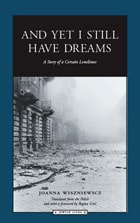
And Yet I Still Have Dreams
A Story of Certain LonelinessJoanna Wiszniewicz
Northwestern University Press, 2004
The book provides a connection to seldom discussed aspects of the Holocaust: the gulf between rich and poor Jews and how this translated into everyday survival; the refusal by Alex to see himself or Jews in general as heroes or victims; his own self-absorption as a teen in the ghetto; and his "priviliged" family's near-indifference to the suffering of those around them. Alex paints a picture of complex and diverse Jewish society in prewar Poland, revealing how, many years later and despite his determine to leave it in the past, the burdens of memory--and the dreams--linger.

And the World Stood Silent
SEPHARDIC POETRY OF THE HOLOCAUSTTranslated and with Commentaries by Isaac Jack Lévy
University of Illinois Press, 1989
And the World Stood Silent gathers the Sephardim's French, Greek, Italian, and Judeo-Spanish poems, accompanied by English translations, about their long journey to the concentration and extermination camps. Isaac Jack Lévy also surveys the 2,000-year history of the Sephardim and discusses their poetry in relation to major religious, historical, and philosophical questions.
Wrenchingly conveying the pathos and suffering of the Jewish community during World War II, And the World Stood Silent is invaluable as a historical account and as a documentary source.
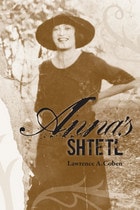
Anna's Shtetl
Lawrence A. Coben
University of Alabama Press, 2007
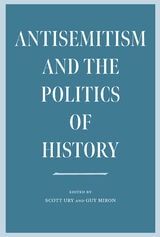
Antisemitism and the Politics of History
Edited by Scott Ury and Guy Miron
Brandeis University Press, 2023
The book begins with a revised and updated version of David Engel’s seminal essay “Away from a Definition of Antisemitism.” Subsequent contributions by renowned specialists in ancient, medieval, and modern history, religious studies, and other fields explore the various and changing definitions and uses of the term “antisemitism” in a range of contexts, including ancient Rome and Greece, the Byzantine Empire, medieval Europe, early modern and modern Europe, North America, and the United Kingdom. The volume also includes a section that focuses on the Second World War, including the Holocaust and its memory. Engel offers a contemporary response to conclude the book.
First published in Hebrew in 2020 as a special issue of the journal Zion: A Quarterly for Research in Jewish History in cooperation with the Zalman Shazar Center in Jerusalem, this compelling collection has already had an impact on the study of antisemitism in Israel. It is certain to become a critical resource for scholars, policymakers, and journalists researching antisemitism, Holocaust studies, and related fields.
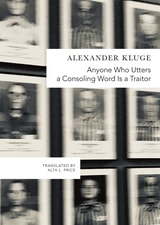
Anyone Who Utters a Consoling Word Is a Traitor
48 Stories for Fritz BauerAlexander Kluge
Seagull Books, 2020
Alexander Kluge’s work has long grappled with the Third Reich and its aftermath, and the extermination of the Jews forms its gravitational center. Kluge is forever reminding us to keep our present catastrophes in perspective—“calibrated”—against this historical monstrosity. Kluge’s newest work is a book about bitter fates, both already known and yet to unfold. Above all, it is about the many kinds of organized machinery built to destroy people. These forty-eight stories of justice and injustice are dedicated to the memory of Fritz Bauer, a determined fighter for justice and district attorney of Hesse during the Auschwitz Trials. “The moment they come into existence, monstrous crimes have a unique ability,” Bauer once said, “to ensure their own repetition.” Kluge takes heed, and in these pages reminds us of the importance of keeping our powers of observation and memory razor sharp.
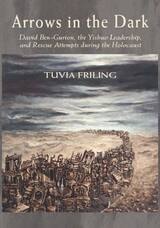
Arrows in the Dark (Volumes 1 and 2)
David Ben-Gurion, the Yishuv Leadership, and Rescue Attempts during the HolocaustTuvia Friling; Translated by Ora Cummings
University of Wisconsin Press, 2005
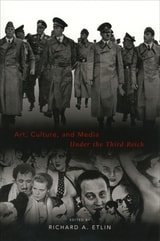
Art, Culture, and Media Under the Third Reich
Edited by Richard A. Etlin
University of Chicago Press, 2002
Contributors address nearly every facet of the arts and mass media under the Third Reich—efforts to define degenerate music and art; the promotion of race hatred through film and public assemblies; views of the racially ideal garden and landscape; race as portrayed in popular literature; the reception of art and culture abroad; the treatment of exiled artists; and issues of territory, conquest, and appeasement. Familiar subjects such as the Munich Accord, Nuremberg Party Rally Grounds, and Lebensraum (Living Space) are considered from a new perspective. Anyone studying the history of Nazi Germany or the role of the arts in nationalist projects will benefit from this book.
Contributors:
Ruth Ben-Ghiat
David Culbert
Albrecht Dümling
Richard A. Etlin
Karen A. Fiss
Keith Holz
Kathleen James-Chakraborty
Paul B. Jaskot
Karen Koehler
Mary-Elizabeth O'Brien
Jonathan Petropoulos
Robert Jan van Pelt
Joachim Wolschke-Bulmahn and Gert Gröning
At Home with the Holocaust
Postmemory, Domestic Space, and Second-Generation Holocaust NarrativesLucas F. W. Wilson
Rutgers University Press, 2025
At the Edge of the Abyss
A Concentration Camp Diary, 1943-1944David Koker; Edited by Robert Jan van Pelt; Translated from the Dutch by Michiel Horn and John Irons
Northwestern University Press, 2012
Finalist for 2012 National Jewish Book Award in the Holocaust category
David Koker's diary is one of the most notable accounts of life in a German concentration camp written by a Jew during the years of the Holocaust. First brought to attention when the Dutch historian Jacob Presser-Koker's history teacher in high school-quoted from Koker's diary in his monumental history, published in English as The Destruction of the Dutch Jews (1968), the diary itself became a part of the Dutch literary canon when it was published in 1977 as Dagboek geschreven in Vught (Diary Written in Vught). It has remained in print ever since, and is notable for its literary qualities, weaving poetry and powerful observations of the emotional life of a camp prisoner, including reflections after an in-person visit by Heinrich Himmler. Surprisingly, the book has never before been translated into English.
During his time in the Vught concentration camp, the 21-year-old David recorded on an almost daily basis his observations, thoughts, and feelings. He mercilessly probed the abyss that opened around him and, at times, within himself. David's diary covers almost a year, both charting his daily life in Vught as it developed over time and tracing his spiritual evolution as a writer. Until early February 1944, David was able to smuggle some 73,000 words from the camp to his best friend Karel van het Reve, a non-Jew.
With an informative introduction, annotation, and list of dramatis personae by Robert Jan van Pelt, At the Edge of the Abyss offers an immediate and wholly original look into the life of a concentration camp prisoner.
Auschwitz, Poland, and the Politics of Commemoration, 1945–1979
Jonathan Huener
Ohio University Press, 2003
Few places in the world carry as heavy a burden of history as Auschwitz. Recognized and remembered as the most prominent site of Nazi crimes, Auschwitz has had tremendous symbolic weight in the postwar world.
Auschwitz, Poland, and the Politics of Commemoration is a history of the Auschwitz memorial site in the years of the Polish People’s Republic. Since 1945, Auschwitz has functioned as a memorial and museum. Its monuments, exhibitions, and public spaces have attracted politicians, pilgrims, and countless participants in public demonstrations and commemorative events.
Jonathan Huener’s study begins with the liberation of the camp and traces the history of the State Museum at Auschwitz from its origins immediately after the war until the 1980s, analyzing the landscape, exhibitions, and public events at the site.
Based on extensive research and illustrated with archival photographs, Auschwitz, Poland, and the Politics of Commemoration accounts for the development and durability of a Polish commemorative idiom at Auschwitz. Emphasis on Polish national “martyrdom” at Auschwitz, neglect of the Shoah as the most prominent element of the camp’s history, political instrumentalization of the grounds and exhibitions—these were some of the more controversial aspects of the camp’s postwar landscape.
Professor Huener locates these and other public manifestations of memory at Auschwitz in the broad scope of Polish history, in the specific context of postwar Polish politics and culture, and against the background of Polish-Jewish relations. Auschwitz, Poland, and the Politics of Commemoration will be of interest to scholars, students, and general readers of the history of modern Poland and the Holocaust.