Results by title
3 books match the query 'Holton, Gerald'

Gender Differences in Science Careers
The Project Access StudyGerhard Sonnert and Gerald Holton
Rutgers University Press, 1995
What determines successful careers in the field of science? What are the early indicators of later failures. And specifically, how do women scientists' career paths differ from men's? While it is easy to theorize about these questions, those who go to the trouble of an extensive empirical study find an increasingly complex picture.
Using the largest database of its kind (699 questionnaires and 200 face-to-face conversations), the authors investigate the career paths of recipients of prestigious postdoctoral fellowships--scientists, engineers, and mathematicians. They outline a theoretical framework for understanding the causes of gender disparities among scientists, test the hypothesis of a gender- specific "glass ceiling," and provide a wealth of pertinent statistical information.
Gender Differences in Science Careers reveals that, as institutional laws changed, patterns of discrimination and exclusion become more subtle. Despite the decline of rigid gender-role socialization, many social practices persist that lead, on average and often in counterintuitive ways, to the accumulation of disadvantages for women scientists. This book is directed to scholars in the social sciences, aspiring and practicing scientists, and administrators interested in equity issues.
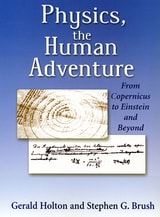
Physics, the Human Adventure
From Copernicus to Einstein and BeyondBrush, Stephen G
Rutgers University Press, 2001
Winner of the 2001 Joseph Hazen Education Prize of the History of Science Society
Physics, the Human Adventure is the third edition of the classic text Introduction to Concepts and Theories in Physical Science. Authored by Gerald Holton, the text was a landmark in science education. It was the first modern textbook in physics (or in any other science) to make full and effective use of the history and philosophy of science in presenting for both the general and the science-oriented student an account of the nature of physical science. A second edition, prepared by Stephen G. Brush, brought the book up to date by increasing the coverage of topics in modern physics and by taking account of recent scholarly research in the history of science.
In the new book Physics, The Human Adventure, each of the chapters has been reworked to further clarify the physics concepts and to incorporate recent physical advances and research. The book shows the unifying power of science by bringing in connections to chemistry, astronomy, and geoscience. In short, the aid of the new edition is to teach good physics while presenting physical science as a human adventure that has become a major force in our civilization.
New chapters discuss theories of the origin of the solar system and the expanding universe; fission, fusion, and the Big Bang–Steady State Controversy; and thematic elements and styles in scientific thought. New topics include:
• Theories of vision: does the eye send out rays or receive them?
• Distances in the solar system
• The prediction of the return of Halley’s comet and analysis of deviations from Kepler’s laws
• Angular momentum conservation and Laplace’s nebular hypothesis
• Relation between symmetries and conservation laws: Emmy Noether’s theorem
• First estimates of atomic sizes
• Consequences of the indistinguishability of elementary particles of the same kind
• Applications of quantum mechanics to many-particle systems
• Dirac’s prediction of anti-matter
• The anthropic principle and other controversial issues on the frontiers of research
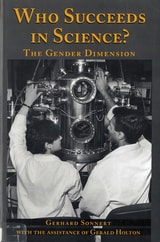
Who Succeeds in Science?
The Gender DilemmaGerald Holton and Gerhard Sonnert
Rutgers University Press, 1995
Why don’t more women become scientists? And why do those who do become scientists often face more difficulties than their male counterparts? Every year, about a quarter of a million young men and women in the United States receive their first academic degree in science, mathematics, or engineering. A small fraction will eventually become research scientists. But many who start out with that goal fail to reach it––for reasons that may have less to do with their scientific ability than with their gender.
Drawing on a wealth of information (699 questionnaires and 200 interviews) from men and women who gave every promise of scientific achievement, Gerhard Sonnert and Gerald Holton illuminate the partly gender-driven dynamics of “the leaky scientific pipeline.” At the heart of this book are gripping personal life stories of ten women and ten men: half became highly successful scientists, the rest left research science. In their own voices, they talk candidly about their career paths, the obstacles and assists they encountered, the difficulties and rewards of attempting to combine a family life with a science career.
This highly readable analysis of the gender dimension in scientific careers––and its clear-headed advice––will be of great interest to everyone considering a career in science as well as to teachers, parents, and active scientists. Academics in sociology of science and gender studies as well as decision-makers in the areas of human resources and science policy will also welcome its discussions of general issues and policy recommendations.