Results by title
13 books match the query 'Home ownership'
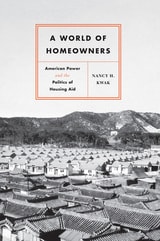
A World of Homeowners
American Power and the Politics of Housing AidNancy H. Kwak
University of Chicago Press, 2015
A World of Homeowners charts the emergence of democratic homeownership in the postwar landscape and booming economy; its evolution as a tool of foreign policy and a vehicle for international investment in the 1950s, ’60s, and ’70s; and the growth of lower-income homeownership programs in the United States from the 1960s to today. Kwak unravels all these threads, detailing the complex stories and policy struggles that emerged from a particularly American vision for global democracy and capitalism. Ultimately, she argues, the question of who should own homes where—and how—is intertwined with the most difficult questions about economy, government, and society.
Architectures of Hope
Infrastructural Citizenship and Class Mobility in Brazil's Public HousingMoisés Kopper
University of Michigan Press, 2022
Architectures of Hope examines how communal idealism, electoral politics, and low-income consumer markets made first-time homeownership a reality for millions of low-income Brazilians over the last ten years.
Drawing on a five-year-long ethnography among city planners, architects, street-level bureaucrats, politicians, market and bank representatives, community leaders, and past, present, and future beneficiaries, Moisés Kopper tells the story of how a group of grassroots housing activists rose from oblivion to build a model community. He explores the strategies set forth by housing activists as they waited and hoped for—and eventually secured—homeownership through Minha Casa Minha Vida’s public-private infrastructure. By showing how these efforts coalesced in Porto Alegre—Brazil’s once progressive hotspot—he interrogates the value systems and novel arrangements of power and market that underlie the country’s post-neoliberal project of modern and inclusive development.
By chronicling the making and remaking of material hope in the aftermath of Minha Casa Minha Vida, Architectures of Hope reopens the future as a powerful venue for ethnographic inquiry and urban development.
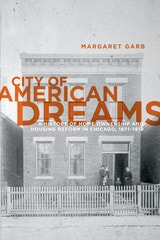
City of American Dreams
A History of Home Ownership and Housing Reform in Chicago, 1871-1919Margaret Garb
University of Chicago Press, 2005
Based on research of real estate markets, housing and health reform, and ordinary homeowners—African American and white, affluent and working class—City of American Dreams provides a richly detailed picture of life in one of America's great urban centers. Garb shows that the pursuit of a single-family house set on a tidy yard, commonly seen as the very essence of the American dream, resulted from clashes of interests and decades of struggle.
From Bureaucracy to Bullets
Extreme Domicide and the Right to HomeBree Akesson
Rutgers University Press, 2022
Homeowners and Neighborhood Reinvestment
George C. Galster
Duke University Press, 1987
Multivariate statistical analyses of models were conducted using household data from Minneapolis and Wooster, Ohio. Three important findings emerged. First, homeowners' sense of solidarity with their neighbors is as significant in determining their efforts at home upkeep as are their income or age. Second, the optimism of homeowners toward increases in property values results in behavior opposite to that produced by optimism about neighborhood quality of life. This implies that different kinds of predictable gaming behavior occur among homeowners, depending on the neighborhoods in which they live. Third, both short-term and extremely long-term plans to move prove damaging to home upkeep.
The results of this study form the basis for a better understanding of such residential phenomena as class succession, racial transition, and gentrification. Galster's findings will also be valuable for analyzing policies that attempt to encourage neighborhood reinvestment.
In Search of a Home
Rental and Shared Housing in Latin AmericaAlan Gilbert
University of Arizona Press, 1993
Just Below the Line
Disability, Housing, and Equity in the SouthKorydon H. Smith
University of Arkansas Press, 2010
Published in collaboration with the Fay Jones School of Architecture.
Natural Attachments
The Domestication of American Environmentalism, 1920–1970Pollyanna Rhee
University of Chicago Press, 2025
A massive oil spill in the Pacific Ocean near Santa Barbara, California, in 1969 quickly became a landmark in the history of American environmentalism, helping to inspire the creation of both the Environmental Protection Agency and Earth Day. But what role did the history of Santa Barbara itself play in this? As Pollyanna Rhee shows, the city’s past and demographics were essential to the portrayal of the oil spill as momentous. Moreover, well-off and influential Santa Barbarans were positioned to “domesticate” the larger environmental movement by embodying the argument that individual homes and families—not society as a whole—needed protection from environmental abuses. This soon would put environmental rhetoric and power to fundamentally conservative—not radical—ends.
Ours to Lose
When Squatters Became Homeowners in New York CityAmy Starecheski
University of Chicago Press, 2016
Those decades of strife, however, also gave the Lower East Side something unusual: a radical movement that blended urban homesteading and European-style squatting in a way never before seen in the United States. Ours to Lose tells the oral history of that movement through a close look at a diverse group of Lower East Side squatters who occupied abandoned city-owned buildings in the 1980s, fought to keep them for decades, and eventually began a long, complicated process to turn their illegal occupancy into legal cooperative ownership. Amy Starecheski here not only tells a little-known New York story, she also shows how property shapes our sense of ourselves as social beings and explores the ethics of homeownership and debt in post-recession America.
Racial Democracy and the Black Metropolis
Housing Policy in Postwar ChicagoPreston H. Smith II
University of Minnesota Press, 2012
“The African American community.” “The black position.” In accounts of black politics after the Second World War, these phrases reflect how the African American perspective generally appeared consistent, coherent, and unified. In Racial Democracy and the Black Metropolis, Preston H. Smith II examines housing debates in Chicago that go beyond black and white politics, and he shows how class and factional conflicts among African Americans actually helped to reproduce stunning segregation along economic lines.
Class and factional conflicts were normal in the rough-and-tumble world of land use politics. They are, however, often not visible in accounts of the postwar fight against segregation. Smith outlines the ideological framework that black civic leaders in Chicago used to formulate housing policy, both within and outside the black community, to reveal a surprising picture of leaders who singled out racial segregation as the source of African Americans’ inadequate housing rather than attacking class inequalities. What are generally presented as black positions on housing policy in Chicago, Smith makes clear, belonged to the black elite and did not necessarily reflect black working-class participation or interests.
This book details how black civic leaders fought racial discrimination in ways that promoted—or at least did not sacrifice—their class interests in housing and real estate struggles. And, as Smith demonstrates, their accommodation of the real estate practices and government policy of the time has had a lasting effect: it contributed to a legacy of class segregation in the housing market in Chicago and major metropolitan areas across the country that is still felt today.
The Homeowner Ideology
Economic (F)Utility of Real Property Rights in Four African CitiesSingumbe Muyeba
University of Michigan Press, 2025
The Last House on the Block
Black Homeowners, White Homesteaders, and Failed Gentrification in DetroitSharon Cornelissen
University of Chicago Press, 2025
In the minds of many, Detroit is undergoing a renaissance thanks to gentrifying urbanites who’ve been drawn to the city with the promise of cheap housing and thriving culture. But what happens when gentrification attempts to come to one of the most depopulated neighborhoods in the country—a place where every other property in the neighborhood was a vacant lot and every third house stood empty? To find out, Sharon Cornelissen moved to the Brightmoor neighborhood of Detroit for three years and became the owner of a $7,000 house.
The Last House on the Block takes us to Brightmoor to meet Cornelissen’s fellow residents. She introduces us to the long-time residents of the neighborhood who reveal their struggles to keep a home while keeping violence, tall grass, and yes—gentrification—at bay. We also meet the eclectic white newcomers of Brightmoor and learn about their real estate bargains, urban farms, and how they became the unlikely defenders of urban desolation. Where oldtimers take pride in neatly mowed lawns and hope for a return to residential density, newcomers love the open space and aim to buy more empty lots to raise chickens and goats. It is a story of gentrification, but not at all in the usual sense: it is a case of failed gentrification. We often think about gentrification as an unstoppable force—once the first white newcomers with yoga mats enter an often brown or Black community, the coffee shops and restaurants follow. But in Brightmoor, the dreams of white newcomers met the harsh reality of decade-long decline. Nearly a decade after Cornelissen’s fieldwork began, Brightmoor is even emptier than it was when she started.
Today, depopulation remains more common than gentrification in poor communities. Cornelissen’s story offers deep insights into what it is like to live in a declining neighborhood, and through the example of Brightmoor, Cornelissen reveals why depopulation continues and helps us imagine a more inclusive and equitable city turnaround.
Well Worth Saving
How the New Deal Safeguarded Home OwnershipPrice Fishback, Jonathan Rose, and Kenneth Snowden
University of Chicago Press, 2013
Well Worth Saving tells the story of the disastrous housing market during the Great Depression and the extent to which an immensely popular New Deal relief program, the Home Owners’ Loan Corporation (HOLC), was able to stem foreclosures by buying distressed mortgages from lenders and refinancing them. Drawing on historical records and modern statistical tools, Price Fishback, Jonathan Rose, and Kenneth Snowden investigate important unanswered questions to provide an unparalleled view of the mortgage loan industry throughout the 1920s and early ’30s. Combining this with the stories of those involved, the book offers a clear understanding of the HOLC within the context of the housing market in which it operated, including an examination of how the incentives and behaviors at play throughout the crisis influenced the effectiveness of policy.
More than eighty years after the start of the Great Depression, when politicians have called for similar programs to quell the current mortgage crisis, this accessible account of the Home Owners’ Loan Corporation holds invaluable lessons for our own time.