Results by title
6 books match the query 'Homeless women'
A Roof Over My Head
Homeless Women and the Shelter IndustryJean Calterone Williams
University Press of Colorado, 2003
The author draws upon interviews with homeless women, interviews with housed people, and, finally, evaluations of shelter services, philosophies, and policies to get at the causes and social construction of homelessness. A Roof Over My Head is a ground-breaking study that unveils the centrality of abuse and poverty in homeless women's lives and outlines ways in which societal responses can and should be more effective.

Five Days of Bleeding
Ricardo Cortez Cruz
University of Alabama Press, 1995
Taunted by the violent character "Chops," Zu-Zu sings to keep her spirit alive in New York City's Central Park. Zu-Zu and the novel's narrator have a relationship which is transformed into a stormy, dreamlike urban affair. Their oppressive situation is depicted through multiple collages of sound and image, a funky mix of original and sampled cuts, both literary and musical.
The social chaos around them is remixed in a text consisting of street beats, classic breaks, and fresh-cool cadences. Bleeding proves that the loudest noises of moral panic can be gunshots, to be sure, but they can also be the very human sound of the music of hope and despair.
Homeless Mothers
Face to Face with Women and PovertyDeborah R. Connolly
University of Minnesota Press, 2001
Love, Sorrow, And Rage
Alisse Waterston
Temple University Press, 1999
From drug addiction and the spread of AIDS to the growing gap between rich and poor in the U.S., the topics in this book get front-page coverage in daily newspapers across the country. Waterston seeks to understand, to explain, and to solve the human crisis that surrounds us. Towards this end, she challenges us to look at the ways in which our society and the workings of our political, economic, and popular culture contribute to the suffering experienced by our most vulnerable citizens. An important corrective to popular depictions of the urban poor, Love, Sorrow, and Rage provides a penetrating analysis of the causes and consequences of poverty. It offers a deeper understanding of what leads to and perpetuates poverty and of the human complex of love, sorrow, and rage felt by those who experience it.
Love, Sorrow, and Rage will engage readers interested in urban studies, women's studies, social issues and policies, anthropology, sociology, political economy, and New York City life.
Magdalene House
A Place about MercySarah VanHooser Suiter
Vanderbilt University Press, 2012
However, the story of the Magdalene community is not about these statistics, but about the stories the women tell. They say they thrive in the community because it is a place where they are free to be themselves, safe to give and receive love, and free to speak their trutheven to complain sometimes about how their storytelling is exploited "for the good of the community." A Place about Mercy is a participantobservation account of the history of this remarkable community founded in 1997, its structure, its Thistle Farms beauty products operation, and Reverend Becca Stevens's communal and spiritual vision. The book is finally about what it means to walk the path of healing with a group of unlikely women as guide.
Magdalene House was the subject of a multiplepart documentary on National Public Radio.
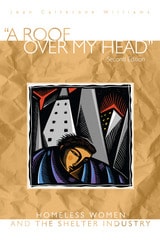
Roof Over My Head, Second Edition
Homeless Women and the Shelter IndustryJean Calterone Williams
University Press of Colorado, 2016
Based upon extensive ethnographic data, “A Roof Over My Head” examines the lives of homeless women who cope with domestic violence, low-income housing shortages, and poverty. The author draws upon interviews with homeless women, interviews with housed people, and, finally, evaluations of shelter services, philosophies, and policies to get at the causes and social constructions of homelessness. “A Roof Over My Head” is a groundbreaking study that unveils the centrality of abuse and poverty in homeless women’s lives and outlines ways in which societal responses can and should be more effective.
The second edition explores recent attempts to integrate homeless and battered women’s shelters and recent research on domestic violence as a cause of homelessness. It contains a new introduction that analyzes the most recent homeless policy developments and paints a picture of the homeless population today. With updated statistics and policy information throughout, the second edition of “A Roof Over My Head” illustrates why ending homelessness in the United States continues to present a thorny and complex challenge.