Results by title
8 books match the query 'Homosexuality and motion pictures'
Incongruous Entertainment
Camp, Cultural Value, and the MGM MusicalSteven Cohan
Duke University Press, 2005
In addition to examining the spectatorship of the mgm musical, Cohan investigates the genre’s production and marketing, paying particular attention to the studio’s employment of a largely gay workforce of artists and craftspeople. He reflects on the role of the female stars—including Judy Garland, Debbie Reynolds, Esther Williams, and Lena Horne—and he explores the complex relationship between Gene Kelley’s dancing and his masculine persona. Cohan looks at how, in the decades since the 1950s, the marketing and reception of the mgm musical have negotiated the more publicly recognized camp value attached to the films. He considers the status of Singin’ in the Rain as perhaps the first film to be widely embraced as camp; the repackaging of the musicals as nostalgia and camp in the That’s Entertainment! series as well as on home video and cable; and the debates about Garland’s legendary gay appeal among her fans on the Internet. By establishing camp as central to the genre, Incongruous Entertainment provides a new way of looking at the musical.
Manly Arts
Masculinity and Nation in Early American CinemaDavid A. Gerstner
Duke University Press, 2006
Gerstner provides in-depth readings of several early American films, illuminating their connections to a wide range of artistic traditions and cultural developments, including dance, poetry, cubism, realism, romanticism, and urbanization. He shows how J. Stuart Blackton and Theodore Roosevelt developed The Battle Cry of Peace (1915) to disclose cinema’s nationalist possibilities during the era of the new twentieth-century urban frontier; how Paul Strand and Charles Sheeler positioned a national avant-garde through the fusion of “American Cubism” and industrialization in their film, Manhatta (1921); and how Oscar Micheaux drew on slave narratives and other African American artistic traditions as he grappled with the ideological terms of African American and white American manhood in his movie Within Our Gates (1920). Turning to Vincente Minnelli’s Cabin in the Sky (1943), Gerstner points to the emergence of an aesthetic of cultural excess that brought together white and African American cultural producers—many of them queer—and troubled the equation of national arts with masculinity.
Out Takes
Essays on Queer Theory and FilmEllis Hanson, ed.
Duke University Press, 1999
The essays examine a wide array of films, including Calamity Jane, Rear Window, The Hunger, Heavenly Creatures, and Bound , and discuss such figures as Doris Day, Elizabeth Taylor, and Alfred Hitchcock. Divided into three sections, the first part reconsiders the construction of masculinity and male homoerotic desire—especially with respect to the role of women—in classic cinema of the 1940s and 1950s. The second section offers a deconstructive consideration of lesbian film spectatorship and lesbian representation. Part three looks at the historical trajectory of independent queer cinema, including works by H.D., Kenneth Anger, and Derek Jarman.
By exploring new approaches to the study of sexuality in film, Out Takes will be useful to scholars in gay and lesbian studies, queer theory, and cinema studies.
Contributors. Bonnie Burns, Steven Cohan, Alexander Doty, Lee Edelman, Michelle Elleray, Jim Ellis, Ellis Hanson, D. A. Miller, Eric Savoy, Matthew Tinkcom, Amy Villarejo, Jean Walton
Queer African Cinemas
Lindsey B. Green-Simms
Duke University Press, 2022
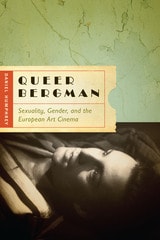
Queer Bergman
Sexuality, Gender, and the European Art CinemaBy Daniel Humphrey
University of Texas Press, 2013
One of the twentieth century’s most important filmmakers—indeed one of its most important and influential artists—Ingmar Bergman and his films have been examined from almost every possible perspective, including their remarkable portrayals of women and their searing dramatizations of gender dynamics. Curiously however, especially considering the Swedish filmmaker’s numerous and intriguing comments on the subject, no study has focused on the undeniably queer characteristics present throughout this nominally straight auteur’s body of work; indeed, they have barely been noted.
Queer Bergman makes a bold and convincing argument that Ingmar Bergman’s work can best be thought of as profoundly queer in nature. Using persuasive historical evidence, including Bergman’s own on-the-record (though stubbornly ignored) remarks alluding to his own homosexual identifications, as well as the discourse of queer theory, Daniel Humphrey brings into focus the director’s radical denunciation of heteronormative values, his savage and darkly humorous deconstructions of gender roles, and his work’s trenchant, if also deeply conflicted, attacks on homophobically constructed forms of patriarchic authority. Adding an important chapter to the current discourse on GLBT/queer historiography, Humphrey also explores the unaddressed historical connections between post–World War II American queer culture and a concurrently vibrant European art cinema, proving that particular interrelationship to be as profound as the better documented associations between gay men and Hollywood musicals, queer spectators and the horror film, lesbians and gothic fiction, and others.
Queer Cinema in the World
Karl Schoonover and Rosalind Galt
Duke University Press, 2016
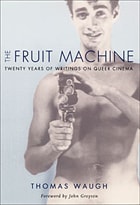
The Fruit Machine
Twenty Years of Writings on Queer CinemaThomas Waugh
Duke University Press, 2000
In this wide-ranging anthology Waugh touches on some of the great films of the gay canon, from Taxi zum Klo to Kiss of the Spider Woman. He also discusses obscure guilty pleasures like Born a Man . . . Let Me Die a Woman, unexpectedly rich movies like Porky’s and Caligula, filmmakers such as Fassbinder and Eisenstein, and film personalities from Montgomery Clift to Patty Duke. Emerging from the gay liberation movement of the 1970s, Waugh traverses crises from censorship to AIDS, tackling mainstream potboilers along with art movies, documentaries, and avant-garde erotic videos. In these personal perspectives on the evolving cinematic landscape, his words oscillate from anger and passion to wry wit and irony. With fifty-nine rare film stills and personal photographs and an introduction by celebrated gay filmmaker John Greyson, this volume demonstrates that the movie camera has been the fruit machine par excellence.
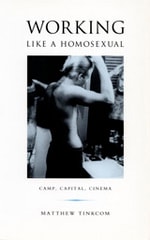
Working Like a Homosexual
Camp, Capital, CinemaMatthew Tinkcom
Duke University Press, 2002
With a special emphasis on the tensions between high and low forms of culture and between good and bad taste, Matthew Tinkcom offers a new vision of queer politics and aesthetics that is critically engaged with Marxist theories of capitalist production. He argues that camp—while embracing the cheap, the scorned, the gaudy, the tasteless, and what Warhol called “the leftovers” of artistic production—is a mode of intellectual production and a critical philosophy of modernity as much as it is an expression of a dissident sex/gender difference. From Minnelli’s musicals and the “everyday glamour” of Warhol’s films to Anger’s experimental films and Waters’s “trash aesthetic,” Tinkcom demonstrates how camp allowed these gay men to design their own relationship to labor and to history in a way that protected them from censure even as they struggled to forge a role for themselves within a system of “value” that failed to recognize them.