Results by title
72 books match the query 'Honor' and 6 start with a

A Clubbable Man
Essays on Eighteenth-Century Literature and Culture in Honor of Greg ClinghamAnthony W. Lee
Bucknell University Press, 2022
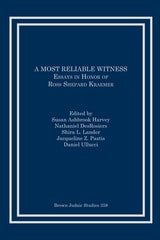
A Most Reliable Witness
Essays in Honor of Ross Shepard KraemerSusan Ashbrook Harvey
SBL Press, 2015
Celebrate a trailblazer in the areas of women and re
Celebrate a trailblazer in the areas of women and religion, Jews and Judaism, and earliest Christianity in the ancient Mediterranean
Ross Kraemer is Professor Emerita in the Department of Religious Studies at Brown University. This volume of essays, conceived and produced by students, colleagues, and friends bears witness to the breadth of her own scholarly interests. Contributors include Theodore A. Bergren, Debra Bucher, Lynn Cohick, Mary Rose D’Angelo, Nathaniel P. DesRosiers, Robert Doran, Jennifer Eyl, Paula Fredriksen, John G. Gager, Maxine Grossman, Kim Haines-Eitzen, Susan Ashbrook Harvey, Jordan Kraemer, Robert A. Kraft, Shira L. Lander, Amy-Jill Levine, Susan Marks, E. Ann Matter, Renee Levine Melammed, Susan Niditch, Elaine Pagels, Adele Reinhartz, Jordan Rosenblum, Sarah Schwarz, Karen B. Stern, Stanley K. Stowers, Daniel Ullucci, Arthur Urbano, Heidi Wendt, and Benjamin G. Wright.Features:
- Articles that examine both ancient and modern texts in cross-cultural and trans-historical perspective
- Twenty-eight original essays on ancient Judaism, Christianity, and women in the Greco-Roman world

After The Grapes Of Wrath
Essays On John Steinbeck In Honor of Tetsumaro HayashiDonald V. Coers
Ohio University Press, 1994
Traditionally, the critical reputation of Nobel Prize-winning American novelist John Steinbeck (1902-1968) has rested on his achievements of the 1930s, especially In Dubious Battle (1936), Of Mice and Men (19370, The Long Valley (1938), and, of course, The Grapes of Wrath (1939), one of the most powerful – and arguable on of the greatest – American novels of this century.
Book reviewers and academic critics often turned antagonistic toward Steinbeck when he no longer produced work with the sweeping reach and social consciousness of The Grapes of Wrath. He was accused of selling out, or co-opting his talent, when in fact the inordinate public success of Grapes and especially its attendant notoriety had caused a backlash for Steinbeck. As a result he became self-conscious about his own ability, and suspicious of that “clumsy vehicle,” the novel. The very act of researching and writing Grapes, which occupied him fully for several years and which he had already conceived as his final book on proletarian themes, changed him drastically.
No longer willing to be the chronicler of Depression-era subjects, Steinbeck went afield to find new roots, new sources, new forms. For example, in the six years following the publication of Grapes, Steinbeck completed a suit of love poems; a full-length novel (bastardized by Alfred Hitchcock in his 1943 film, Lifeboat); a nonfiction scientific book, Sea of Cortez: A Leisurely Journal of Travel and Research (with Edward F. Ricketts); a documentary film, The Forgotten Village; a documentary book to help the war effort, Bombs Away: The Story of a Bomber Team; a series of articles he wrote as a war correspondent for the New York Herald Tribune (later collected as Once There Was a War); and two novels, The Moon Is Down and Cannery Row.
Steinbeck came to define himself less as a novelist and more as a man of letters, a restless experimenter with form and subject matter, and a prophetic postmodernist whose key subject for the rest of his career was the dilemma of individual choice and ethical consciousness. Thus, Steinbeck’s later fiction, from The Moon Is Down (1942) through The Winter of Our Discontent (1962), and his later nonfiction, from Sea of Cortez (1941) through Travels with Charley (1962) and America and Americans (1966), often shows a different set of stylistic, thematic, and philosophical bearings from his earlier work and underscores his dramatic shift toward “individual thinking.” A full appreciation of Steinbeck’s mid-career metamorphosis and, consequently, of his later achievement requires a corresponding shift in critical approach – a departure from the traditional New Critical norms. Instead of marginalizing these works, all the contributors to this volume agree that Steinbeck’s later publications merit – indeed, demand – closer scrutiny.
Written especially for this collection in honor of Professor Tetsumaro Hayashi, the distinguished founder and editor-in-chief of the Steinbeck Quarterly, on his retirement from Ball State University and his move to Kwassui Women’s College in Nagasaki, Japan, these essays explore new ways of addressing Steinbeck’s later work and career, and include forays into subjects as diverse as ethnicity and music. They range from treatment of his post-structuralist use of language in Sea of Cortez and his involvement as a speech writer for Franklin Delano Roosevelt’s reelection bid in 1944 to the influence of Charles Darwin’s theories of sexual selection in The Wayward Bus, his revision of the myth of Cain in The Winter of Our Discontent, and his employment of Arthurian quest values in his last book, America and Americans.
For this group of critics – which includes respected veteran Steinbeck scholars Robert DeMott, John Ditsky, Mimi Gladstein, Cliff Lewis, Robert Morsberger, Susan Shillinglaw, and Roy Simmonds, as well as talented new voices Debra Barker, Kevin Hearle, Michael Meyer, Brian Railsback, Eiko Shiraga, and Geralyn Strecker – The Moon is Down and The Wayward Bus loom as significant works in the post 1930s re-evaluation (two essays each appear on these works). The book also includes Donald Coers’s interview with the writer’s widow, Elaine Steinbeck, the first of its kind ever published. After The Grapes of Wrath opens with eminent Americanist Warren French’s appreciation of Professor Hayashi’s distinguished career and his influence in Steinbeck studies; a bibliography of Hayashi’s major publication concludes this honorary gathering.

Archival Values
Essays in Honor of Mark A. GreeneChristine Weideman
Society of American Archivists, 2019

Archival Values
Essays in Honor of Mark A. GreeneChristine Weideman
American Library Association, 2019
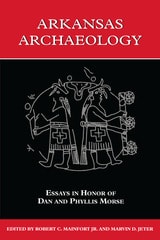
Arkansas Archaeology
Essays in Honor of Dan and Phyllis MorseRobert C. Mainfort
University of Arkansas Press, 1999