Results by title
6 books match the query 'Hope in literature'
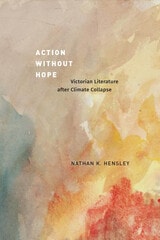
Action without Hope
Victorian Literature after Climate CollapseNathan K. Hensley
University of Chicago Press, 2025
What does it feel like to live helplessly in a world that is coming undone? Nathan Hensley turns to Victorian literature to uncover a prehistory of this deeply contemporary sense of powerlessness. For many in nineteenth-century Britain, their world seemed so scarred by human rapacity that restoring it seemed beyond the powers of any one individual. Like George Eliot’s characters in Middlemarch or the doomed lovers of Wuthering Heights, observers of the gathering carbon economy felt themselves ensnared by interlocked and broken systems. In the face of damage so vast and apparently irreversible, what could possibly be done?
To answer this question, Hensley shows that nineteenth-century writers and artists devised new ways to understand action—and hope. They rescaled action away from the grandly heroic and toward minor adjustments and collaborative interventions. They turned away from logical proofs and direct argumentation and instead called on aesthetic technologies like sonnets and fractured lyrics, watercolor sketches, and vast, multiplot novels, finding scope for action not at the level of the theme or the thesis but in gestures and details. Ranging from J. M. W. Turner’s painterly technique to Emily Brontë’s dreamlike fragments (and reading along the way works by Alfred, Lord Tennyson, H. G. Wells, Lewis Carroll, Gerard Manley Hopkins, William Berryman, Charlotte Brontë, George Eliot, and Christina Rossetti), Hensley’s study makes an important contribution to Victorian studies and the environmental humanities.
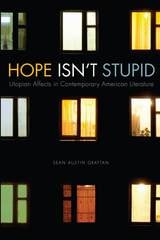
Hope Isn't Stupid
Utopian Affects in Contemporary American LiteratureSean Austin Grattan
University of Iowa Press, 2017
Novelists William S. Burroughs, Dennis Cooper, John Darnielle, Toni Morrison, Thomas Pynchon, and Colson Whitehead are deeply invested in the creation of utopian possibilities. A return to reading the utopian wager in literature from the postmodern to the contemporary period reinvigorates critical forms that imagine reading as an act of communication, friendship, solace, and succor. These forms also model richer modes of belonging than the diluted and impoverished ones on display in the neoliberal present. Simultaneously, by linking utopian studies and affect studies, Grattan’s work resists the tendency for affect studies to codify around the negative, instead reorienting the field around the messy, rich, vibrant, and ambivalent affective possibilities of the world. Hope Isn’t Stupid insists on the centrality of utopia not only in American literature, but in American life as well.
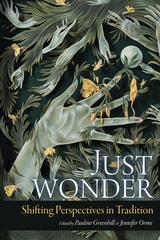
Just Wonder
Shifting Perspectives in TraditionPauline Greenhill
Utah State University Press, 2024
These essays examine fairy tales and other traditional forms of the fantastic and the real to offer alternative expressions of justice relevant to gender, sex, sexuality, environment, Indigeneity, class, ability, race, decolonizing, and human and nonhuman relations. By analyzing fairy tales and wonder texts from various media through an intersectional feminist lens, Pauline Greenhill and Jennifer Orme consider how wonder genres and forms blend with diverse conceptions of seeking and enacting justice. International collaborators—both established and emerging scholars who self-identify with different subjectivities, locations, and generations and come from an impressive range of inter/disciplines—engage with contemporary and historical texts from various languages and cultural contexts, including interventions, counterparts, and comparisons to the fairy tale. Just Wonder offers a critical look at how creative wondering can expand the ability to resist modes of oppression while fostering equity, as well as encourage curiosity and imagination.
In a world that can be overwhelming and precarious, this book presents scholarly, artistic, personal, and collective-action interventions to identify and respond to injustice while centering wonder and, thus, imagination, questioning, and hope. Just Wonder will appeal to fairy-tale scholars; folklorists; students and scholars of film, media studies, and cultural studies; as well as a general audience.
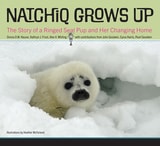
Natchiq Grows Up
The Story of an Alaska Ringed Seal Pup and Her Changing HomeDonna D.W. Hauser
University of Alaska Press, 2023
Beginning in the 1980s, scientists started traveling to northwest Alaska to research the lives of ringed seals, bringing Labrador retrievers who could sniff out seals and their snow cave homes (called lairs) on the sea ice. Decades later, scientists partnered with the Iñupiaq people of
Qikiktaġruk (Kotzebue) to learn more about ringed seals. They relied on a combination of Indigenous Knowledge and scientific techniques to capture and apply tags to understand the movements and behavior of ringed seals.
But the Arctic homes of ringed seals are changing, and the long history of ringed seal science in the Kotzebue Sound proved to be just the beginning of long and cooperative relationships melding science and Indigenous knowledge. During 2018 and 2019, with unprecedented sea ice conditions, Qikiktagrumiut Elders and scientists returned to the ice to measure changes in the habitat available for ringed seal pups in the region.

Scepticism and Hope in Twentieth Century Fantasy Literature
Kath Filmer
University of Wisconsin Press, 1992
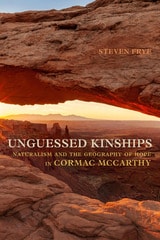
Unguessed Kinships
Naturalism and the Geography of Hope in Cormac McCarthySteven Frye
University of Alabama Press, 2023
Literary naturalism at play in one of America’s most visionary novelists: Cormac McCarthy
It took six novels and nearly thirty years for Cormac McCarthy to find commercial success with the National Book Award–winning All the Pretty Horses, followed by major prizes, more best sellers, and Hollywood adaptations of his work. Those successes, though, have obscured McCarthy’s commitment to an older form of literary expression: naturalism.
It is hardly a secret that McCarthy’s work tends to darker themes: violence, brutality, the cruel indifference of nature, themes which would not be out of place in the writing of Jack London or Stephen Crane. But literary naturalism is more than the oversimplified Darwinism that many think of. Nature may be red in tooth and claw, and humans are part of nature, but the humanity depicted in naturalist literature is capable of love, selflessness, and spirituality, as well.
In Unguessed Kinships, Steven Frye illuminates all these dimensions of McCarthy’s work. In his novels and plays, McCarthy engages both explicitly and obliquely with the project of manifest destiny, in the western drama Blood Meridian, the Tennessee Valley Authority-era Tennessee novels, and the atomic frontier of Alamogordo in Cities of the Plain. McCarthy’s concerns are deeply religious and philosophical, drawing on ancient Greek philosophy, Gnosticism, and Nietzsche, among other sources. Frye argues for McCarthy not merely as a naturalist writer but as a naturalist in the most expansive sense. Unguessed Kinships includes biographical and historical context in each chapter, widening the appeal of the text to not just naturalists or McCarthy scholars but anyone studying the literature of the South or the West.