Results by title
3 books match the query 'Hopkins, Pauline E. (Pauline Elizabeth)'
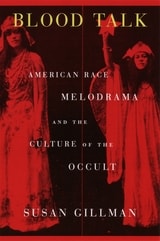
Blood Talk
American Race Melodrama and the Culture of the OccultSusan Gillman
University of Chicago Press, 2003
Blood Talk shows how race melodrama emerged from abolitionist works such as Uncle Tom's Cabin and surprisingly manifested itself in a set of more aesthetically and politically varied works, such as historical romances, sentimental novels, the travel literature of Mark Twain, the regional fiction of Kate Chopin and George Washington Cable, and the work of W. E. B. Du Bois. Gillman then uses the race melodrama to show how racial discourses in the United States have been entangled with occultist phenomena, from the rituals of the Ku Klux Klan and the concept of messianic second-sight to the production of conspiracy theories and studies of dreams and trances.
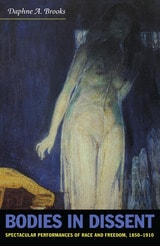
Bodies in Dissent
Spectacular Performances of Race and Freedom, 1850–1910Daphne A. Brooks
Duke University Press, 2006
Brooks pieces together reviews, letters, playbills, fiction, and biography in order to reconstruct not only the contexts of African American performance but also the reception of the stagings of “bodily insurgency” which she examines. Throughout the book, she juxtaposes unlikely texts and entertainers in order to illuminate the complicated transatlantic cultural landscape in which black performers intervened. She places Adah Isaacs Menken, a star of spectacular theatre, next to Sojourner Truth, showing how both used similar strategies of physical gesture to complicate one-dimensional notions of race and gender. She also considers Henry Box Brown’s public re-enactments of his escape from slavery, the Pan-Africanist discourse of Bert Williams’s and George Walker’s musical In Dahomey (1902–04), and the relationship between gender politics, performance, and New Negro activism in the fiction of the novelist and playwright Pauline Hopkins and the postbellum stage work of the cakewalk dancer and choreographer Aida Overton Walker. Highlighting the integral connections between performance and the construction of racial identities, Brooks provides a nuanced understanding of the vitality, complexity, and influence of black performance in the United States and throughout the black Atlantic.

The Unruly Voice
Rediscovering Pauline Elizabeth HopkinsEdited by John Cullen Gruesser
University of Illinois Press, 1996
The work and times of the Black writer, editor, and intellectual
John Cullen Gruesser edits essays that explore the literary and journalistic career of Pauline Elizabeth Hopkins. A Black woman writer at the turn of the twentieth century, Hopkins worked as the unacknowledged editor-in-chief of the Colored American Magazine but also wrote short fiction, novels, nonfiction articles, and a play believed to be the first by a Black woman. Versatile and politically committed, she was fired when her strong editorial stands and non-conciliatory politics offended the new owner of Colored American Magazine.
A rare examination of an overlooked figure in Black letters, The Unruly Voice explores Hopkins’s writing and her significance for contemporary readers.
Contributors: Elizabeth Ammons; Kristina Brooks; Lois Lamphere Brown; C. K. Doreski; John Cullen Gruesser; Jennie A. Kassanoff; Kate McCullough; Nelly Y. McKay; and Cynthia D. Schrager