Results by title

6 books match the query 'Horizons'
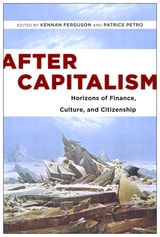
cover of After Capitalism: Horizons of Finance, Culture, and Citizenship

After Capitalism

Horizons of Finance, Culture, and Citizenship

Ferguson, Kennan

Rutgers University Press, 2016
From Thomas Piketty to David Harvey, scholars are increasingly questioning whether we are entering into a post-capitalist era. If so, does this new epoch signal the failure of capitalism and emergence of alternative systems? Or does it mark the ultimate triumph of capitalism as it evolves into an unstoppable entity that takes new forms as it engulfs its opposition? 
 
After Capitalism brings together leading scholars from across the academy to offer competing perspectives on capitalism’s past incarnations, present conditions, and possible futures.  Some contributors reassess classic theorizations of capitalism in light of recent trends, including real estate bubbles, debt relief protests, and the rise of a global creditocracy. Others examine Marx’s writings, unemployment, hoarding, “capitalist realism,” and coyote (trickster) capitalism, among many other topics. Media and design trends locate the key ideologies of the current economic moment, with authors considering everything from the austerity aesthetics of reality TV to the seductive smoothness of liquid crystal. 
 
Even as it draws momentous conclusions about global economic phenomena, After Capitalism also pays close attention to locales as varied as Cuba, India, and Latvia, examining the very different ways that economic conditions have affected the relationship between the state and its citizens. Collectively, these essays raise provocative questions about how we should imagine capitalism in the twenty-first century. Will capitalism, like all economic systems, come to an end, or does there exist in history or elsewhere a hidden world that is already post-capitalist, offering alternative possibilities for thought and action?  
 
[more]
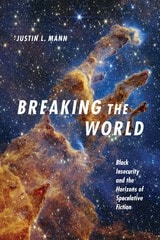
cover of Breaking the World: Black Insecurity and the Horizons of Speculative Fiction

Breaking the World

Black Insecurity and the Horizons of Speculative Fiction

Justin L. Mann

Duke University Press, 2026
In Breaking the World, Justin L. Mann argues that Black speculative fictions are an essential but overlooked archive for understanding the modern security ambitions of the United States. Foregrounding how the contemporary security state renders Black life insecure, Mann theorizes worldbreaking: speculative narrative, aesthetic, and ethical strategies that Black writers, musicians, and artists employ to unmake the processes by which state and parastate agents augment and build up the tools, techniques, and infrastructures intended to make people safer. He shows how the techniques of worldbreaking in the works of Octavia E. Butler, Colson Whitehead, N.K. Jemisin, Janelle Monáe, and the Marvel and DC Cinematic Universes chart the distinction between securitization and Black insecurity. These works illuminate the difference between the antiblackness of state security and the power of Black collectivity. Contending that speculative worldbreaking is a vital part of the Black radical imagination, Mann shows that its destructive strategies can help transform worlds of securitization to worlds of liberation.
[more]
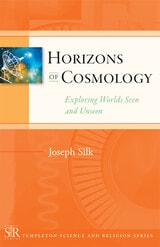
cover of Horizons of Cosmology

Horizons of Cosmology

Joseph Silk

Templeton Press, 2009

Horizons of Cosmology: Exploring Worlds Seen and Unseen is the fourth title published in the Templeton Science and Religion Series, in which scientists from a wide range of fields distill their experience and knowledge into brief tours of their respective specialties. In this volume, highly esteemed astrophysicist Joseph Silk explores the vast mysteries and speculations of the field of cosmology in a way that balances an accessible style for the general reader and enough technical detail for advanced students and professionals. Indeed, while the physical laws and origins of the universe can be endlessly complex, even Einstein once mused that they could be explained simply enough to be grasped by nonspecialists. To that end Silk begins by introducing the basic story of the major discoveries in cosmology over the past century—wherein we learned that we live in an expanding universe populated with galaxies and stars. The middle chapters examine a number of contemporary puzzles such as dark matter and dark energy. The last third of the book looks at the human side of cosmology and moves to the more philosophical frontiers of the field, such as concepts of multiverses and time travel—areas of exploration where some crossover into speculative territory becomes unavoidable. In the past century alone, our understanding of the universe has expanded exponentially, and it will be fascinating to see what discoveries the next hundred years hold. Few books will provide such a thorough understanding of where we have been and what might lie ahead as Horizons of Cosmology.
[more]
cover of Horizons of Enchantment: Essays in the American Imaginary

Horizons of Enchantment

Essays in the American Imaginary

Lene M. Johannessen

Dartmouth College Press, 2011
Horizons of Enchantment is about the peculiar power and exceptional pull of the imaginary in American culture. Johannessen’s subject here is the almost mystical American belief in the promise and potential of the individual, or the reliance on a kind of “modern magic” that can loosely be characterized as a fundamental and unwavering faith in the secular sanctity of the American project of modernity. Among the diverse topics and cultural artifacts she examines are the Norwegian American novel A Saloonkeeper’s Daughter by Drude Krog Janson, Walt Whitman’s Song of Myself, Rodolfo Gonzales’s I Am Joaquín, Richard Ford’s The Sportwriter, Ana Menéndez’s In Cuba I Was a German Shepherd, essays by Samuel Huntington and Richard Rodriquez, and the 2009 film Sugar, about a Dominican baseball player trying to make it in the big leagues. In both her subject matter and perspective, Johannessen reconfigures and enriches questions of the transnational and exceptional in American studies.
[more]
cover of Teaching Writing: Landmarks and Horizons

Teaching Writing

Landmarks and Horizons

Edited by Christina Russell McDonald and Robert L. McDonald. Foreword by Gary Tate. Postscript by Steve North

Southern Illinois University Press, 2002

Teaching Writing: Landmarks and Horizons, edited by Christina Russell McDonald and Robert L. McDonald, is designed to present an overview of some of the major developments in the establishment of composition studies as a field during the past thirty-five years. The essays are theoretically grounded but are focused on pedagogy as well. Divided into two parts, the first presents nine landmark essays, selected and introduced by distinguished composition scholars, and the second brings together eight new essays by emerging scholars.

[more]
cover of Theory from the Trenches: Decolonization and the Horizons of Subaltern Marxism

Theory from the Trenches

Decolonization and the Horizons of Subaltern Marxism

Shozab Raza

Duke University Press, 2027

Decolonization has become a buzzword claimed by liberals and fascists, nonprofits and for-profits alike, and stripped of its liberatory force. In Theory from the Trenches, Shozab Raza recovers a radical vision of decolonization: one driven not by political or intellectual elites but by ordinary, subaltern actors, a vision at once global and local, dedicated as much to dismantling imperialist political economies as it is to transforming the terms of theory itself. Raza offers a striking example of this “trench theory” in his ethnographic study of Marxism in post-independence Pakistan. Drawing on oral histories, archival materials, and fieldwork among surviving organizers, he recounts how Pakistani peasants joined the communist Mazdoor Kisan Party (MKP) in the 1970s and began reading and remaking Marxist theory for their own contexts. Inspired by Maoism, Sufi Islam, Baloch tribal ethics, and more, MKP cadres developed a theory and practice primed for political combat. By examining how peasants became theorists for a global communist movement, Raza buries assumptions about peasant parochialism, upends a long-presumed divide between fieldwork and theory work, and plots the horizons of a revolutionary decolonization.
[more]