Results by title
25 books match the query 'Horses'
A Song for the Horses
Musical Heritage for More-than-Human Futures in MongoliaK. G. Hutchins
University of Arizona Press, 2025
Hutchins’s ethnographic research, spanning more than a decade, provides a vivid and intimate portrayal of Mongolian life. Musicians use the morin khuur, or ‘horse fiddle,’ to engage with the subjectivities and agencies of nonhuman animals and other beings. This work is a significant contribution to the posthuman turn in social sciences, engaging with theories from prominent scholars such as Donna Haraway and Anna Tsing .
As climate change continues to impact communities worldwide, this book offers a unique perspective on how cultural heritage can be mobilized to address environmental challenges, providing valuable lessons for global efforts to build sustainable and resilient futures. At the intersection of music, environment, and posthumanism, A Song for the Horses shows how Mongolian musicians use cultural traditions to imagine and build toward alternative futures beyond climate change and neoliberalism.
Breeds of Empire
The Invention of the Horse in Southeast Asia and Southern Africa 1500-1950Edited by Greg Bankoff and Sandra Swart
National University of Singapore Press, 2007
Came Men on Horses
The Conquistador Expeditions of Francisco Vázquez de Coronado and Don Juan de OñateStan Hoig
University Press of Colorado, 2013
Guided by myths of golden cities and worldly rewards, policy makers, conquistador leaders, and expeditionary aspirants alike came to the new world in the sixteenth century and left it a changed land. Came Men on Horses follows two conquistadors—Francisco Vázquez de Coronado and Don Juan de Oñate—on their journey across the southwest.
Driven by their search for gold and silver, both Coronado and Oñate committed atrocious acts of violence against the Native Americans, and fell out of favor with the Spanish monarchy. Examining the legacy of these two conquistadors Hoig attempts to balance their brutal acts and selfish motivations with the historical significance and personal sacrifice of their expeditions. Rich human details and superb story-telling make Came Men on Horses a captivating narrative scholars and general readers alike will appreciate.
Cavalry of the American Revolution
Jim Piecuch
Westholme Publishing, 2012
Nine Historians and Writers Investigate the Role of Cavalry in the War for Independence
From the bitterly contested no-man’s-land between American and British lines in New York and New Jersey to the scorching pine forests of the South, the cavalry of both armies fought valiantly throughout the American Revolution. This volume explores several aspects of cavalry’s role in the war, which has often been overlooked in general histories. The topics covered include the development of the Continental Army’s cavalry arm, European influences on American cavalry training and tactics, accounts of several important cavalry raids and battles, and histories of mounted units such as the Continental Light Dragoons, American rangers in the South Carolina backcountry, and the British army’s Queen’s Rangers and “Black Dragoons,” the latter force composed entirely of former slaves. The essays also examine the roles of important commanders, including Brigadier General Francis “Swamp Fox” Marion, Lieutenant Colonel William Washington, and Colonel Anthony Walton White of the American army, and British cavalry leaders Banastre “Bloody Ban” Tarleton and John Graves Simcoe, as well as the American prisoners of war who switched sides and served in the “British Legion.” The authors of the essays include acclaimed military historians Gregory J. W. Urwin and Lawrence E. Babits. Readers with a general interest in military history, as well as those with more specific interests in the American Revolution or the history of the cavalry arm, and anyone who wishes to undertake further study of these subjects, will find the essays fresh, engaging, and informative.
@font-face { font-family: "Times New Roman";}@font-face { font-family: "HelveticaNeue-LightCond";}p.MsoNormal, li.MsoNormal, div.MsoNormal { margin: 0in 0in 0.0001pt; font-size: 12pt; font-family: "Times New Roman"; }table.MsoNormalTable { font-size: 10pt; font-family: "Times New Roman"; }div.Section1 { page: Section1; }
Contents
Gregory J. W. Urwin: The Continental Light Dragoons, 1776-1783
Lee F. McGee: European Influences on Continental Cavalry
John M. Hutchins: Cavalry Action at Poundridge, New York
Donald J. Gara: Cavalry Battles in New York and New Jersey
Scott A. Miskimon: Anthony Walton White: A Revolutionary Dragoon
Michael C. Scoggins: South Carolina’s Backcountry Rangers
Lawrence E. Babits and Joshua B. Howard: Continentals in Tarleton’s
British Legion
Charles F. Price: Cavalry Operations at Eutaw Springs
Jim Piecuch: The “Black Dragoons”
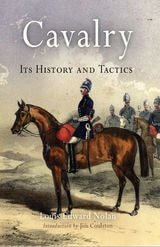
Cavalry
Its History and TacticsLouis Edward Nolan
Westholme Publishing, 2020
A New Edition of One of the Great Military Treatises of the Nineteenth Century
First published in 1853, Cavalry: Its History and Tactics had a major impact on military theorists and officers for decades—it was reprinted as a manual during the American Civil War—and its influence on European cavalry performance can be traced into World War I. It is an intelligent work which discusses the history and development of cavalry over the ages, advocates a program of reform for Britain’s horsed troops, and covers many aspects of equipment, training, drill, organization, formation, and battlefield tactics. The author, an experienced and gifted cavalryman, first served in the Austrian army, then joined the British army’s 15th Hussars in 1839, fought in India, and became the regimental riding master. Captain Nolan’s 1852 tour of European armies, wide reading in many languages, and service in Europe and India makes Cavalry an extraordinary statement on mid-nineteenth-century theory and practice.
As historian Jon Coulston explains in his introduction, Nolan was writing at the cusp of technological change, drawing upon the experiences of the Napoleonic Wars, continental suppression of the 1848 Revolutions, and Britain’s wars in India, but with an eye to firepower developments on the eve of the Crimean War. In 1854, at the Battle of Balaklava, Nolan rode with the written order which unleashed the Charge of the Light Brigade, an action in which he lost his life. Presented here as the first modern reprint, complete with a new introduction and further reading, Nolan’s Cavalry remains a hallmark of military history.
Equestrian Cultures
Horses, Human Society, and the Discourse of ModernityEdited by Kristen Guest and Monica Mattfeld
University of Chicago Press, 2019
Kristen Guest and Monica Mattfeld place the modern period front and center in this collection, illuminating the largely untold story of how the horse has responded to the accelerated pace of modernity. The book’s contributors explore equine cultures across the globe, drawing from numerous interdisciplinary sources to show how horses have unexpectedly influenced such distinctively modern fields as photography, anthropology, and feminist theory. Equestrian Cultures boldly steps forward to redefine our view of the most recent developments in our long history of equine partnership and sets the course for future examinations of this still-strong bond.

Forevering
Carol Mavor
Duke University Press, 2027
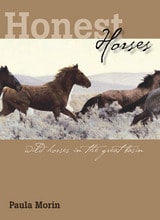
Honest Horses
Wild Horses In The Great BasinPaula Morin
University of Nevada Press, 2006
Horses have been part of the American West since the first Spanish explorers brought their European-bred steeds onto the new continent. Soon thereafter, some of these animals, lost or abandoned by their owners or captured by indigenous peoples, became the foundation of the great herds of mustangs (from the Spanish mesteño, stray) that still roam the West. These feral horses are inextricably intertwined with the culture, economy, and mythology of the West. The current situation of the mustangs as vigorous competitors for the scanty resources of the West’s drought-parched rangelands has put them at the center of passionate controversies about their purpose, place, and future on the open range. Photographer/oral historian Paula Morin has interviewed sixty-two people who know these horses best: ranchers, horse breeders and trainers, Native Americans, veterinarians, wild horse advocates, mustangers, range scientists, cowboy poets, western historians, wildlife experts, animal behaviorists, and agents of the federal Bureau of Land Management. The result is the most comprehensive, impartial examination yet of the history and impact of wild mustangs in the Great Basin. Morin elicits from her interviewees a range of expertise, insight, and candid opinion about the nature of horses, ranching, and the western environment. Honest Horses brings us the voices of authentic westerners, people who live intimately with horses and the land, who share their experiences and love of the mustangs, and who understand how precariously all life exists in Great Basin.
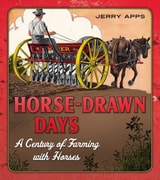
Horse-Drawn Days
A Century of Farming with HorsesJerry Apps
Wisconsin Historical Society Press, 2010
Horsing Around in New Jersey
The Horse Lover's Guide to Everything EquineZatz, Arline
Rutgers University Press, 2004
Arline Zatz has writtenthe first guidebook to everything equine in the Garden State: Horsing Around in New Jersey. This accessible, easy-to-use volume is essential reading for the novice who yearns to go horseback riding but doesn't know how or where to begin; for the experienced equestrian seeking new trails and campsites; for anyone wishing to attend an equestrian event; and for those seeking a job in the equestrian field, which already employs nearly 6,000 New Jerseyans. The industry generates more than 650 million dollars in annual revenue. Millions of people attend equine events in New Jersey each year. The U.S. Equestrian team makes its home there, and New Jersey's state animal is the horse.
Zatz tells readers--including those with disabilities--where they can take lessons, rent a horse, and prepare for riding. She includes safety and first aid tips. Horse history and breeds common to New Jersey are discussed, as are health concerns, including diseases, preventative medicine, and emergency care. The book showcases New Jersey's eighty-five equestrian trails and covers information on where to obtain riding permits and their accompanying rules and regulations. There is advice for both new horse owners and renters, including recommendations on tack and clothing, stable management, and horse adoption.
The book acquaints readers with year-round equine entertainment opportunities, and offers dozens of suggestions on where to watch or participate in sports on horseback. Zatz lists equine education programs for all ages, and outlines numerous employment opportunities within the equine industry. The book concludes with a glossary of common horse industry terminology, a listing of national equine associations and breed registries, equipment sources, and equine publications for further reading.
Like Cattle and Horses
Nationalism and Labor in Shanghai, 1895-1927S. A. Smith
Duke University Press, 2002
While the massive wave of labor protest in the 1920s was principally an expression of militant nationalism rather than of class consciousness, Smith argues, elements of a precarious class identity were in turn forged by the very discourse of nationalism. By linking work-related demands to the defense of the nation, anti-imperialist nationalism legitimized participation in strikes and sensitized workers to the fact that they were worthy of better treatment as Chinese citizens. Smith shows how the workers’ refusal to be treated “like cattle and horses” (a phrase frequently used by workers to describe their condition) came from a new but powerfully felt sense of dignity. In short, nationalism enabled workers to interpret the anger they felt at their unjust treatment in the workplace in political terms and to create a link between their position as workers and their position as members of an oppressed nation. By focusing on the role of the working class, Like Cattle and Horses is one of very few studies that examines nationalism “from below,” acknowledging the powerful agency of nonelite forces in promoting national identity.
Like Cattle and Horses will interest historians of labor, modern China, and nationalism, as well as those engaged in the study of revolutions and revolt.
Precarious Partners
Horses and Their Humans in Nineteenth-Century FranceKari Weil
University of Chicago Press, 2020
Weil traces the evolving partnerships established between French citizens and their horses through this era. She considers the newly designed “races” of workhorses who carried men from the battlefield to the hippodrome, lugged heavy loads through the boulevards, or paraded women riders, amazones, in the parks or circus halls—as well as those unfortunate horses who found their fate on a dinner plate. Moving between literature, painting, natural philosophy, popular cartoons, sports manuals, and tracts of public hygiene, Precarious Partners traces the changing social, political, and emotional relations with these charismatic creatures who straddled conceptions of pet and livestock in nineteenth-century France.
Rhythms of Care
Autistic Embodiment and Empathy in Equine TherapyRoslyn Malcolm
University of Minnesota Press, 2027
A thoughtful exploration of autism, offering a new understanding of social relations through a sensory-perceptual approach
Sensitive and flighty, horses require carefully designed environments to help them feel calm and soothed—precisely the sort of places that are understood to help some autistic youth to flourish. In Rhythms of Care, Roslyn Malcolm changes the conversation around autism, detailing shifting understandings of the condition from neurological misfiring to a whole-body condition of sensory-perceptual difference.
Malcolm chronicles the experiences of several autistic youth and their families at two UK equestrian riding centers, developing new language to elaborate on an advancing sense of autistic embodiment and sociality emerging through equine-assisted therapy. Her inquiry turns away from a focus on autistic brains and toward cultivating ecologies where autistic people's ways of being and embodiments can be accepted and supported.
Tracing the role of sensory and endocrinological knowledge in our formulations of bodies, empathy, and personhood, Rhythms of Care explores more-than-human sociality, multispecies distributions of care, and the anthropology of the body. In our chronically stressful and overstimulating era of late capitalism and inequality, Malcolm envisions a sensory environment for all beings.
Retail e-book files for this title are screen-reader friendly with images accompanied by short alt text and/or extended descriptions.

Riding
Pardis Mahdavi
Duke University Press, 2025
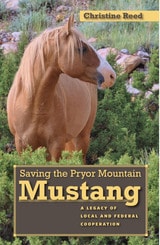
Saving the Pryor Mountain Mustang
A Legacy of Local and Federal CooperationChrstine Reed
University of Nevada Press, 2015
Saving the Pryor Mountain Mustang explores the unique and ongoing relationship between locals and the federal government, highlighting the Lovell citizens’ philosophy of cooperation instead of the typical mistrust that exists between wild horse advocates and federal agencies. The book provides a rich analysis of how a determined group of people saved an endangered wild horse herd. The book will have wide appeal to wild horse activists, scholars of local and federal governance, and western history enthusiasts.
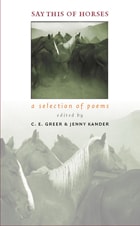
Say This of Horses
A Selection of PoemsC.E. Greer
University of Iowa Press, 2007
Divided into six sections, Say This of Horses considers horses in a multitude of times and places. “Antiquity” explores the forging of the earliest mythical ties between horses and humans. “Here, Now” places horses in the present, where their physical presence is most acutely felt. “Esssence” explores the metaphysical qualities of horses. “Harnessed” contains a selection of poems about horses in war, at work, and in sport and recreation. “Mirrors” shows them as imaginative symbols. Finally, “Lenses” moves into the realm of abstraction and fantasy.
The selections within this far-reaching collection are joyous, moving, erudite, and at times profoundly sad. Poems by Henry Wadsworth Longfellow, W. S. Merwin, Tess Gallagher, Yusef Komunyakaa, Pablo Neruda, Anne Sexton, Wallace Stevens, May Sarton, Jane Kenyon, and James Dickey, among many others, are sure to delight and surprise readers familiar with or just exploring the rich literature on horses.
Contributors include:
Guillaume Apollinaire, Gwendolyn Brooks, Lawrence Ferlinghetti, C.E. Greer, Donald Hall, Joy Harjo, Imru’ al-Qays, Ted Kooser, Philip Larkin, Ann McCarthy de Zavala, Rainer Maria Rilke, Patiann Rogers, William Carlos Williams

Special Needs, Special Horses
A Guide to the Benefits of Therapeutic RidingNaomi Scott
University of North Texas Press, 2005
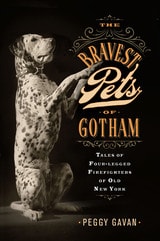
The Bravest Pets of Gotham
Tales of Four-Legged Firefighters of Old New YorkPeggy Gavan
Rutgers University Press, 2024
The Bravest Pets of Gotham takes readers on a fun historical tour of Old New York, sharing touching and comical stories about the bond between FDNY firefighters and their four-legged or feathered friends. The book contains more than one hundred astonishing, emotional, and sometimes hilariously absurd tales of the FDNY animal mascots whose extraordinary intelligence, acts of bravery, and funny antics deserve to be remembered. Some anecdotes depict fire companies that broke the one-pet rule and welcomed a veritable menagerie of animals into their firehouses, including goats, turtles, and even monkeys. Whether you are an animal lover, a history buff, or a fan of firefighting, The Bravest Pets of Gotham is full of stories that will thrill and amuse you.
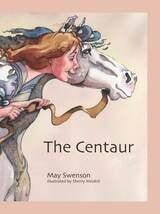
The Centaur
May Swenson
Utah State University Press, 2007
First published in 1956, May Swenson's "The Centaur" remains one of her most popular and most anthologized poems. This is its first appearance as a picture book for children.
In images bright and brisk and nearly tangible, the poet re-creates the joy of riding a stick horse through a small-town summer. We find ourselves, with her, straddling "a long limber horse with . . . a few leaves for a tail," and pounding through the lovely dust along the path by the old canal. As her shape shifts from child to horse and back, we know exactly what she feels.
Sherry Meidell's water-color illustrations perfectly convey the wit and wisdom of May Swenson's poem. These are playful, satisfying images full of vitality and imagination. Meidell handles the joy of poem's fantasy and the joy of its occasional naughtiness with equal success.
Other books by and about May Swenson: Body My House, May Swenson, Dear Elizabeth, May Out West
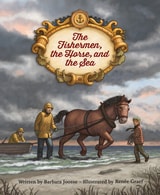
The Fishermen, the Horse, and the Sea
Barbara Joosse
Wisconsin Historical Society Press, 2021
This beautifully illustrated children’s book based on a true story recounts a dramatic rescue on Lake Michigan and introduces young readers to Lester Smith and his family, who founded Port Washington’s long-running and beloved Smith Bros. Fish Shanty. Educational materials including definitions, an illustrated map of Lake Michigan, and short biographies of the story’s featured characters supplement this engaging story for elementary-age readers.
The Horses of the Sahara
By General E. Daumas
University of Texas Press, 1968
The Arabs created one of the world's finest breeds of saddle horses, the Arabian, and they have long possessed an immense store of knowledge regarding the care, training, and breeding of this splendid horse. In the nineteenth century, General Melchior Joseph Eugene Daumas had access to their knowledge even though, as he pointed out, "it requires a great deal of patience and tact for a Christian to obtain from the Mohammedans even the most insignificant of details . . ." General Daumas was, because of his unique relationship with the Arabs, probably the first European to produce a comprehensive study of Arabian horses. And to add even greater value to The Horses of the Sahara, he was able to secure for the ninth edition, here translated, extended commentaries on all aspects of Arabian horsemanship by the Emir Abd-el-Kadar, one of the most important nineteenth-century Arab leaders and certainly one of the foremost authorities on the subject.
The Horses of the Sahara will be of interest not only to equestrians but also to historians and other scholars interested in the customs of the North African desert tribes and in the complex backgrounds of European–North African relations. General Daumas took part in the conquest of Algeria by France, so distinguishing himself that he was named Director of the Bureau of Algerian Affairs in the French Ministry of War. During the campaigns and the occupation that followed, he studied and attempted to understand the native peoples, with an objectivity and sympathy unusual among the colonialists of the period. His book provides fascinating sidelights on many aspects of Arab life, including customs, superstitions, religion, and family life.
Sheila M. Ohlendorf was uniquely suited to translate The Horses of the Sahara. An excellent rider herself, thoroughly experienced with the animals and the techniques being discussed, she also spoke fluent French, having received her B.A. degree in languages from Texas Western University (now the University of Texas at El Paso). As curator of the Hall of the Horsemen, the large collection at the University of Texas at Austin, she had access to a wide variety of supplementary authorities, which enriched both her translation and the notes that accompany the book.
They Sang for Horses
The Impact of the Horse on Navajo and Apache FolkloreLaVerne Harrell Clark
University Press of Colorado, 2001
No Native American groups placed more emphasis on the horse in their lives than did the Navajo and Apache of the Southwest. They Sang for Horses, first published in 1966 and now considered a classic, remains the only comprehensive treatment of the profound mystical influence that the horse has exerted for more than 300 years.
In this completely redesigned and expanded edition, LaVerne Harrell Clark examines how storytellers, singers, medicine men, and painters created the animal's evolving symbolic significance by adapting existing folklore and cultural symbols. Exploring the horse's importance in ceremonies, songs, prayers, customs, and beliefs, she investigates the period of the horse's most pronounced cultural impact on the Navajo and the Apache, starting from the time of its acquisition from the Spanish in the seventeenth century and continuing to the mid-1960s, when the pickup truck began to replace it as the favored means of transportation. In addition, she presents a look at how Navajos and Apaches today continue to redefine the horse's important role in their spiritual as well as material lives.
This classic work is a must for historians, readers interested in Native American folklore and mythology, and anyone who has ever been captivated by the magic and romance of the horse.
War Horse
A History of the Military Horse and RiderLouis A. DiMarco
Westholme Publishing, 2008
The Role of Horses in Battle From Ancient Egypt to Modern Afghanistan
For more than four thousand years, the horse and rider have been an integral part of warfare. Armed with weapons and accessories ranging from a simple javelin to the hand-held laser designator, the horse and rider have fought from the steppes of central Asia to the plains of North America. Understanding the employment of the military horse is key to understanding the successes and the limitations of military operations and campaigns throughout history. Over the centuries, horses have been used to pull chariots, support armor-laden knights, move scouts rapidly over harsh terrain, and carry waves of tightly formed cavalry. In War Horse: A History of the Military Horse and Rider, Louis A. DiMarco discusses all of the uses of horses in battle, including the Greek, Persian, and Roman cavalry, the medieval knight and his mount, the horse warriors—Huns, Mongols, Arabs, and Cossacks—the mounted formations of Frederick the Great and Napoleon, and mounted unconventional fighters, such as American Indians, the Boers, and partisans during World War II. The book also covers the weapons and forces which were developed to oppose horsemen, including longbowmen, pike armies, cannon, muskets, and machine guns. The development of organizations and tactics are addressed beginning with those of the chariot armies and traced through the evolution of cavalry formations from Alexander the Great to the Red Army of World War II.
In addition, the author examines the training and equipping of the rider and details the types of horses used as military mounts at different points in history, the breeding systems that produced those horses, and the techniques used to train and control them. Finally, the book reviews the importance of the horse and rider to battle and military operations throughout history, and concludes with a survey of the current military use of horses. War Horse is a comprehensive look at this oldest and most important aspect of military history, the relationship between human and animal, a weapons system that has been central to warfare longer than any other.
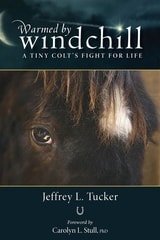
Warmed by Windchill
A Tiny Colt’s Fight for LifeJeffrey L. Tucker; Foreword by Carolyn L. Stull, PhD
University of Wisconsin Press, 2013
One bitterly cold winter afternoon, a nine-month-old colt—extremely weak, starving, left to die—was frozen to the rock-hard white landscape of a northern Wisconsin pasture. His whinny for help barely carried through thirty-mile-an-hour winds lashing snow and ice against his thin coat. But somewhere inside him a light refused to go out.
The colt's call for help was answered, and that light inspired a worldwide response to his story. The struggle of the little colt, called Windchill by his rescuers, was reported widely, and soon 1.2 million people were following Windchill's progress on a blog and webcam.
Warmed by Windchill tells how Jeffrey L. Tucker, owner of nearby Raindance Farms, and Kathi Davis, owner of a horse training operation co-located at Raindance, rescued and cared for the colt, aided by an outpouring of assistance. Donations of money, feed, blankets, and other supplies streamed in as round-the-clock volunteers tried to save Windchill. Warmed by Windchill is both heartening and heartbreaking.
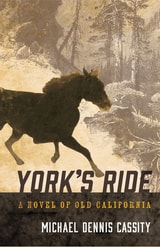
York's Ride
A Novel of Old CaliforniaMichael Dennis Cassity
University of Nevada Press, 2025
Jim, an orphan, has moved to the West to live on his Uncle Martin and Aunt Hanna’s ranch in the small, post-Gold Rush town of Taylorsville where the Sierra Nevada meets the Cascades. Mostly, Jim doesn’t miss his family farm in Missouri, and when he’s not doing ranch chores, he spends his time fly-fishing on nearby Indian Creek. This is where he first encounters York, a local boy from the Maidu tribe, and the two become fast friends. Jim and York soon meet up with Blind Charlie, a famous Maidu elder storyteller, who fills their heads with ancestral myths and legends.
After the untimely death of York, Meshuga’s caretaker, Jim is suddenly moved to take responsibility for the great black mustang and become part of Blind Charlie’s prophecies. With York gone, Jim must fulfill what his friend knew all along—that he and Meshuga would learn to conquer the challenge of the race of the century. A romantic novel of the Old West imbued with rich historical details, York’s Ride is a complex and beautiful tale about family relationships and coming-of-age in early twentieth-century California.