Results by title
8 books match the query 'Hospitality'
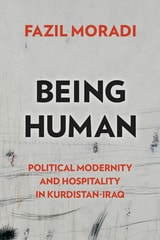
Being Human
Political Modernity and Hospitality in Kurdistan-IraqFazil Moradi
Rutgers University Press, 2024
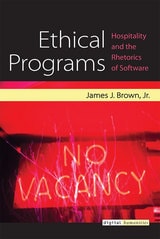
Ethical Programs
Hospitality and the Rhetorics of SoftwareJames J. Brown, Jr.
University of Michigan Press, 2015
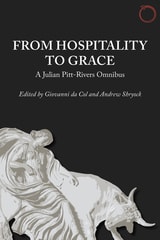
From Hospitality to Grace
A Julian Pitt-Rivers OmnibusJulian Pitt-Rivers
HAU, 2015
Holding Pitt-Rivers’s diversity of subjects and ethnographic foci in the same gaze, this book reveals a theoretical unity that ran through his work and highlights his iconic wit and brilliance. Striking at the heart of anthropological theory, the pieces here explore the relationship between the mental and the material, between what is thought and what is done. Classic, definitive, and yet still extraordinarily relevant for contemporary anthropology, Pitt-Rivers’s lifetime contribution will provide a new generation of anthropologists with an invaluable resource for reflection on both ethnographic and theoretical issues.

Fêting the Queen
Civic Entertainments and the Elizabethan ProgressJohn M Adrian
University of Massachusetts Press, 2021
While previous scholars have studied Elizabeth I and her visits to the homes of influential courtiers, Fêting the Queen places a new emphasis on the civic communities that hosted the monarch and their efforts to secure much needed support. Case studies of the cities of Oxford, Canterbury, Sandwich, Bristol, Worcester, and Norwich focus on the concepts of hospitality and space—including the intimate details of the built environment.
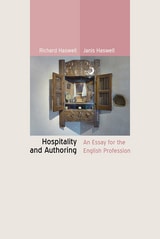
Hospitality and Authoring
An Essay for the English ProfessionRichard Haswell
Utah State University Press, 2015
Hospitality and Authoring, a sequel to the Haswells’ 2010 volume Authoring, attempts to open the path for hospitality practice in the classroom, making a strong argument for educational use and offering an initial map of the territory for teachers and authors.
Hospitality is a social and ethical relationship not only between host and guest but also between writer and reader or teacher and student. Hospitality initiates, maintains, and completes acts of authoring. This extended essay explores the ways that a true hospitable classroom community can be transformed through assigned reading, one-on-one conferencing, interpretation, syllabus, reading journals, topic choice, literacy narrative, writing centers, program administration, teacher training, and many other passing habitations.
Hospitality and Authoring strives to offer a few possibilities of change to help make college an institution where singular students and singular teachers create a room to learn with room to learn.
Hospitality, Volume I
Jacques Derrida
University of Chicago Press, 2023
Hospitality reproduces a two-year seminar series delivered by Jacques Derrida at the École des hautes études en sciences sociales in Paris between 1995 and 1997. In these lectures, Derrida asks a series of related questions about responsibility and “the foreigner”: How do we welcome or turn away the foreigner? What does the idea of the foreigner reveal about kinship and the state, particularly in relation to friendship, citizenship, migration, asylum, assimilation, and xenophobia? Derrida approaches these questions through readings of several classical texts as well as modern texts by Heidegger, Arendt, Camus, and others. Central to his project is a rigorous distinction between conventional, finite hospitality, with its many conditions, and the aspirational idea of hospitality as something offered unconditionally to the stranger. This volume collects the first year of the seminar.
Hospitality, Volume II
Jacques Derrida
University of Chicago Press, 2024
Hospitality reproduces a two-year seminar series delivered by Jacques Derrida at the École des hautes études en sciences sociales in Paris between 1995 and 1997. In these lectures, Derrida asks a series of related questions about responsibility and “the foreigner”: How do we welcome or turn away the foreigner? What does the idea of the foreigner reveal about kinship and the state, particularly in relation to friendship, citizenship, migration, asylum, assimilation, and xenophobia? Central to his project is a rigorous distinction between conventional, finite hospitality, with its many conditions, and the aspirational idea of hospitality as something offered unconditionally to the stranger. This volume collects the second year of the seminar, which considers an Islamic problematic of hospitality, the relevance of forgiveness, and the work of Emmanuel Levinas.

The Hostess
Hospitality, Femininity, and the Expropriation of IdentityTracy McNulty
University of Minnesota Press, 2006
The meaning of hospitality in Western thought—from the Bible to Derrida
The evolution of the idea of hospitality can be traced alongside the development of Western civilization. Etymologically, the host is the “master,” but this identity is established through expropriation and loss—the best host is the one who gives the most, ultimately relinquishing what defines him as master.
In The Hostess, Tracy McNulty asks, What are the implications for personhood of sharing a person—a wife or daughter—as an act of hospitality? In many traditions, the hostess is viewed not as a subject but as the master’s property. A foreign presence that both sustains and undercuts him, the hostess embodies the interplay of self and other within the host’s own identity.
Here McNulty combines critical readings of the Bible and Pierre Klossowski’s trilogy The Laws of Hospitality with analyses of exogamous marital exchange, theological works from the Talmud to Aquinas, the writings of Kant and Nietzsche, and the theory of femininity in the work of Freud and Lacan. Ultimately, she contends, hospitality involves the boundary between the proper and the improper, affecting the subject as well as interpersonal relations.