Results by title
9 books match the query 'Hour'
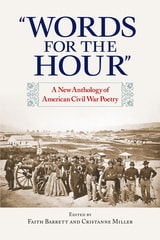
"Words for the Hour"
A New Anthology of American Civil War PoetryFaith Barrett
University of Massachusetts Press, 2005
“Words for the Hour” presents a readable and illuminating account of the Civil War, told through the words of poets North and South. From bathos to profound philosophical meditation and sorrow, the range of these poems illuminates the complexity of their era while also revealing the continuing power of this turning point in American history to speak to readers in the present day.
The volume is divided into three parts, each offering a different perspective on the poetry generated by the war. Part I samples the extraordinary range of poems written immediately preceding and during the war and published in popular periodicals, providing a kind of poetic newspaper account as one might have read it then—from the early days of optimistically heralded victory on both sides, through the mounting casualties and brutal deaths of the long middle years, to the war's conclusion and President Lincoln's assassination. Viewing the struggle from many different vantage points gives the reader access to the ways that people from various backgrounds experienced the trajectory of the war. Civilians and soldiers, free blacks and proponents of slavery, women and men from Massachusetts and Virginia and from recently admitted states and barely developed territories, writers with their eyes on the national political stage and those focused on personal domestic issues: these are the multiple voices of America responding to the war.
Part II includes substantial selections of poems by writers who published extensively in response to the conflict, providing more complex and comprehensive perceptions of the war. These poets include not just well-known figures such as Walt Whitman, Herman Melville, and John Greenleaf Whittier, but also African American poets George Moses Horton and Frances Ellen Watkins Harper and Southern poets Henry Timrod and Sarah Piatt.
Part III offers poems by two poets who did not publish during their lifetimes, but had strong imaginative responses to the conflict, thus giving a sense of the long reach of the war as a defining national experience. One of these two poets (Emily Dickinson) is now renowned while the other (Obadiah Ethelbert Baker) is first published in this volume.
“Words for the Hour” is indeed “new” among anthologies of Civil War poetry not only in its wide range of poems by popular, anonymous, and now canonical poets but also in its informational apparatus. A historical timeline listing major battles and events of the war begins the volume, and historical photographs or lithographs introduce each section of poems. The book also includes a substantial introduction, a glossary of important names and terminology relevant to understanding the poems, and biographical sketches for all the poets whose work is included.

A Trail of Fire for Political Cinema
The Hour of the Furnaces Fifty Years LaterEdited by Javier Campo and Humberto Perez-Blanco
Intellect Books, 2018
Book for the Hour of Recreation
María de San José Salazar
University of Chicago Press, 2002
María wrote this book as a defense of the Discalced practice of setting aside two hours each day for conversation, music, and staging of religious plays. Casting the book in the form of a dialogue, María demonstrates through fictional conversations among a group of nuns during their hours of recreation how women could serve as very effective spiritual teachers for each other. The book includes one of the first biographical portraits of Teresa and Maria's personal account of the troubled founding of the Discalced convent at Seville, as well as her tribulations as an Inquisitional suspect. Rich in allusions to women's affective relationships in the early modern convent, Book for the Hour of Recreation also serves as an example of how a woman might write when relatively free of clerical censorship and expectations.
A detailed introduction and notes by Alison Weber provide historical and biographical context for Amanda Powell's fluid translation.
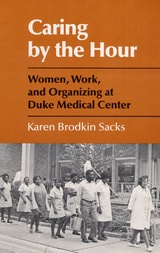
Caring by the Hour
Women, Work, and Organizing at Duke Medical CenterKaren Brodkin Sacks
University of Illinois Press, 1988
In addition to an analysis of the dynamics of women's activism, Caring by the Hour provides a comparative study of Duke Medical Center's treatment of both black and white female workers. Sacks links patterns of racial segregation in clerical jobs to the relationship between race, working conditions, and unequal opportunities for black and white women, and to their differing work cultures and patterns of public militance. She also discusses recent changes in service, clerical, and professional work and their effects on white and black women, placing them in the context of national changes in health funding and policies.
Cheaper by the Hour
Temporary Lawyers and the Deprofessionalization of the LawAuthored by Robert A. Brooks
Temple University Press, 2012
Recent law school graduates often work as temporary attorneys, but law firm layoffs and downsizing have strengthened the temporary attorney industry. Cheaper by the Hour is the first book-length account of these workers.
Drawing from participant observation and interviews, Robert A. Brooks provides a richly detailed ethnographic account of freelance attorneys in Washington, DC. He places their document review work in the larger context of the deprofessionalization of skilled labor and considers how professionals relegated to temporary jobs feel diminished, degraded, or demeaned by work that is often tedious, repetitive, and well beneath their abilities.
Brooks documents how firms break a lawyer's work into discrete components that require less skill to realize maximum profits. Moreover, he argues that information technology and efficiency demands are further stratifying the profession and creating a new underclass of lawyers who do low-end commodity work.
History of the Hour
Clocks and Modern Temporal OrdersGerhard Dohrn-van Rossum
University of Chicago Press, 1996
"In tracing the evolution of time consciousness with scholarship and skill . . . Dohrn-van Rossum evokes the many ways that the small moments of life have come to be reckoned with the passage of time."—Dava Sobel, Civilization
"Dohrn-van Rossum paints a highly nuanced picture of time's conquest of modern life."—Steven Lagerfeld, Wilson Quarterly
"This book is definitive in showing the clock's pervasive influence over European society."—Virginia Quarterly Review
"[A] delightful, excellently translated history."—Choice
"Dohrn-van Rossum has produced a persuasive and brilliantly documented new understanding of how modern time-consciousness arose."—Owen Gingerich, Nature
Hometown for an Hour
PoemsJennifer Rose
Ohio University Press, 2006
In her second collection of poems, Jennifer Rose writes primarily of places and displacement. Using the postcard’s conventions of brevity, immediacy, and, in some instances, humor, these poems are greetings from destinations as disparate as Cape Cod, Kentuckiana, and Croatia. Rich in imagery, deftly crafted, and imbued with a lightness of voice, these poems are also postmarked from poetry’s more familiar provinces of love, nature, and loss.
The Hour of All Things and Other Plays
Caridad Svich
Intellect Books, 2018
Welcome the Hour of Conflict
William Cowan McClellan and the 9th AlabamaWilliam Cowan McClellan, edited by John C. Carter
University of Alabama Press, 2007
In the Spring of 1861, a 22-year-old Alabamian did what many of his friends and colleagues were doing—he joined the Confederate Army as a volunteer. The first of his family to enlist, William Cowan McClellan, who served as a private in the 9th Alabama Infantry regiment, wrote hundreds of letters throughout the war, often penning for friends who could not write home for themselves. In the letters collected in John C. Carter’s volume, this young soldier comments on his feelings toward his commanding officers, his attitude toward military discipline and camp life, his disdain for the western Confederate armies, and his hopes and fears for the future of the Confederacy.
McClellan’s letters also contain vivid descriptions of camp life, battles, marches, picket duty, and sickness and disease in the army. The correspondence between McClellan and his family dealt with separation due to war as well as with other wartime difficulties such as food shortages, invasion, and occupation. The letters also show the rise and fall of morale on both the home front and on the battlefield, and how they were closely intertwined.
Remarkable for their humor, literacy, and matter-of-fact banter, the letters reveal the attitude a common soldier in the Army of Northern Virginia had toward the day-to-day activity and progression of the war. John C. Carter includes helpful appendixes that list the letters chronologically and offer the regimental roster, casualty/enlistment totals, assignments, and McClellan’s personal military record.