Results by title
27 books match the query 'Households'

Allocation of Income within the Household
Edward P. Lazear and Robert T. Michael
University of Chicago Press, 1988
Lazear and Michael also explore the implications their study may hold for the process of determining child support payments in households that dissolve. They argue that, unless the spending of every dollar can be monitored, alimony cannot be disentangled from child support. They also develop several criteria by which income might be distributed among family members, and, using one of those criteria, they present a series of tables that suggest the appropriate payment from one parent to another given family size, structure, and income level. Their model is particularly useful because it takes account of the ways other family members who were not part of the original household may contribute income to the new household. Other issues considered include the appropriate way to deal with children with special needs and the timing of transfer payments.
American Families and Households
James A. Sweet
Russell Sage Foundation, 1987
Ancient Households of the Americas
Conceptualizing What Households DoJohn G. Douglass
University Press of Colorado, 2012
Several different cultures-Iroquois, Coosa, Anasazi, Hohokam, San Agustín, Wankarani, Formative Gulf Coast Mexico, and Formative, Classic, Colonial, and contemporary Maya-are analyzed through the lens of household archaeology in concrete, data-driven case studies. The text is divided into three sections: Section I examines the spatial and social organization and context of household production; Section II looks at the role and results of households as primary producers; and Section III investigates the role of, and interplay among, households in their greater political and socioeconomic communities.
In the past few decades, household archaeology has made substantial contributions to our understanding and explanation of the past through the documentation of the household as a social unit-whether small or large, rural or urban, commoner or elite. These case studies from a broad swath of the Americas make Ancient Households of the Americas extremely valuable for continuing the comparative interdisciplinary study of households.
Communities and Households in the Greater American Southwest
New Perspectives and Case StudiesRobert J. Stokes
University Press of Colorado, 2019
Today’s archaeologists and anthropologists understand that communities operate as a multi-level, -organizational, -contextual, and -referential human creation, which informs their understanding of how people actively negotiate their way through and around community constraints. The chapters in this book creatively examine these interactions, revealing the dynamic nature of ancient and modern groups in the American Southwest. The book has two broad complementary themes: one focusing on household decision-making, identity, and structural relations with the greater community; the other concerned with community organization and integration, household roles within the community, and changes in community organization—violence and destabilization, coalescence and cooperation—over time.
Communities and Households in the Greater American Southwest weaves a rich tapestry of ancient and modern life through innovative approaches that will be of interest not only to Southwestern archaeologists but to all researchers and students interested in social organization at the household and community levels.
Contributors: James R. Allison, Andrew Duff, Lindsay Johansson, Michael Lindeman, Myles Miller, James Potter, Alison E. Rautman, J. Jefferson Reid, Katie Richards, Oscar Rodriguez, Barbara Roth, Kristin Safi, Deni Seymour, Robert J. Stokes, Richard K. Talbot, Scott Ure, Henry Wallace, Stephanie M. Whittlesey
Controlling Corporeality
The Body and the Household in Ancient IsraelBerquist, Jon L.
Rutgers University Press, 2002
Human bodily existence is at the core of the Torah and the rest of the Hebrew Scriptures—from birth to death. From God’s creation of Adam out of clay, to the narratives of priests and kings whose regulations governed bodily practices, the Hebrew Bible focuses on the human body. Moreover, ancient Israel’s understanding of the human body has greatly influenced both Judaism and Christianity. Despite this pervasive influence, ancient Israel’s view of the human body has rarely been studied and, until now, has been poorly understood.
In this beautifully written book, Jon L. Berquist guides the reader through the Hebrew Bible, examining ancient Israel’s ideas of the body, the unstable roles of gender, the deployment of sexuality, and the cultural practices of the time. Conducting his analysis with reference to contemporary theories of the body, power, and social control, Berquist offers not only a description and clarification of ancient Israelite views of the body, but also an analysis of how these views belong to the complex logic of ancient social meanings. When this logic is understood, the familiar Bible becomes strange and opens itself to a wide range of new interpretations.
Empirical Foundations of Household Taxation
Edited by Martin Feldstein and James M. Poterba
University of Chicago Press, 1996
The nine papers in this volume exploit the substantial variation in U.S. tax policy during the last two decades to investigate how taxes affect a range of household behavior, including labor-force participation, saving behavior, choice of health insurance plan, choice of child care arrangements, portfolio choice, and tax evasion. They also present new analytical results on the effects of different types of tax policy. All of this research relies on household-level data—drawn either from public-use tax return files or from large household-level surveys—to explore various aspects of the relationship between taxes and household behavior.
As debates about the effects of proposed tax reforms continue in the 1990s, this volume will be of interest to policy makers and scholars in the field of public finance.
Engendering Households in the Prehistoric Southwest
Edited by Barbara J. Roth
University of Arizona Press, 2010
Now Southwestern archaeologists have begun to delve into the task of “engendering” their sites. Using a “close to the ground” approach, the contributors to this book seek to engender the prehistoric Southwest by examining evidence at the household level.
Focusing on gendered activities in household contexts throughout the southwestern United States, this book represents groundbreaking work in this area. The contributors view households as a crucial link to past activities and behavior, and by engendering these households, we can gain a better understanding of their role in prehistoric society. Gender-structured household activities, in turn, can offer insight into broader-scale social and economic factors. The chapters offer a variety of theoretical and methodological approaches to engendering households and examine topics such as the division of labor, gender relations, household ritual, ceramic and ground stone production and exchange, and migration.
Engendering Households in the Prehistoric Southwest ultimately addresses broader issues of interest to many archaeologists today, including households and their various forms, identity and social boundary formation, technological style, and human agency. Focusing on gendered activities in household contexts throughout the southwestern United States, this book represents groundbreaking work in this area. The contributors view households as a crucial link to past activities and behavior, and by engendering these households, we can gain a better understanding of their role in prehistoric society. Gender-structured household activities, in turn, can offer insight into broader-scale social and economic factors.
Feeding the Family
The Social Organization of Caring as Gendered WorkMarjorie L. DeVault
University of Chicago Press, 1991
Drawing from interviews conducted in 1982-83 in a diverse group of American households, DeVault reveals the effort and skill behind the "invisible" work of shopping, cooking, and serving meals. She then shows how this work can become oppressive for women, drawing them into social relations that construct and maintain their subordinate position in household life.
From Household to Empire
Society and Economy in Early Colonial New MexicoHeather B. Trigg
University of Arizona Press, 2005
William P. Clements Center for Southwest Studies, Southern Methodist University
Settlers at Santa Fe and outlying homesteads during the seventeenth century established a thriving economy that saw the exchange of commodities produced by indigenous peoples, settlers, and Franciscan friars for goods manufactured as far away as China, France, and Turkey. This early Spanish colonial period in New Mexico provides an opportunity to explore both economic activity within a colony and the relations between colony and homeland. By examining the material remains of this era from 1598 to 1680, Heather Trigg reveals a more complete picture of colonial life. Drawing on both archaeological and historical sources, Trigg analyzes the various levels of economic activity that developed: production of items in colonial households, exchanges between households, and trade between the colony and Mexico. Rather than focusing only on the flow of products and services, she also explores the social mechanisms that likely had a significant impact on the economic life of the colony. Because economic activity was important to so many aspects of daily life, she is able to show how and why colonial society worked the way it did. While focusing on the colonists, she also explores their relations with Pueblo peoples. Through her analysis of these two pools of data, Trigg generates insights not usually gleaned from the limited texts of the period, providing information about average colonists in addition to the governors and clergy usually covered in historical accounts. By using specific examples from historical documents and archaeological materials, she shows that colonists from all levels of society modified both formal and informal rules of economic behavior to better fit the reality of the colonial frontier. With its valuable comparative data on colonization, From Household to Empire provides a novel way of examining colonial economies by focusing on the maintenance and modification of social values. For all readers fascinated by the history of the Southwest, this book provides a fuller picture of life in early New Mexico than has previously been seen.
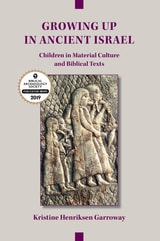
Growing Up in Ancient Israel
Children in Material Culture and Biblical TextsKristine Henriksen Garroway
SBL Press, 2018
The first expansive reference examining the texts and material culture related to children in ancient Israel
Growing Up in Ancient Israel uses a child-centered methodology to investigate the world of children in ancient Israel. Where sources from ancient Israel are lacking, the book turns to cross-cultural materials from the ancient Near East as well as archaeological, anthropological, and ethnographic sources. Acknowledging that childhood is both biologically determined and culturally constructed, the book explores conception, birth, infancy, dangers in childhood, the growing child, dress, play, and death. To bridge the gap between the ancient world and today’s world, Kristine Henriksen Garroway introduces examples from contemporary society to illustrate how the Hebrew Bible compares with a Western understanding of children and childhood.
Features:
- More than fifty-five illustrations illuminating the world of the ancient Israelite child
- An extensive investigation of parental reactions to the high rate of infant mortality and the deaths of infants and children
- An examination of what the gendering and enculturation process involved for an Israelite child
Hinterland Households
Rural Agrarian Household Diversity in Northwest HondurasJohn G. Douglass
University Press of Colorado, 2002
Household Chores and Household Choices
Theorizing the Domestic Sphere in Historical ArchaeologyEdited by Kerri S. Barile and James C. Brandon
University of Alabama Press, 2004
Discusses the concepts of “home,” “house,” and “household” in past societies
Because archaeology seeks to understand past societies, the concepts of "home," "house," and "household" are important. Yet they can be the most elusive of ideas. Are they the space occupied by a nuclear family or by an extended one? Is it a built structure or the sum of its contents? Is it a shelter against the elements, a gendered space, or an ephemeral place tied to emotion? We somehow believe that the household is a basic unit of culture but have failed to develop a theory for understanding the diversity of households in the historic (and prehistoric) periods.
In an effort to clarify these questions, this volume examines a broad range of households—a Spanish colonial rancho along the Rio Grande, Andrew Jackson's Hermitage in Tennessee, plantations in South Carolina and the Bahamas, a Colorado coal camp, a frontier Arkansas farm, a Freedman's Town eventually swallowed by Dallas, and plantations across the South—to define and theorize domestic space. The essays devolve from many disciplines, but all approach households from an archaeological perspective, looking at landscape analysis, excavations, reanalyzed collections, or archival records. Together, the essays present a body of knowledge that takes the identification, analysis, and interpretation of households far beyond current conceptions.
Households on the Mimbres Horizon
Excavations at La Gila Encantada, Southwestern New MexicoBarbara J. Roth
University of Arizona Press, 2023
Little is known about the variability present at pithouse sites away from the major Mimbres and Gila River Valleys. Nonriverine occupations have been understudied until now. This book describes subsistence and settlement practices and compares the results with recent research conducted at the larger villages in the Mimbres River Valley. Despite basic similarities in material culture, households at La Gila Encantada appear to have followed different trajectories than those along the rivers. Examining these differences, archaeologist Barbara J. Roth provides insights into some of the reasons why they existed and shows that the variability present in pithouse occupations over the years was tied to multiple factors, including environmental differences, economic practices, and the social composition of groups occupying the sites. With chapters assessing ceramic data, chipped and groundstone analysis, shell and mineral jewelry, and regional context, this look at the past offers relevant insights into current issues in Southwest archaeology, including identity, interaction, and household organization.
Insufficient Funds
Savings, Assets, Credit, and Banking Among Low-Income HouseholdsRebecca M. Blank
Russell Sage Foundation, 2009
International Comparisons of Household Saving
Edited by James M. Poterba
University of Chicago Press, 1994
Each of the six chapters examines micro data sets of household saving within a particular country and summarizes statistics on patterns of saving by age, income, and other demographic factors. The authors provide age-earning profiles and analyses of the accumulation of wealth over the lifetime in a clear way that allows quick comparisons between earning, consumption, and saving in the six countries.
Designed as a companion to Public Policies and Household Saving (1994), which addresses saving policies in the G-7 nations, this volume offers detailed descriptions of saving behavior in all G-7 nations except France.
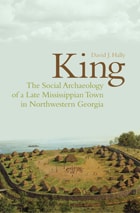
King
The Social Archaeology of a Late Mississippian Town in Northwestern GeorgiaDavid Hally
University of Alabama Press, 2008
At the time of Spanish contact in A.D. 1540, the Mississippian inhabitants of the great valley in northwestern Georgia and adjacent portions of Alabama and Tennessee were organized into a number of chiefdoms distributed along the Coosa and Tennessee rivers and their major tributaries. The administrative centers of these polities were large settlements with one or more platforms mounds and a plaza. Each had a large resident population, but most polity members lived in a half dozen or so towns located within a day’s walk of the center. This book is about one such town, located on the Coosa River in Georgia and known to archaeologists as the King site.
Excavations of two-thirds of the 5.1 acre King site reveal a detailed picture of the town’s domestic and public architecture and overall settlement plan. Intensive analysis of architectural features, especially of domestic structures, enables a better understanding of the variation in structure size, compass orientation, construction stages, and symbolic cosmological associations; the identification of multi-family households; and the position of individual structures within the town’s occupation sequence or life history. Comparison of domestic architecture and burials reveals considerable variation between households in house size, shell bead wealth, and prominence of adult members. One household is preeminent in all these characteristics and may represent the household of the town chief or his matrilineal extended family. Analysis of public architectural features has revealed the existence of a large meeting house with likely historical connections to 18th-century Creek town houses; a probable cosmological basis for the town’s physical layout; and an impressive stockade-and-ditch defensive perimeter.
The King site represents a nearly ideal opportunity to identify the kinds of status positions that were held by individual inhabitants; analyze individual households and investigate the roles they played in King site society; reconstruct the community that existed at King, including size, life history, symbolic associations, and integrative mechanisms; and place King in the larger regional political system. With excavations dating back to 1973, and supported in part by the National Endowment for the Humanities and the National Geographic Society, this is social archaeology at its best.
Mississippian Communities and Households
Edited by J. Daniel Rogers and Bruce D. Smith
University of Alabama Press, 1995
During the Mississippian period (approximately A.D. 1000-1600) in the midwestern and southeastern United States a variety of greater and lesser chiefdoms took shape. Archaeologists have for many years explored the nature of these chiefdoms from the perspective common in archaeological investigations—from the top down, investigating ceremonial elite mound structures and predicting the basic domestic unit from that data. Because of the increased number of field investigations at the community level in recent years, this volume is able to move the scale of investigation down to the level of community and household, and it contributes to major revisions of settlement hierarchy concepts.
No Place Like Home
Relationships and Family Life among Lesbians and Gay MenChristopher Carrington
University of Chicago Press, 1999
"Carefully separating stereotype from reality, Carrington investigates family in the gay and lesbian community. Relying upon interviews and observation, the author analyzes the loves and routings of 52 diverse lesbian, gay, and bisexual couples in the Bay area. . . . [He] closes the work with a discussion of the raging same-sex marriage debate and posits an enlightened solution to this dilemma." —Library Journal
Our New Husbands Are Here
Households, Gender, and Politics in a West African State from the Slave Trade to Colonial RuleEmily Lynn Osborn
Ohio University Press, 2011
In Our New Husbands Are Here, Emily Lynn Osborn investigates a central puzzle of power and politics in West African history: Why do women figure frequently in the political narratives of the precolonial period, and then vanish altogether with colonization? Osborn addresses this question by exploring the relationship of the household to the state. By analyzing the history of statecraft in the interior savannas of West Africa (in present-day Guinea-Conakry), Osborn shows that the household, and women within it, played a critical role in the pacifist Islamic state of Kankan-Baté, enabling it to endure the predations of the transatlantic slave trade and become a major trading center in the nineteenth century. But French colonization introduced a radical new method of statecraft to the region, one that separated the household from the state and depoliticized women’s domestic roles. This book will be of interest to scholars of politics, gender, the household, slavery, and Islam in African history.

Pox, Empire, Shackles, and Hides
The Townsend Site, 1670-1715Jon Bernard Marcoux
University of Alabama Press, 2010
Marcoux studies the material remains of daily life in order to identify the strategies that households enacted while adapting to the social, political, and economic disruptions associated with European contact. The author focuses on households as the basic units of analysis because these represent the most fundamental and pervasive unit of economic and social production in the archaeological record. His investigations show how the daily lives of Cherokee households changed dramatically as they coped with the shifting social, political, and economic currents of the times. He demonstrates that the community excavated at the Townsend site was formed by immigrant households who came together from geographically disparate and ethnically distinct Cherokee settlements as a way to ameliorate population losses. He also explores changes in community and household patterning, showing how the spatial organization of the Townsend community became less formal and how households became more transient compared to communities predating contact with Europeans. From this evidence, Marcoux concludes that these changes reflect a broader strategic shift to a more flexible lifestyle that would have aided Cherokee households in negotiating the social, political, and economic uncertainty of the period.
Reconsidering Mississippian Communities and Households
Edited by Elizabeth Watts Malouchos and Alleen Betzenhauser
University of Alabama Press, 2021
Advancing the study of Mississippian societies through innovative archaeological theory and method.
Published in 1995, Mississippian Communities and Households, edited by J. Daniel Rogers and Bruce D. Smith, was a foundational text that advanced southeastern archaeology in significant ways and brought household-level archaeology to the forefront of the field. Reconsidering Mississippian Communities and Households revisits and builds on what has been learned in the years since the Rogers and Smith volume, advancing the field further with the diverse perspectives of current social theory and methods and big data as applied to communities in Native America from the AD 900s to 1700s and from northeast Florida to southwest Arkansas.
Watts Malouchos and Betzenhauser bring together scholars researching diverse Mississippian Southeast and Midwest sites to investigate aspects of community and household construction, maintenance, and dissolution. Thirteen original case studies prove that community can be enacted and expressed in various ways, including in feasting, pottery styles, war and conflict, and mortuary treatments.
Rituals and Sisterhoods
Single Women's Households in Mexico, 1560–1750Amos Megged
University Press of Colorado, 2019
Megged analyzes these women’s life stories recorded during the Spanish Inquisition, as well as wills and bequests, petitions, parish records, and private letters that describe—in their own words—how they exercised agency in male-dominated and religious spaces. Translations of select documents and accompanying analysis illustrate the conditions in which women dissolved their marriages, remained in long-lasting extramarital cohabitations, and formed female-led households and “sisterhoods” of their own. Megged provides evidence that single women in colonial Mexico played a far more active and central role in economic systems, social organizations, cults, and political activism than has been previously thought, creating spaces for themselves in which they could initiate and maintain autonomy and values distinct from those of elite society.
The institutionalization of female-headed households in mid-colonial Mexico had wide-ranging repercussions and effects on general societal values. Rituals and Sisterhoods details the particular relevance of these changes to the history of emotions, sexuality, gender concepts, perceptions of marriage, life choices, and views of honor and shame in colonial society. This book will be of significant interest to students and scholars of colonial Latin American history, the history of Early Modern Spain and Europe, and gender and women’s studies.
The Archaeology of Houses and Households in the Native Southeast
Benjamin A. Steere
University of Alabama Press, 2017
The Archaeology of Houses and Households in the Native Southeast contributes enormously to the study of household archaeology and domestic architecture in the region. This significant volume combines both previously published and unpublished data on communities from the Southeast and is the first systematic attempt to understand the development of houses and households as interpreted through a theoretical framework developed from broad-ranging studies in cultural anthropology and archaeology.
Steere’s major achievement is the compilation of one of the largest and most detailed architectural datasets for the Southeast, including data for 1,258 domestic and public structures from 65 archaeological sites in North Carolina, Georgia, Alabama, Tennessee, Kentucky, and the southern parts of Missouri, Indiana, and Illinois. Rare data from hard-to-find cultural resource management reports is also incorporated, creating a broad temporal and geographic scope and serving as one of many remarkable features of the book, which is sure to be of considerable value to archaeologists and anthropologists interested in comparative studies of architecture.
Similar to other analyses, Steere’s research uses multiple theoretical angles and lines of evidence to answer archaeological questions about houses and the people who built them. However, unlike other examinations of household archaeology, this project spans multiple time periods (Woodland, Mississippian, and Historic); is focused squarely on the Southeast; features a more unified approach, using data from a single, uniform database; and privileges domestic architecture as a line of evidence for reconstructing daily life at major archaeological sites on a much broader scale than other investigations.
The Crossroads of Class and Gender
Industrial Homework, Subcontracting, and Household Dynamics in Mexico CityLourdes Benería and Martha Roldán
University of Chicago Press, 1987
Unfamiliar Relations
Family and History in South AsiaChatterjee, Indrani
Rutgers University Press, 2004
Unfamiliar Relations restores the family and its many forms and meanings to a central place in the history of South Asia between the seventeenth and nineteenth centuries.
In her incisive introduction, Indrani Chatterjee argues that the recent wealth of scholarship on ethnicity, sexuality, gender, imperialism, and patriarchy in South Asia during the colonial period often overlooks careful historical analysis of the highly contested concept of family. Together, the essays in this book demolish "family" as an abstract concept in South Asian colonial history, demonstrating its exceedingly different meanings across temporal and geographical space.
The scholarship in this volume reveals a far more complex set of dynamics than a simple binary between indigenous and colonial forms and structures. It approaches this study from the pre-colonial period on, rather than backwards as has been the case with previous scholarship. Topics include a British colonial officer who married a Mughal noblewoman and converted to Islam around the turn of the nineteenth century, the role gossip and taboo play in the formation of Indian family history, and an analysis of social relations in the penal colony on the Andaman Islands.
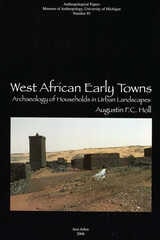
West African Early Towns
Archaeology of Households in Urban LandscapesAugustin F. C. Holl
University of Michigan Press, 2006
Women in 1900
Gateway to the Political Economy of the 20th CenturyChristine E. Bose
Temple University Press, 2001