Results by title

9 books match the query 'Houses'
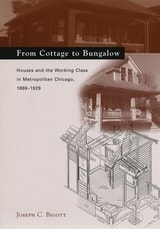
cover of From Cottage to Bungalow: Houses and the Working Class in Metropolitan Chicago, 1869-1929

From Cottage to Bungalow

Houses and the Working Class in Metropolitan Chicago, 1869-1929

Joseph C. Bigott

University of Chicago Press, 2001

It's hard to overestimate the complexity of the factors that dictate something as simple as where, and in what sorts of structures, people live. Urban planning, business, labor, ethnicity, architecture—each influences the types of structures people live in, and the sorts of lives they lead within them.

Joseph C. Bigott takes on all of these fields in From Cottage to Bungalow, a sophisticated study of domestic structures and ethnic working-class neighborhoods in Chicago during the critical period of 1869 to 1929, when the city attracted huge numbers of immigrants. Exploring the meaning of home ownership in this context, Bigott develops two case studies that combine the intimate lives of ordinary people (primarily in Chicago's Polish and German communities) with broad analysis of everything from real estate markets to the very carpentry practices used to construct houses. His progressive methods and the novel conclusions they support chronicle not only the history of housing in Chicago, but also the organizations of people's lives, and the ways in which housing has affected notions of who is—and who is not—a worthy American citizen.
[more]
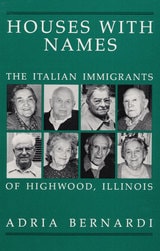
cover of HOUSES WITH NAMES: "THE ITALIAN IMMIGRANTS OF HIGHWOOD, ILL

HOUSES WITH NAMES

"THE ITALIAN IMMIGRANTS OF HIGHWOOD, ILL

Adria Bernardi

University of Illinois Press, 1990
Combining her other research with interviews of nearly fifty Italian immigrants of her grandparents' generation, Adria Bernardi has crafted a memorable oral history of a community of working-class immigrants. Bernardi tells their story clearly and with care, interspersing transcriptions and translations with her own recollections and interpretations of life among the Italian immigrants of Highwood.
 
[more]
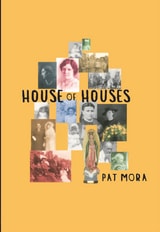
cover of House of Houses

House of Houses

Pat Mora

University of Arizona Press, 1997

Combining poetic language and the traditions of magic realism to paint a vivid portrait of her family, Pat Mora’s House of Houses is an unconventional memoir that reads as if every member, death notwithstanding, is in one room talking, laughing, and crying. In a salute to the Day of the Dead, the story begins with a visit to the cemetery in which all of her deceased relatives come alive to share stories of the family, literally bringing the food to their own funerals. From there the book covers a year in the life of her clan, revealing the personalities and events that Mora herself so desperately yearns to know and understand.
[more]
cover of Houses and House-Life of the American Aborigines

Houses and House-Life of the American Aborigines

Lewis Henry Morgan

University of Utah Press, 2003

A classic, available again.

Lewis Henry Morgan (1818–1881) was trained as a lawyer, but in the second part of his life he focused his attention on the emerging science of ethnography.

Covering areas of North and Central America, Morgan’s last book, Houses and House-Life of the American Aborigines was the first to regard a set of problems that is still currently debated: what does domestic architecture show anthropologists and archaeologists about social organization, and how does social organization combine with a system of production technology and ecological adjustment to influence domestic and public architecture? As William Longacre makes clear in the new introduction, the development of anthropological archaeology was profoundly affected by this book, and its impact continues to resonate.

Demonstrating a lack of ethnocentrism rare for his day, Morgan gathered most of his own data from the field and from a gigantic correspondence. The result is a lively, readable work that is still fascinating and instructive today.
[more]
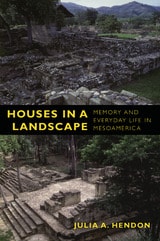
cover of Houses in a Landscape: Memory and Everyday Life in Mesoamerica

Houses in a Landscape

Memory and Everyday Life in Mesoamerica

Julia A. Hendon

Duke University Press, 2010

In Houses in a Landscape, Julia A. Hendon examines the connections between social identity and social memory using archaeological research on indigenous societies that existed more than one thousand years ago in what is now Honduras. While these societies left behind monumental buildings, the remains of their dead, remnants of their daily life, intricate works of art, and fine examples of craftsmanship such as pottery and stone tools, they left only a small body of written records. Despite this paucity of written information, Hendon contends that an archaeological study of memory in such societies is possible and worthwhile. It is possible because memory is not just a faculty of the individual mind operating in isolation, but a social process embedded in the materiality of human existence. Intimately bound up in the relations people develop with one another and with the world around them through what they do, where and how they do it, and with whom or what, memory leaves material traces.

Hendon conducted research on three contemporaneous Native American civilizations that flourished from the seventh century through the eleventh CE: the Maya kingdom of Copan, the hilltop center of Cerro Palenque, and the dispersed settlement of the Cuyumapa valley. She analyzes domestic life in these societies, from cooking to crafting, as well as public and private ritual events including the ballgame. Combining her findings with a rich body of theory from anthropology, history, and geography, she explores how objects—the things people build, make, use, exchange, and discard—help people remember. In so doing, she demonstrates how everyday life becomes part of the social processes of remembering and forgetting, and how “memory communities” assert connections between the past and the present.
[more]
cover of Houses of God: Region, Religion, and Architecture in the United States

Houses of God

Region, Religion, and Architecture in the United States

Peter W. Williams

University of Illinois Press, 1997
Houses of God is the first broad survey of American religious architecture, a cultural cross-country expedition that will benefit travelers as much as scholars. Beautifully illustrated with over 100 photographs — some by well-known photographers such as Walker Evans and Dorothea Lange — this handsome book provides a highly accessible look at how Americans shape their places of worship into multifaceted reflections of their culture, beliefs, and times.
 
[more]
cover of Safe as Houses

Safe as Houses

Marie-Helene Bertino

University of Iowa Press, 2012

Safe as Houses, the debut story collection of Marie-Helene Bertino, proves that not all homes are shelters. The titular story revolves around an aging English professor who, mourning the loss of his wife, robs other people's homes of their sentimental knick-knacks. In "Free Ham," a young dropout wins a ham after her house burns down and refuses to accept it. “Has my ham done anything wrong?” she asks when the grocery store manager demands that she claim it.
 
In "Carry Me Home, Sisters of Saint Joseph," a failed commercial writer moves into the basement of a convent and inadvertently discovers the secrets of the Sisters of Saint Joseph. A girl, hoping to talk her brother out of enlisting in the army, brings Bob Dylan home for Thanksgiving dinner in the quiet, dreamy "North Of." In “The Idea of Marcel,” Emily, a conservative, elegant girl, has dinner with the idea of her ex-boyfriend, Marcel. In a night filled with baffling coincidences, including Marcel having dinner with his idea of Emily, she wonders why we tend to be more in love with ideas than with reality. In and out of the rooms of these gritty, whimsical stories roam troubled, funny people struggling to reconcile their circumstances to some kind of American Ideal and failing, over and over. 
 
The stories of Safe as Houses are magical and original and help answer such universal and existential questions as: How far will we go to stay loyal to our friends? Can we love a man even though he is inches shorter than our ideal? Why doesn’t Bob Dylan ever have his own smokes? And are there patron saints for everything, even lost socks and bad movies?
 

All homes are not shelters. But then again, some are. Welcome to the home of Marie-Helene Bertino. 
[more]
cover of The Archaeology of Houses and Households in the Native Southeast

The Archaeology of Houses and Households in the Native Southeast

Benjamin A. Steere

University of Alabama Press, 2017

Explores the evolution of houses and households in the southeastern United States from the Woodland to the Historic Indian period (ca. 200 BC to 1800 AD)
 
The Archaeology of Houses and Households in the Native Southeast contributes enormously to the study of household archaeology and domestic architecture in the region. This significant volume combines both previously published and unpublished data on communities from the Southeast and is the first systematic attempt to understand the development of houses and households as interpreted through a theoretical framework developed from broad-ranging studies in cultural anthropology and archaeology.
 
Steere’s major achievement is the compilation of one of the largest and most detailed architectural datasets for the Southeast, including data for 1,258 domestic and public structures from 65 archaeological sites in North Carolina, Georgia, Alabama, Tennessee, Kentucky, and the southern parts of Missouri, Indiana, and Illinois. Rare data from hard-to-find cultural resource management reports is also incorporated, creating a broad temporal and geographic scope and serving as one of many remarkable features of the book, which is sure to be of considerable value to archaeologists and anthropologists interested in comparative studies of architecture.
 
Similar to other analyses, Steere’s research uses multiple theoretical angles and lines of evidence to answer archaeological questions about houses and the people who built them. However, unlike other examinations of household archaeology, this project spans multiple time periods (Woodland, Mississippian, and Historic); is focused squarely on the Southeast; features a more unified approach, using data from a single, uniform database; and privileges domestic architecture as a line of evidence for reconstructing daily life at major archaeological sites on a much broader scale than other investigations.

 
[more]
cover of The Houses of Belgrade

The Houses of Belgrade

Borislav Pekic

Northwestern University Press, 1994

The Houses of Belgrade, first published in 1970, draws a parallel between the unrest culminating in the Belgrade student riots of 1968 and that at two earlier points in the history of Yugoslavia: the riots which preceded Germany's 1941 attack on Belgrade and the turmoil of Serbia's entry into WWI. Pekic relates his tale through Negovan, one of Belgrade's prime builders of houses, and through the metaphor of the gradual decline of the builder's mind presents a compelling look at the fear of loss and destruction in a chronically disrupted society.
[more]