Results by title
3 books match the query 'Housing development'
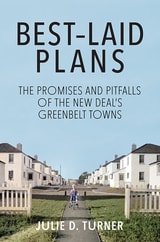
Best-Laid Plans
The Promises and Pitfalls of the New Deal Greenbelt TownsJulie D. Turner
University of Minnesota Press, 2022
A history of the New Deal program intended to improve the living conditions of America’s underclass.
In 1935, under the direction of the Resettlement Administration, the United States government embarked on a New Deal program to construct new suburban towns for the working class. Teams of architects, engineers, and city planners, along with thousands of workers, brought three such communities to life: Greenbelt, Maryland; Greendale, Wisconsin; and Greenhills, Ohio. President Franklin Roosevelt saw this as a way to create jobs. Resettlement Administration head Rexford Tugwell longed to improve the living conditions of the nation’s underclass.
In Best-Laid Plans, Julie Turner identifies where the Greenbelt Towns succeeded and where they failed. The program suffered under the burden of too many competing goals: maximum job creation at minimal cost, exquisite town planning that would provide modest residences for low-income families, progressive innovation that would serve to honor and reinforce traditional American values. Yet the Greenbelt program succeeded in one respect—providing new homes in well-planned communities that continue to welcome residents.
Town planning and suburbanization did not follow the blueprint of the Greenbelt model and instead took a turn toward the suburban sprawl we know today. The Greenbelt towns may represent an unrealistic dream, but they show an imagined way of American life that continues to appeal and hints at what might have been possible.
[more]

Palestine Is Throwing a Party and the Whole World Is Invited
Capital and State Building in the West BankKareem Rabie
Duke University Press, 2021
In 2008, Palestinian Prime Minister Salam Fayyad invited international investors to the first-ever Palestine Investment Conference, which was designed to jump-start the process of integrating Palestine into the global economy. As Fayyad described the conference, Palestine is “throwing a party, and the whole world is invited.” In this book Kareem Rabie examines how the conference and Fayyad's rhetoric represented a wider shift in economic and political practice in ways that oriented state-scale Palestinian politics toward neoliberal globalization rather than a diplomatic two-state solution. Rabie demonstrates that private firms, international aid organizations, and the Palestinian government in the West Bank focused on large-scale private housing development in an effort toward state-scale economic stability and market building. This approach reflected the belief that a thriving private economy would lead to a free and functioning Palestinian state. Yet, as Rabie contends, these investment-based policies have maintained the status quo of occupation and Palestine's subordinate and suspended political and economic relationship with Israel.
[more]
Regional Governance and the Politics of Housing in the San Francisco Bay Area
Paul G. Lewis and Nicholas J. Marantz
Temple University Press, 2023
The San Francisco Bay Area is generally considered the most expensive regional housing market in the country. Because the region added jobs and residents at a faster rate than housing, rents and home prices escalated. Moreover, small municipalities, common in the most job-rich parts of the Bay Area, have strong political incentives to resist development of new multifamily housing. Regional Governance and the Politics of Housing in the San Francisco Bay Area explains how a decentralized, localistic structure of government shapes land-use politics in ways that exacerbate housing shortages and inequalities.
The authors evaluate six potential reforms, arguing that targeted changes to local and regional institutions could generate durable improvements to the region’s housing opportunities. The main lesson from the case of the San Francisco Bay Area is the need to focus on governance when addressing the housing challenge. As the authors effectively illustrate, leaving a solution up to individual cities is unlikely to lead to increased housing supply.
The authors evaluate six potential reforms, arguing that targeted changes to local and regional institutions could generate durable improvements to the region’s housing opportunities. The main lesson from the case of the San Francisco Bay Area is the need to focus on governance when addressing the housing challenge. As the authors effectively illustrate, leaving a solution up to individual cities is unlikely to lead to increased housing supply.
[more]