Results by title
3 books match the query 'Hughes, David McDermott'

Energy without Conscience
Oil, Climate Change, and ComplicityDavid McDermott Hughes
Duke University Press, 2017

Proposals for a Caring Economy
Matthew J. Wolf-Meyer
University of Minnesota Press, 2025
Offering models of care beyond capitalist constraints
For too long, questions of care provision and inclusion have been shaped by economic justifications. This has led to the deprivation of care to individuals and communities based on capitalist assumptions about what and who can be cared for. Proposals for a Caring Economy takes these assumptions to task. Moving between examples focused on immigration and agriculture, patients and art audiences, green energy transitions and unhoused people, prison abolitionists and clients of domestic violence services, the contributors here argue that we need new ways to conceptualize care and its applications.
Proposals for a Caring Economy articulates an economy that situates care at the forefront; sees the preservation of individual, community, and environmental wellbeing as the primary good; and focuses attention on building a sustainable economy of caring that will radically transform social connections and possibilities.
Contributors: Chelsey R. Carter, Yale U; David McDermott Hughes, Rutgers U; Stephanie Delise Jones, U of California, Riverside; Sameena Mulla, Emory U; Katy Overstreet, Saxo Institute, U of Copenhagen; Michelle Parsons, Northern Arizona U; Adair Rounthwaite, U of Washington; Damien M. Sojoyner, U of California, Irvine; Emily Yates-Doerr, Oregon State U.
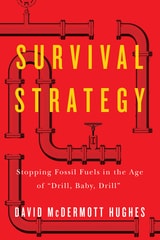
Survival Strategy
Stopping Fossil Fuels in the Age of "Drill, Baby, Drill"David McDermott Hughes
Rutgers University Press, 2027
In the United States, the climate movement has, so far, failed in the all-important task of shutting down fossil fuels. David McDermott Hughes offers a plan for a more daring form of climate politics, recommending that the climate movement adopt a strategy of mass blockades and sabotage against functioning fossil fuel infrastructure. Ideally, the saboteurs would not get caught—but if they did, in their trials they could appeal to the little-known power of jury nullification to avoid prison and to make pipelines unprotectable.
Climate change is no longer a technical problem that can simply be fixed. It is now a political predicament that must be faced. Elected politicians—even those who support renewable energy—remain committed to the extraction of petroleum and methane. No one with political power is even attempting to do the one thing that must be done: shut down fossil fuels. With trepidation, Hughes offers the last resort against the approaching climate catastrophe.