Results by title
2 books match the query 'Human Anatomy'
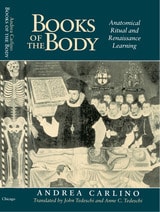
Books of the Body
Anatomical Ritual and Renaissance LearningAndrea Carlino
University of Chicago Press, 1999
We usually see the Renaissance as a marked departure from older traditions, but Renaissance scholars often continued to cling to the teachings of the past. For instance, despite the evidence of their own dissections, which contradicted ancient and medieval texts, Renaissance anatomists continued to teach those outdated views for nearly two centuries.
In Books of the Body, Andrea Carlino explores the nature and causes of this intellectual inertia. On the one hand, anatomical practice was constrained by a reverence for classical texts and the belief that the study of anatomy was more properly part of natural philosophy than of medicine. On the other hand, cultural resistance to dissection and dismemberment of the human body, as well as moral and social norms that governed access to cadavers and the ritual of their public display in the anatomy theater, also delayed anatomy's development.
A fascinating history of both Renaissance anatomists and the bodies they dissected, this book will interest anyone studying Renaissance science, medicine, art, religion, and society.
[more]
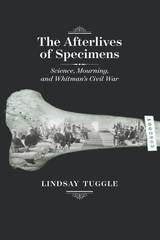
The Afterlives of Specimens
Science, Mourning, and Whitman's Civil WarLindsay Tuggle
University of Iowa Press, 2017
The Afterlives of Specimens explores the space between science and sentiment, the historical moment when the human cadaver became both lost love object and subject of anatomical violence. Walt Whitman witnessed rapid changes in relations between the living and the dead. In the space of a few decades, dissection evolved from a posthumous punishment inflicted on criminals to an element of preservationist technology worthy of the presidential corpse of Abraham Lincoln. Whitman transitioned from a fervent opponent of medical bodysnatching to a literary celebrity who left behind instructions for his own autopsy, including the removal of his brain for scientific study.
Grounded in archival discoveries, Afterlives traces the origins of nineteenth-century America’s preservation compulsion, illuminating the influences of botanical, medical, spiritualist, and sentimental discourses on Whitman’s work. Tuggle unveils previously unrecognized connections between Whitman and the leading “medical men” of his era, such as the surgeon John H. Brinton, founding curator of the Army Medical Museum, and Silas Weir Mitchell, the neurologist who discovered phantom limb syndrome. Remains from several amputee soldiers whom Whitman nursed in the Washington hospitals became specimens in the Army Medical Museum.
Tuggle is the first scholar to analyze Whitman’s role in medically memorializing the human cadaver and its abandoned parts.
[more]