Results by title
7 books match the query 'Human History'
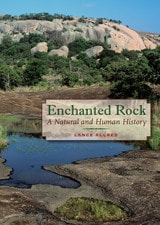
Enchanted Rock
A Natural and Human HistoryBy Lance Allred
University of Texas Press, 2009
With intriguing domes of pinkish granite surrounded by a sea of Hill Country limestone, Enchanted Rock State Natural Area attracts over 300,000 visitors every year who come to the park to hike, rock climb, spelunk, camp, picnic, and observe birds and wildflowers. Geologists from around the world come to Enchanted Rock to examine landforms that were shaped by forces on ancient continents of Earth more than one billion years ago! All of these visitors, however, are only the latest comers in a line of human history that stretches back 13,000 years to early Native Americans and includes Spanish explorers, Mexican and German settlers, and thirteen private and public owners up to the current owner, the state of Texas.
Surprisingly, given the area's wealth of unusual geology, native plants and animals, and human history, no comprehensive guide to Enchanted Rock has been published before now. In Enchanted Rock, you'll find everything you need to fully appreciate this unique place. Lance Allred draws on the work of specialists in many fields to offer a popular account of the park's history, geology, weather, flora, and fauna. Whether you want to know more about how Enchanted Rock was formed, identify a wildflower or butterfly, or learn more about plant communities along the hiking trails, you'll find accurate information here, presented in an inviting style. Over a thousand color photographs illustrate the enjoyable text.
Geology, Ecology, and Human History of the San Luis Valley
Jared Maxwell Beeton
University Press of Colorado, 2020
The first section, “The Geology and Ecology of the San Luis Valley,” surveys the geomorphology, hydrology, animal and plant life, conservation, management, and mining of the valley’s varied terrain. The second section, “Human History of the San Luis Valley,” recounts the valley’s human visitation and settlement, from early indigenous life to Spanish exploration to Hispanic and Japanese settlements. This section introduces readers to the region’s wide range of religious identities—Catholic, Latter-day Saint, Buddhist, Jehovah’s Witness, Amish, and Mennonite—and diverse linguistic traditions, including Spanish, English, Dutch, Danish, Japanese, and Mayan. The final section, “Travel Itineraries,” addresses recreation, specifically fly-fishing and rock climbing.
The book provides a comprehensive overview of the endemic flora and fauna, human history of indigenous lifeways, and diverse settlement patterns that have shaped the region. The Geology, Ecology, and Human History of the San Luis Valley will appeal to students and scholars of geology, ecology, environmental history, and cultural history, as well as residents and tourists seeking to know more about this fascinating and integral part of Colorado and New Mexico.
Contributors:
Benjamin Armstrong, Timothy Armstrong, Deacon Aspinwall, Robert Benson, Lorrie Crawford, Kristy Duran, Jeff Elison, Eric Harmon, Devin Jenkins, Bradley G. Johnson, Robert M. Kirkham, Bessie Konishi, Angie Krall, Richard D. Loosbrock, Richard Madole, A. W. Magee, Victoria Martinez, James McCalpin, Mark Mitchell, R. Nathan Pipitone, Andrew Valdez, Rio de la Vista, Damián Vergara Wilson
Natures Past
The Environment and Human HistoryEdited by Paolo Squatriti
University of Michigan Press, 2007
Plough, Sword, and Book
The Structure of Human HistoryErnest Gellner
University of Chicago Press, 1990
"A thoughtful and lively meditation upon probably the greatest transformation in human history, upon the difficult problems it poses and the scant resources it has left us to solve them."—Charles Larmore, New Republic
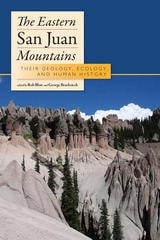
The Eastern San Juan Mountains
Their Ecology, Geology, and Human HistoryRob Blair
University Press of Colorado, 2011
A natural division between the eastern and western slopes of the San Juans is the north-south line that runs approximately through Lake City, south of the crossing of the Piedra River by US Highway 160. In this super guidebook, twenty-seven contributors--all experts in their fields--artfully bring the geology, hydrology, animal and plant life, human histories, and travel routes of these eastern slopes to life. Designed to inform researchers, educators, and students about the region's complex systems, The Eastern San Juan Mountains also serves as an informative guidebook to accompany visitors along their travels on the Silver Thread National Scenic Byway, which stretches between South Fork and Lake City.
The Eastern San Juan Mountains deserves a place next to The Western San Juan Mountains on the bookshelf of every naturalist, researcher, resident, educator, student, and tourist seeking a greater understanding of this marvelous place and its history.
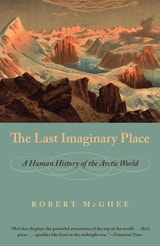
The Last Imaginary Place
A Human History of the Arctic WorldRobert McGhee
University of Chicago Press, 2007
The Arctic of towering icebergs and midnight sun, of flaming auroras and endless winter nights, has long provoked flights of the imagination. Now, in The Last Imaginary Place, renowned archeologist Robert McGhee lifts the veil to reveal the true Arctic world. Based on thirty years of work with native peoples of the Arctic and travel in the region, McGhee’s account dispels notions of the frozen land as an exotic, remote world that exists apart from civilization.
Between the frigid reality and lurid fantasy lies McGhee’s true interest, the people who throughout human history have called the Arctic home. He paints a vivid portrait of Viking farmers, entrepreneurial Inuit, and Western explorers who have been seduced by the natural wealth and haunting beauty of this land. From lively accounts of fur trading, ivory hunting, and whaling to white-knuckle tales of the first, doomed expeditions, McGhee takes the reader on a whirlwind journey across this disorienting, dreamlike terrain that has fascinated mankind for centuries.
“In prose infused by his position as curator of Arctic archaeology at the Canadian Museum of Civilization—which has taken him to sites in several countries—McGhee demolishes some persistent illusions about the white North . . . evocative.”—Times Literary Supplement
“[A] compelling account . . . [McGhee] believes that the Arctic is not so much a region as a dream—what he sees as a dream of a unique, attractive world . . . An archaeologist who has spent thirty years there, the author lets his love for the region shine through on every page.—Booklist
“McGhee displays the powerful attractions of the top of the world . . . [his] prose . . . sparkles like frost in the midnight sun.”—Financial Times
“McGhee has written a sensitive, fascinating and extremely important book.”—Canadian Geographic
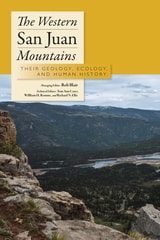
The Western San Juan Mountains
Their Geology, Ecology, and Human HistoryRob Blair
University Press of Colorado, 1996
The most complete work published on the natural history of southwest Colorado's majestic mountain system, The Western San Juan Mountains: Their Geology, Ecology, and Human History is designed to be used while exploring the scenic 235-mile paved San Juan Skyway, which passes through Durango, Silverton, Ouray, Telluride, Dolores, and Cortez.
The Western San Juan Mountains covers the physical environment, the biological communities, the human history, and points of interest represented on milepost signs along the highway. Some of the many topics covered include: how the San Juan Mountains were formed; why the landscape is so rugged and picturesque; why the vegetation changes from the lowlands to the alpine heights; energy and mineral resources of the area; why these mountains intrigued early explorers; factors that influence the unpredictable weather; and the first-known inhabitants.
The contributions to this guide include Fort Lewis College geologists, biologists, archaeologists, historians, and other specialists. Together they have amassed more than one hundred years of study based not only on previous work but on their own research.
This generously illustrated guidebook is aimed at all those who wish to understand this intricate mountain system in much greater detail than provided by most picture books.