Results by title
6 books match the query 'Human Person'
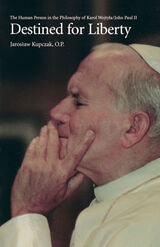
Destined for Liberty
The Human Person in the Philosophy of Karol Wojtyla/John Paul IIJaroslaw Kupczak, O.P.
Catholic University of America Press, 2000
In this compelling new work, Jaroslaw Kupczak, O.P., presents a complete introduction to John Paul II's theory of the human person
[more]
Encyclical Letter Magnifica Humanitas
On Safeguarding the Human Person in the Time of Artificial IntelligencePope Leo XIV
Catholic University of America Press, 2026
"Humanity, created by God in all its grandeur, is today facing a pivotal choice: either to construct a new Tower of Babel or to build the city in which God and humanity dwell together. Each generation inherits the task of shaping its own era, of guiding history to become a place where the dignity of every person is safeguarded, justice is promoted and fraternity is made possible."
Thus begins the first encyclical of the first pope from the United States, written during the country's 250th anniversary and addressing a topic - artificial intelligence - whose industry is centered in the United States. Yet Pope Leo's message is for everyone of good will throughout the world, to remind them of the principles of Catholic social teaching, the grandeur of being human, and the dignity of work as signposts in navigating the challenges and opportunities of an economy shaped by AI.
This handsome paperback version from The Catholic University of America Press, the publishers of the pope's doctoral thesis, will spark reflection and action upon Pope Leo's words.
[more]
Freedom and the Human Person
Richard Velkley
Catholic University of America Press, 2007
The present collection seeks to contribute toward finding that distance by making the tradition of thought more a living reality and not an object of arid analyses. Unlike most collections the present one transcends disciplinary boundaries, as it acknowledges the interconnectedness of philosophical, theological, and political arguments on these themes.
[more]
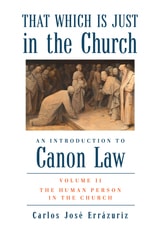
That Which Is Just in the Church
Volume 2: The Human Person in the ChurchCarlos José Errázuriz
St. Augustine's Press, 2023
Volume one of Prof. Carlos J. Errázuriz's monumental treatment of canon law establishes that law in the Catholic Church is properly understood as that which is just. In the second volume, he moves to the foremost protagonist in this arena––namely, the human person. The human person is the primary holder of rights and obligations in the Church, destined for the salvation merited by Christ. The salvific goods constituted by the Word of God and the sacraments are fundamental aspects of juridical relationships and life in the Church.
Being subject to law, Errázuriz observes, does not undermine the freedom and dignity of the person. Rather, ecclesial law intends to confront the human person with his true supernatural inheritance, while preserving him in the mystery of communion within which the Church herself exists. Indeed, the human person has both natural and supernatural dignity, and likewise responsibilities that bear upon the seen and unseen realms of communion.
Prof. Errázuriz examines the practical applications of personhood and law, as well as the perspectives of the human subject that derive from his ontological status. This is further drawn across various states of life that occur within the Church and the differing juridical relations encountered. Also considered is the nature of association in the Church, and Errázuriz breaks down the concepts and particular realities pertaining to this natural tendency and the legal discipline.
[more]
The Human Person
Steven J. Jensen
Catholic University of America Press, 2018
The Human Person presents a brief introduction to the human mind, the soul, immortality, and free will. While delving into the thought of Thomas Aquinas, it addresses contemporary topics, such as skepticism, mechanism, animal language research, and determinism. Steven J. Jensen probes the primal questions of human nature. Are human beings free or determined? Is the capacity to reason distinctive to human beings or do animals also have some share of reason? Have animals really been taught to use language?
[more]
The Irreducibility of the Human Person
A Catholic SynthesisMark K. Spencer
Catholic University of America Press, 2022
Catholic philosophical anthropologists have defended views of the human person on which we are irreducible to anything non-personal. For example, it is not the case that we are nothing but matter, souls, or parts of society. But many Catholic anthropologies have overlooked ways in which we are irreducible and so have not given an adequate account of the uniqueness of each human person. This book presents a philosophical portrait of human persons that depicts each way in which we are irreducible, with the goal of guiding the reader to perceive, wonder at, and love all the unique features of human persons. It builds this portrait by showing how claims from many strands of the Catholic tradition can be synthesized. These strands include Thomism, Scotism, phenomenology, personalism, nouvelle théologie, analytic philosophy, and Greek and Russian thought. The book focuses on how these traditions’ claims are grounded in experience and on how they help us to perceive irreducible features of persons. While many metaphysical claims about persons are defended, the picture of persons that ultimately emerges is one on which persons are best grasped not through abstract concepts but through aesthetic perception and love, as unique kinds of beauty.
This book also explores irreducible features of our subjectivity, senses, intellect, freedom, and affections, and of our souls, bodies, and activities. It includes discussions of divine simplicity and causality, and of the nature of angels, matter, organisms, and artifacts, all of which must be understood to fully grasp our irreducibility. In showing how to synthesize various traditions’ claims, the book also offers new solutions to a number of debates in Catholic philosophy. These include debates over natural law, the natural desire to see God, the separated soul, integralism and personalism, idealist and realist phenomenology, and scholastic accounts of the act of existence.
[more]