Results by title
4 books match the query 'Human Society'
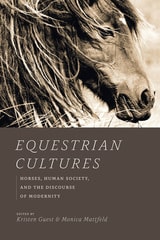
Equestrian Cultures
Horses, Human Society, and the Discourse of ModernityEdited by Kristen Guest and Monica Mattfeld
University of Chicago Press, 2019
As much as dogs, cats, or any domestic animal, horses exemplify the vast range of human-animal interactions. Horses have long been deployed to help with a variety of human activities—from racing and riding to police work, farming, warfare, and therapy—and have figured heavily in the history of natural sciences, social sciences, and the humanities. Most accounts of the equine-human relationship, however, fail to address the last few centuries of Western history, focusing instead on pre-1700 interactions. Equestrian Cultures fills in the gap, telling the story of how prominently horses continue to figure in our lives, up to the present day.
Kristen Guest and Monica Mattfeld place the modern period front and center in this collection, illuminating the largely untold story of how the horse has responded to the accelerated pace of modernity. The book’s contributors explore equine cultures across the globe, drawing from numerous interdisciplinary sources to show how horses have unexpectedly influenced such distinctively modern fields as photography, anthropology, and feminist theory. Equestrian Cultures boldly steps forward to redefine our view of the most recent developments in our long history of equine partnership and sets the course for future examinations of this still-strong bond.
Kristen Guest and Monica Mattfeld place the modern period front and center in this collection, illuminating the largely untold story of how the horse has responded to the accelerated pace of modernity. The book’s contributors explore equine cultures across the globe, drawing from numerous interdisciplinary sources to show how horses have unexpectedly influenced such distinctively modern fields as photography, anthropology, and feminist theory. Equestrian Cultures boldly steps forward to redefine our view of the most recent developments in our long history of equine partnership and sets the course for future examinations of this still-strong bond.
[more]
Imperfection and Defeat
The Role of Aesthetic Imagination in Human SocietyVirgil Nemoianu
Central European University Press, 2006
Literature is defined in a challenging way as the "science" of imperfection and defeat, or else as a type of discourse that deals with defeat, loss, uncertainty in social life, by contrast with virtually all disciplines (hard sciences or social sciences) that affirm certainties and wish to convince us of truths. If in real history most constructive attempts end up in failure, it follows that we ought to have also a field of research that examines this diversity of failures and disappointments, as well as the alternative options to historical evolution and progress. Thus literature serves an indispensable role: that of gleaning the abundance of past existence, the gratuitous and the rejected being placed here on an equal level with the useful and the successful.This provocative and unusual approach is illustrated in chapters that deal with the dialectics between literary writing and such fields as historical writing, or religious discourses, and is also illustrated by the socio-historical development of East-Central Europe.
[more]
Mixed Messages
Cultural and Genetic Inheritance in the Constitution of Human SocietyRobert A. Paul
University of Chicago Press, 2015
As social and symbolic animals—animals with language and systems of signs—humans are informed by two different kinds of heritage, one biological, the other cultural. Scholars have tended to study our genetic and symbolic lineages separately, but in recent years some have begun to explore them together, offering a “dual inheritance theory.” In this book, Robert A. Paul offers an entirely new and original consideration of our dual inheritance to date, going deep inside an extensive ethnographic record to outline a fascinating relationship between our genetic codes and symbolic systems.
Examining a wide array of cultures, Paul reveals how the inherent tensions between these two modes of transmission generate many of the features of human society, such as marriage rules, initiation rituals, gender asymmetry, and sexual symbolism. Exploring differences in the requirements, range, and agendas of genetic and symbolic reproduction, he shows that a properly conceived dual inheritance model does a better job of accounting for the distinctive character of actual human societies than either evolutionary or socio-cultural construction theories can do alone. Ultimately this book offers a powerful call for a synthesis of the traditions inspired by Darwin, Durkheim, and Freud—one that is critically necessary if we are to advance our understanding of human social life.
Examining a wide array of cultures, Paul reveals how the inherent tensions between these two modes of transmission generate many of the features of human society, such as marriage rules, initiation rituals, gender asymmetry, and sexual symbolism. Exploring differences in the requirements, range, and agendas of genetic and symbolic reproduction, he shows that a properly conceived dual inheritance model does a better job of accounting for the distinctive character of actual human societies than either evolutionary or socio-cultural construction theories can do alone. Ultimately this book offers a powerful call for a synthesis of the traditions inspired by Darwin, Durkheim, and Freud—one that is critically necessary if we are to advance our understanding of human social life.
[more]
Redefining History
Ghosts, Spirits, and Human Society in P'u Sung-ling's World, 1640-1715Chun-shu Chang and Shelley Hsueh-lun Chang
University of Michigan Press, 1998
This fascinating new book by Chun-shu Chang and Shelley Hsueh-lun Chang follows the career, times, and ideas of P'u Sung-ling (1640-1715) and focuses its discussion on his magnum opus, Liao-chai chih- i, or Tales of the Unusual from the Studio of Deliberation and Musing. P'u lived through the turbulent period of Ming-Ch'ing dynastic transition in the seventeenth century and he aspired, as did millions of young men of his time, to pass the Imperial Civil Service Examinations necessary for securing a government position.
While P'u did not attain his goal of becoming a statesman, having failed exam after exam for fifty years, he was not impeded in his intellectual and literary pursuits. When he died in 1715, he left a body of work including over 500 essays, 1,295 poems, 119 lyrics, 18 encyclopedias and handbooks, 20 operas, 100 folk songs, and 500 short stories. He went on to become one of the most well-known scholar-writers and the best known short-story author in Chinese history. The 500 stories in Liao-chai chih-i, which P'u composed in his self-styled capacity as historian, had the most lasting influence of any single work on the shaping of popular consciousness in China.
Following the life and literature of one man, this study sets out to detail the history of the Ming-Ch'ing dynastic transition in the East Shantung region. It is based on an exhaustive exploration of contemporary Chinese historical and literary sources, including local histories, clan and family records, autobiographical and biographical materials, folklore, essays, poems, and plays: in short, the entire range of literary sources. Using a comprehensive historical approach, the authors cover a broad array of issues relevant to the topic at hand.
Redefining History is an important source for the study of Chinese history and literature and comparative historical studies. It will also appeal to people interested in the relation between history and literature, issues of gender and class, race relations, biographical studies, and popular culture movements.
Chun-shu Chang is Professor of History, University of Michigan, and Honorary Professor of Chinese History, China. Shelley Hsueh-lun Chang is Visiting Associate Professor of History and Research Associate, Center for Chinese Studies, University of Michigan.
[more]