Results by title

6 books match the query 'Human biology'
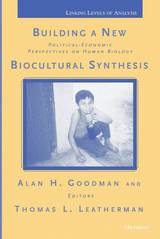
cover of Building a New Biocultural Synthesis: Political-Economic Perspectives on Human Biology

Building a New Biocultural Synthesis

Political-Economic Perspectives on Human Biology

Alan H. Goodman and Thomas L. Leatherman, Editors

University of Michigan Press, 1998

Anthropology, with its dual emphasis on biology and culture, is--or should be--the discipline most suited to the study of the complex interactions between these aspects of our lives. Unfortunately, since the early decades of this century, biological and cultural anthropology have grown distinct, and a holistic vision of anthropology has suffered.
This book brings culture and biology back together in new and refreshing ways. Directly addressing earlier criticisms of biological anthropology, Building a New Biocultural Synthesis concerns how culture and political economy affect human biology--e.g., people's nutritional status, the spread of disease, exposure to pollution--and how biological consequences might then have further effects on cultural, social, and economic systems.
Contributors to the volume offer case studies on health, nutrition, and violence among prehistoric and historical peoples in the Americas; theoretical chapters on nonracial approaches to human variation and the development of critical, humanistic and political ecological approaches in biocultural anthropology; and explorations of biological conditions in contemporary societies in relationship to global changes.
Building a New Biocultural Synthesis will sharpen and enrich the relevance of anthropology for understanding a wide variety of struggles to cope with and combat persistent human suffering. It should appeal to all anthropologists and be of interest to sister disciplines such as nutrition and sociology.
Alan H. Goodman is Professor of Anthropology, Hampshire College. Thomas L. Leatherman is Associate Professor of Anthropology, University of South Carolina.
[more]
cover of Gender and the Science of Difference: Cultural Politics of Contemporary Science and Medicine

Gender and the Science of Difference

Cultural Politics of Contemporary Science and Medicine

Fisher, Jill A

Rutgers University Press, 2011

How does contemporary science contribute to our understanding about what it means to be women or men? What are the social implications of scientific claims about differences between "male" and "female" brains, hormones, and genes? How does culture influence scientific and medical research and its findings about human sexuality, especially so-called normal and deviant desires and behaviors? Gender and the Science of Difference examines how contemporary science shapes and is shaped by gender ideals and images.

Prior scholarship has illustrated how past cultures of science were infused with patriarchal norms and values that influenced the kinds of research that was conducted and the interpretation of findings about differences between men and women. This interdisciplinary volume presents empirical inquiries into today's science, including examples of gendered scientific inquiry and medical interventions and research. It analyzes how scientific and medical knowledge produces gender norms through an emphasis on sex differences, and includes both U.S. and non-U.S. cases and examples.
[more]
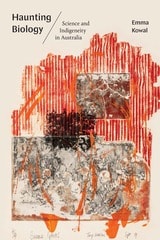
cover of Haunting Biology: Science and Indigeneity in Australia

Haunting Biology

Science and Indigeneity in Australia

Emma Kowal

Duke University Press, 2023

In Haunting Biology Emma Kowal recounts the troubled history of Western biological studies of Indigenous Australians and asks how we now might see contemporary genomics, especially that conducted by Aboriginal and Torres Strait Islander scientists. Kowal illustrates how the material persistence of samples over decades and centuries folds together the fates of different scientific methodologies. Blood, bones, hair, comparative anatomy, human biology, physiology, and anthropological genetics all haunt each other across time and space, together with the many racial theories they produced and sustained. The stories Kowal tells feature a variety of ghostly presences: a dead anatomist, a fetishized piece of hair hidden away in a war trunk, and an elusive white Indigenous person. By linking this history to contemporary genomics and twenty-first-century Indigeneity, Kowal outlines the fraught complexities, perils, and potentials of studying Indigenous biological difference in the twenty-first century.
[more]
cover of The Politics of Women's Biology

The Politics of Women's Biology

Hubbard, Ruth

Rutgers University Press, 1990

For a range of historical and contemporary issues in eugenics, human evolution, and procreative technology, Ruth Hubbard explains why scientific descriptions and choices should not generalize human, or female, attributes without acknowledging the realities of people's lives. Sophisticated in its analysis, yet not at all technical in its exposition, this book will find a wide readership among feminists, the general public, and the scientific community.
[more]
cover of The Puerto Rican Population: A Study in Human Biology

The Puerto Rican Population

A Study in Human Biology

Frederick P. Thieme

University of Michigan Press, 1959
In this study, author Frederick P. Thieme presents data on biological characteristics of the population of Puerto Rico. He includes data on nutrition, dental status, intestinal infestation, blood types, and more: data he gathered during fieldwork in 1948 and 1949. Thieme’s goals were to set up a baseline as a point of comparison; to study the relationship between physical variability and environment; and to pave the way for establishing medical standards for Puerto Rico.
[more]
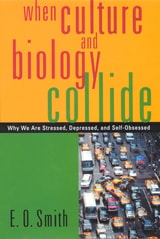
cover of When Culture and Biology Collide: Why We are Stressed, Depressed, and Self-Obsessed

When Culture and Biology Collide

Why We are Stressed, Depressed, and Self-Obsessed

E. O. Smith

Rutgers University Press, 2002

Why do we do things that we know are bad for us? Why do we line up to buy greasy fast food that is terrible for our bodies? Why do we take the potentially lethal risk of cosmetic surgery to have a smaller nose, bigger lips, or a less wrinkled face? Why do we risk life and limb in a fit of road rage to seek revenge against someone who merely cut us off in traffic? If these life choices are simply responses to cultural norms and pressures, then why did these particularly self-destructive patterns evolve in place of more sensible ones?

In When Culture and Biology Collide, E. O. Smith explores various aspects of behavior that are endemic to contemporary Western society, and proposes new ways of understanding and addressing these problems. Our physiology and behavior are the products of thousands of generations of evolutionary history. Every day we play out behaviors that have been part of the human experience for a very long time, yet these behaviors are played out in an arena that is far different from that in which they evolved. Smith argues that this discordance between behavior and environment sets up conditions in which there can be real conflict between our evolved psychological predispositions and the dictates of culture.

Topics such as drug abuse, depression, beauty and self-image, obesity and dieting, stress and violence, ethnic diversity, and welfare are all used as sample case studies. As with all of his case studies, Smith emphasizes the importance of not using an evolutionary explanation as an excuse for a particular pattern of behavior. Instead, he seeks to offer a perspective that will help us see ourselves more clearly and that may be useful in developing intelligent solutions to seemingly intractable problems. Smith provides ways of developing strategies for minimizing our self-destructive tendencies.

[more]