Results by title
12 books match the query 'Human ecology in literature'
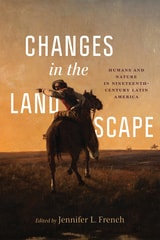
Changes in the Landscape
Humans and Nature in Nineteenth-Century Latin AmericaEdited by Jennifer L. French
Vanderbilt University Press, 2024
Ranging from the immediate aftermath of the Spanish‑American Wars of Independence (1810–1826) to the early twentieth century (1925), the volume’s essays cover a wide variety of genres and forms of cultural production, from José Hernández’s epic poem Martín Fierro to prose fiction, painting and photography, and the personal albums compiled by Spanish-American women. Individually and collectively, the essays engage with scientific writing as both a discourse of power and a source of potentially significant, even revelatory information about human and nonhuman nature. Changes in the Landscape enables readers to more fully understand the transition from colonial regimes to the ecocidal extractivism of the export boom (1870–1930) by drawing out and analyzing some of the cognitive resources and rhetorical strategies that were available to imagine, protest, or enact new norms and expectations regarding the relations between human and nonhuman life, be it the life of wildflowers, waterfalls, or Cuba’s Ciénaga de Zapata.
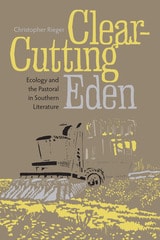
Clear-Cutting Eden
Ecology and the Pastoral in Southern LiteratureChristopher Rieger
University of Alabama Press, 2009
Examines how Southern literary depictions of the natural world were influenced by the historical, social, and ecological changes of the 1930s and 1940s
Rieger studies the ways that nature is conceived of and portrayed by four prominent Southern writers of the era: Erskine Caldwell, Marjorie Kinnan Rawlings, Zora Neale Hurston, and William Faulkner. Specifically, he argues that these writers created new versions of an old literary mode—the pastoral—in response to the destabilizing effects of the Great Depression, the rise of Southern modernism, and the mechanization of agricultural jobs.
Mass deforestation, soil erosion, urban development, and depleted soil fertility are issues that come to the fore in the works of these writers. In response, each author depicts a network model of nature, where humans are part of the natural world, rather than separate, over, or above it, as in the garden pastorals of the Old South, thus significantly revising the pastoral mode proffered by antebellum and Reconstruction-era writers.
Each writer, Rieger finds, infuses the pastoral mode with continuing relevance, creating new versions that fit his or her ideological positions on issues of race, class, and gender. Despite the ways these authors represent nature and humankind’s place in it, they all illustrate the idea that the natural environment is more than just a passive background against which the substance of life, or fiction, is played out.
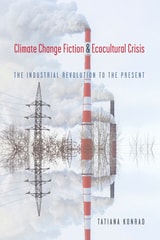
Climate Change Fiction and Ecocultural Crisis
The Industrial Revolution to the PresentTatiana Konrad
University of Nevada Press, 2024
Focusing on a diverse range of issues, including fossil fuels, cheap energy, the intricacies of human–more-than-human relationships, and postcolonial geographies, Konrad illustrates how cli-fi transcends mere storytelling. The genre ultimately emerges as an important means to forecast, imagine, and contemplate climatic events.
The book invites a broadening of the environmental humanities discourse, asking readers not only to deepen their understanding of the current climate crisis, but also to consider how cli-fi culture can be viewed as an effective method to address climate change.
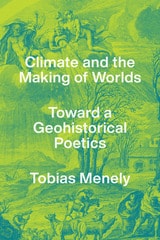
Climate and the Making of Worlds
Toward a Geohistorical PoeticsTobias Menely
University of Chicago Press, 2021
In this book, Tobias Menely develops a materialist ecocriticism, tracking the imprint of the planetary across a long literary history of poetic rewritings and critical readings which continually engage with the climate as a condition of human world making. Menely’s central archive is English poetry written between John Milton’s Paradise Lost (1667) and Charlotte Smith’s “Beachy Head” (1807)—a momentous century and a half during which Britain, emerging from a crisis intensified by the Little Ice Age, established the largest empire in world history and instigated the Industrial Revolution. Incorporating new sciences into ancient literary genres, these ambitious poems aspired to encompass what the eighteenth-century author James Thomson called the “system . . . entire.” Thus they offer a unique record of geohistory, Britain’s epochal transition from an agrarian society, buffeted by climate shocks, to a modern coal-powered nation. Climate and the Making of Worlds is a bracing and sophisticated contribution to ecocriticism, the energy humanities, and the prehistory of the Anthropocene.
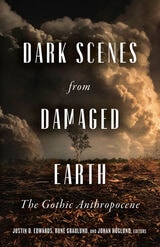
Dark Scenes from Damaged Earth
The Gothic AnthropoceneJustin D. Edwards
University of Minnesota Press, 2022
An urgent volume of essays engages the Gothic to advance important perspectives on our geological era
What can the Gothic teach us about our current geological era? More than just spooky, moonlit castles and morbid graveyards, the Gothic represents a vibrant, emergent perspective on the Anthropocene. In this volume, more than a dozen scholars move beyond longstanding perspectives on the Anthropocene—such as science fiction and apocalyptic narratives—to show that the Gothic offers a unique (and dark) interpretation of events like climate change, diminished ecosystems, and mass extinction.
Embracing pop cultural phenomena like True Detective, Jaws, and Twin Peaks, as well as topics from the New Weird and prehistoric shark fiction to ruin porn and the “monstroscene,” Dark Scenes from Damaged Earth demonstrates the continuing vitality of the Gothic while opening important new paths of inquiry. These essays map a genealogy of the Gothic while providing fresh perspectives on the ongoing climate chaos, the North/South divide, issues of racialization, dark ecology, questions surrounding environmental justice, and much more.
Contributors: Fred Botting, Kingston U; Timothy Clark, U of Durham; Rebecca Duncan, Linnaeus U; Michael Fuchs, U of Oldenburg, Germany; Esthie Hugo, U of Warwick; Dawn Keetley, Lehigh U; Laura R. Kremmel, South Dakota School of Mines and Technology; Timothy Morton, Rice U; Barry Murnane, U of Oxford; Jennifer Schell, U of Alaska Fairbanks; Lisa M. Vetere, Monmouth U; Sara Wasson, Lancaster U; Jeffrey Andrew Weinstock, Central Michigan U.

Ecofeminist Literary Criticism
Theory, Interpretation, PedagogyEdited by Greta Gaard and Patrick D. Murphy
University of Illinois Press, 1998
Ecofeminism is a practical movement for social change that discerns interconnections among all forms of oppression: the exploitation of nature, the oppression of women, class exploitation, racism, colonialism. Against binary divisions such as self/other, culture/nature, man/woman, humans/animals, and white/non-white, ecofeminist theory asserts that human identity is shaped by more fluid relationships and by an acknowledgment of both connection and difference.
Once considered the province of philosophy and women's studies, ecofeminism in recent years has been incorporated into a broader spectrum of academic discourse. Ecofeminist Literary Criticism assembles some of the most insightful advocates of this perspective to illuminate ecofeminism as a valuable component of literary criticism.
Influx and Efflux
Writing Up with Walt WhitmanJane Bennett
Duke University Press, 2020
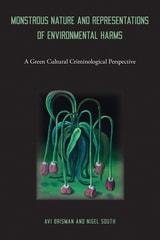
Monstrous Nature and Representations of Environmental Harms
A Green Cultural Criminological PerspectiveAvi Brisman and Nigel South
Temple University Press, 2025
The authors use examples from popular culture, including Disney and Marvel Cinematic Universe films, to consider ideas about how the environment responds to people who cause it harm. Brisman and South identify and discuss three dominant and interrelated depictions of the relationship between humans and the environment: first, nature as monstrous or fear inducing; second, nature and the Earth (or parts of it) as abject; and third, the entanglement of nature and the apocalypse, wherein nature is contributing to the end of the world, with an end point sometimes conceptualized as one without humans.
Monstrous Nature and Representations of Environmental Harms argues that such representations have material consequences. The authors make the case for challenging them so that we neither perpetuate them nor retreat into cynicism and defeatism about the future of our planet.
Narrative in the Anthropocene
Erin James
The Ohio State University Press, 2022
Steinbeck and the Environment
Interdisciplinary ApproachesSusan F. Beegel
University of Alabama Press, 2007
This interdisciplinary collection of essays explores in-depth a topic previously neglected by scholars: John Steinbeck's early continuing preoccupation with ecology and marine biology and the effect of that interest on his writings. Written by scholars from various disciplines, the essays offer a dynamic contribution to the study of John Steinbeck by considering his writings from an environmental perspective. They reveal Steinbeck as a prophet that was ahead of his time and supremely relevant to our own.
The World in Which We Occur
John Dewey, Pragmatist Ecology, and American Ecological Writing in the Twentieth CenturyNeil W. Browne
University of Alabama Press, 2007
Where nature meets democracy—John Dewey’s vision for a more connected world.
American philosopher John Dewey considered all human endeavors to be one with the natural world. In his writings, particularly Art as Experience (1934), Dewey insists on the primacy of the environment in aesthetic experience. Dewey’s conception of environment includes both the natural and the man-made. The World in Which We Occur highlights this notion in order to define “pragmatist ecology,” a practice rooted in the interface of the cultural and the natural. Neil Browne finds this to be a significant feature of some of the most important ecological writing of the last century.
To fully understand human involvement in the natural world, Browne argues that disciplinary boundaries must be opened, with profound implications for the practice of democracy. The degradation of the physical environment and democratic decay, for Browne, are rooted in the same problem: our persistent belief that humans are somehow separate from their physical environment.
Browne probes the work of a number of major American writers through the lens of Dewey’s philosophy. Among other texts examined are John Muir’s My First Summer in the Sierra (1911); Sea of Cortez (1941) by John Steinbeck and Edward Ricketts; Rachel Carson’s three books about the sea, Under the Sea-Wind (1941), The Sea Around Us (1951), and The Edge of the Sea (1955); John Haines’s The Stars, the Snow, the Fire (1989); Barry Lopez’s Arctic Dreams (1986); and Terry Tempest Williams’s Refuge (1991). Together, these texts—with their combinations of scientific observation and personal meditation—challenge the dichotomies that we have become accustomed and affirm the principles of a pragmatist ecology, one in which ecological and democratic values go hand in hand.
Unnatural Ecopoetics
Unlikely Spaces in Contemporary PoetrySarah Nolan
University of Nevada Press, 2017
By approaching environments in a new way, Nolan closes this gap and recognizes how contemporary poets employ self-reflexive commentary and formal experimentation in order to create new natural/cultural environments on the page. She proposes a radical new direction for ecopoetics and deploys it in relation to four major American poets. Working from literal to textual spaces through the contemporary poetry of A.R. Ammons’s Garbage, Lyn Hejinian’s My Life, Susan Howe’s The Midnight, and Kenneth Goldsmith’s Seven American Deaths and Disasters, the book presents applications of unnatural ecopoetics in poetic environments, ones that do not engage with traditional ideas of nature and would otherwise remain outside the scope of ecocritical and ecopoetic studies.
Nolan proposes a new practical approach for reading poetic language. Ecocriticism is a very fluid and evolving discipline, and Nolan’s pioneering new book pushes the boundaries of second-wave ecopoetics—the fundamental issue being what is nature/natural, and how does poetic language, particularly self-conscious contemporary poetic agency, contribute to and complicate that question.