Results by title
11 books match the query 'Human figure in art'
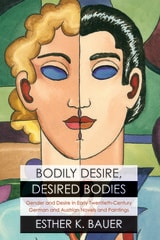
Bodily Desire, Desired Bodies
Gender and Desire in Early Twentieth-Century German and Austrian Novels and PaintingsEsther K. Bauer
Northwestern University Press, 2014
Bodily Desire, Desired Bodies examines the diverse ways that literary works and paintings can be read as screens onto which new images of masculinity and femininity are cast. Esther Bauer focuses on German and Austrian writers and artists from the 1910s and 1920s —specifically authors Franz Kafka, Vicki Baum, and Thomas Mann, and painters Otto Dix, Christian Schad, and Egon Schiele—who gave spectacular expression to shifting trends in male and female social roles and the organization of physical desire and the sexual body.
Bauer’s comparative approach reveals the ways in which artists and writers echoed one another in undermining the gender duality and highlighting sexuality and the body. As she points out, as sites of negotiation and innovation, these works reconfigured bodies of desire against prevailing notions of sexual difference and physical attraction and thus became instruments of social transformation.
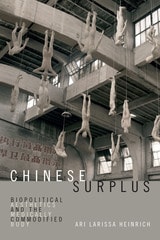
Chinese Surplus
Biopolitical Aesthetics and the Medically Commodified BodyAri Larissa Heinrich
Duke University Press, 2018
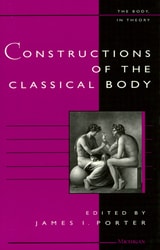
Constructions of the Classical Body
James I. Porter, Editor
University of Michigan Press, 2002
Classical scholarship has traditionally neglected the prominence of the body in antiquity. Constructions of the Classical Body theorizes that the study of antiquity is necessarily a study of the body, and that attention to this fact can lead to a much-needed shift in the way in which classical studies are approached today. This volume aims to reestablish the relevance of the problem of the body at the perimeters of several different kinds of inquiry, and, in this way, to help open up a field of possibilities for future study. The range covered by the essays in this volume is sweeping: from Corinthian vaseware to Athenian and Roman politics, poetry from Homer to Ovid, medical writers from the Hippocratic corpus to the diary of Aelius Aristides (second century c.e.), philosophy (Seneca, Porphyry), the Greek novel, Christian apocrypha, Ovid's medieval reception, and twentieth century film. This range is a consequence of the multidisciplinarity that any study of the body requires, and it attests to the particular richness of the body in classical antiquity and as an object for study today. The volume illustrates that body is located between traditional borders, not within them; the body dissolves traditional objects of study and joins areas usually kept apart. Retracing the fate of the body is thus a way of rendering antiquity truly strange again -- it allows us to see the past afresh, with open eyes. This volume includes essays by Carlin A. Barton, Anne Carson, Eric Downing, Catherine Edwards, Maud W. Gleason, John Henderson, Ralph Hexter, S. C. Humphreys, Helen King, Leslie Kurke, Robert Lamberton, David S. Potter, Amy Richlin, Giulia Sissa, Maria Wyke, and Froma I. Zeitlin, along with an introduction by James I. Porter. ". . . a superb collection, one that I know will be most welcome not only in the field of classical studies, but in the libraries of all those interested in the history and historicity of the body." --Page duBois, University of California, San Diego
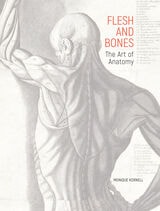
Flesh and Bones
The Art of AnatomyMonique Kornell
J. Paul Getty Trust, The, 2022
This illustrated volume examines the different methods artists and anatomists used to reveal the inner workings of the human body and evoke wonder in its form.
For centuries, anatomy was a fundamental component of artistic training, as artists such as Leonardo da Vinci and Michelangelo sought to skillfully portray the human form. In Europe, illustrations that captured the complex structure of the body—spectacularly realized by anatomists, artists, and printmakers in early atlases such as Andreas Vesalius’s De humani corporis fabrica libri septem of 1543—found an audience with both medical practitioners and artists.
Flesh and Bones examines the inventive ways anatomy has been presented from the sixteenth through the twenty-first century, including an animated corpse displaying its own body for study, anatomized antique sculpture, spectacular life-size prints, delicate paper flaps, and 3-D stereoscopic photographs. Drawn primarily from the vast holdings of the Getty Research Institute, the over 150 striking images, which range in media from woodcut to neon, reveal the uncanny beauty of the human body under the skin.
This volume is published to accompany an exhibition on view at the Getty Research Institute at the Getty Center from February 22 to July 10, 2022.

Fra Angelico
Dissemblance and FigurationGeorges Didi-Huberman
University of Chicago Press, 1995
A Florentine painter who took Dominican vows, Fra Angelico (1400-1455) approached his work as a largely theological project. For him, the problems of representing the unrepresentable, of portraying the divine and the spiritual, mitigated the more secular breakthroughs in imitative technique. Didi-Huberman explores Fra Angelico's solutions to these problems—his use of color to signal approaching visibility, of marble to recall Christ's tomb, of paint drippings to simulate (or stimulate) holy anointing. He shows how the painter employed emptiness, visual transformation, and displacement to give form to the mystery of faith.
In the work of Fra Angelico, an alternate strain of Renaissance painting emerges to challenge rather than reinforce verisimilitude. Didi-Huberman traces this disruptive impulse through theological writings and iconographic evidence and identifies a widespread tradition in Renaissance art that ranges from Giotto's break with Byzantine image-making well into the sixteenth century. He reveals how the techniques that served this ultimately religious impulse may have anticipated the more abstract characteristics of modern art, such as color fields, paint spatterings, and the absence of color.
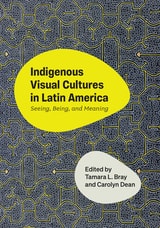
Indigenous Visual Cultures in Latin America
Seeing, Being, and MeaningEdited by Tamara L. Bray and Carolyn Dean
University of Texas Press, 2026
Reframing the study of Indigenous visual cultures, this volume explores how images and objects generate affect and relation in non-Western contexts, foregrounding alternative modes of material engagement and meaning-making.
While traditional approaches to Indigenous visual cultures have often centered on iconography and representation, this volume turns toward other ways that images and objects act in the world. Indigenous Visual Cultures in Latin America explores how material productions function not merely as signs that point elsewhere but as agents that help shape relationships, environments, and affective experience.
Spanning Mesoamerica, the Andes, and Amazonia from 1500 BCE to the present, the chapters examine how meaning may reside in materials themselves; how making is a form of exchange between maker and matter; and how visual forms participate in configuring relations among humans, ancestors, deities, and place. These works are not passive containers of meaning, but charged presences—generative forces within ongoing worlds. Attuned to Indigenous ways of knowing and being, the volume invites readers to think beyond the frame, beyond the image, and beyond representation itself.
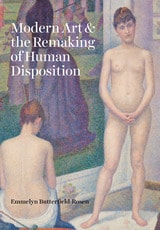
Modern Art and the Remaking of Human Disposition
Emmelyn Butterfield-Rosen
University of Chicago Press, 2021
With this book, Emmelyn Butterfield-Rosen brings a new formal and conceptual rubric to the study of turn-of-the-century modernism, transforming our understanding of the era’s canonical works. Butterfield-Rosen analyzes a hitherto unexamined formal phenomenon in European art: how artists departed from conventions for posing the human figure that had long been standard. In the decades around 1900, artists working in different countries and across different media began to present human figures in strictly frontal, lateral, and dorsal postures. The effect, both archaic and modern, broke with the centuries-old tradition of rendering bodies in torsion, with poses designed to simulate the human being’s physical volume and capacity for autonomous thought and movement. This formal departure destabilized prevailing visual codes for signifying the existence of the inner life of the human subject.
Exploring major works by Georges Seurat, Gustav Klimt, and the dancer and choreographer Vaslav Nijinsky— replete with new archival discoveries—Modern Art and the Remaking of Human Disposition combines intensive formal analysis with inquiries into the history of psychology and evolutionary biology. In doing so, it shows how modern understandings of human consciousness and the relation of mind to body were materialized in art through a new vocabulary of postures and poses.
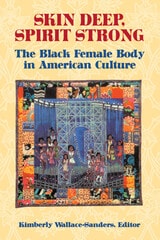
Skin Deep, Spirit Strong
The Black Female Body in American CultureKimberly Wallace-Sanders, Editor
University of Michigan Press, 2002
The collection blends original and classic essays to reveal the interconnections among art, literature, public policy, the history of medicine, and theories about sexuality with regard to bodies that are both black and female. Contributors include Rachel Adams, Elizabeth Alexander, Lisa Collins, Bridgette Davis, Lisa E.Farrington, Anne Fausto-Sterling, Beverly Guy-Sheftall, Evelynn Hammonds, Terri Kapsalis, Jennifer L. Morgan, Siobhan B. Somerville, Kimberly Wallace-Sanders, Carla Williams, and Doris Witt.
Skin Deep, Spirit Strong: The Black Female Body in American Culture will appeal to both the academic reader attempting to integrate race into discussion about the female body and to the general reader curious about the history of black female representation.
Kimberly Wallace-Sanders is Assistant Professor, Graduate Institute of Liberal Arts and Institute of Women's Studies, Emory University.
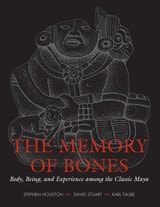
The Memory of Bones
Body, Being, and Experience among the Classic MayaBy Stephen Houston, David Stuart, and Karl Taube
University of Texas Press, 2006
All of human experience flows from bodies that feel, express emotion, and think about what such experiences mean. But is it possible for us, embodied as we are in a particular time and place, to know how people of long ago thought about the body and its experiences? In this groundbreaking book, three leading experts on the Classic Maya (ca. AD 250 to 850) marshal a vast array of evidence from Maya iconography and hieroglyphic writing, as well as archaeological findings, to argue that the Classic Maya developed a coherent approach to the human body that we can recover and understand today.
The authors open with a cartography of the Maya body, its parts and their meanings, as depicted in imagery and texts. They go on to explore such issues as how the body was replicated in portraiture; how it experienced the world through ingestion, the senses, and the emotions; how the body experienced war and sacrifice and the pain and sexuality that were intimately bound up in these domains; how words, often heaven-sent, could be embodied; and how bodies could be blurred through spirit possession.
From these investigations, the authors convincingly demonstrate that the Maya conceptualized the body in varying roles, as a metaphor of time, as a gendered, sexualized being, in distinct stages of life, as an instrument of honor and dishonor, as a vehicle for communication and consumption, as an exemplification of beauty and ugliness, and as a dancer and song-maker. Their findings open a new avenue for empathetically understanding the ancient Maya as living human beings who experienced the world as we do, through the body.
The Naked Truth
Viennese Modernism and the BodyAlys X. George
University of Chicago Press, 2020
Viennese modernism is often described in terms of a fin-de-siècle fascination with the psyche. But this stereotype of the movement as essentially cerebral overlooks a rich cultural history of the body. The Naked Truth, an interdisciplinary tour de force, addresses this lacuna, fundamentally recasting the visual, literary, and performative cultures of Viennese modernism through an innovative focus on the corporeal.
Alys X. George explores the modernist focus on the flesh by turning our attention to the second Vienna medical school, which revolutionized the field of anatomy in the 1800s. As she traces the results of this materialist influence across a broad range of cultural forms—exhibitions, literature, portraiture, dance, film, and more—George brings into dialogue a diverse group of historical protagonists, from canonical figures such as Egon Schiele, Arthur Schnitzler, Joseph Roth, and Hugo von Hofmannsthal to long-overlooked ones, including author and doctor Marie Pappenheim, journalist Else Feldmann, and dancers Grete Wiesenthal, Gertrud Bodenwieser, and Hilde Holger. She deftly blends analyses of popular and “high” culture, laying to rest the notion that Viennese modernism was an exclusively male movement. The Naked Truth uncovers the complex interplay of the physical and the aesthetic that shaped modernism and offers a striking new interpretation of this fascinating moment in the history of the West.
The Repeating Body
Slavery's Visual Resonance in the ContemporaryKimberly Juanita Brown
Duke University Press, 2015