Results by title
3 books match the query 'Human mechanics'
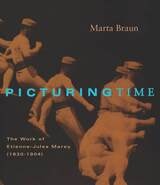
Picturing Time
The Work of Etienne-Jules Marey (1830-1904)Marta Braun
University of Chicago Press, 1992
Etienne-Jules Marey was an inventor whose methods of recording movement revolutionized our way of visualizing time and motion. Best remembered for his chronophotography, Marey constructed a single-camera system that led the way to cinematography. Picturing Time, the first complete survey of Marey's work, investigates the far reaching effects of Marey's inventions on stream-of-consciousness literature, psychoanalysis, Bergsonian philosophy, and the art of cubists and futurists.
Braun offers a fascinating look at how Marey's chronophotography was used to express the profound transformation in understanding and experiencing time that occurred in the late nineteenth century. Featuring 335 illustrations, Picturing Time includes many unpublished examples of Marey's chronophotographs and cinematic work. It also contains a complete bibliography of his writings and the first catalog of his films, photographic prints, and recently discovered negatives.
Braun offers a fascinating look at how Marey's chronophotography was used to express the profound transformation in understanding and experiencing time that occurred in the late nineteenth century. Featuring 335 illustrations, Picturing Time includes many unpublished examples of Marey's chronophotographs and cinematic work. It also contains a complete bibliography of his writings and the first catalog of his films, photographic prints, and recently discovered negatives.
[more]
Sport, Physical Culture, and the Moving Body
Materialisms, Technologies, EcologiesJoshua I. Newman
Rutgers University Press, 2020
2020 Choice Outstanding Academic Title
The moving body—pervasively occupied by fitness activities, intense training and dieting regimes, recreational practices, and high-profile sporting mega-events—holds a vital function in contemporary society. As the body moves—as it performs, sweats, runs, and jumps—it sets in motion an intricate web of scientific rationalities, spatial arrangements, corporate imperatives, and identity politics (i.e. politics of gender, race, social class, etc.). It represents vitality in its productive and physiological capacities, it drives a complex economy of experiences and products, and it is a meaningful site of cultural identities and politics.
Contributors to Sport, Physical Culture, and the Moving Body work from a simple premise: as it moves, the material body matters. Adding to the burgeoning fields of sport studies and body studies, the works featured here draw upon the traditions of feminist theory, posthumanism, actor network theory, and new materialism to reposition the physical, moving body as crucial to the cultural, political, environmental, and economic systems that it constitutes and within which is constituted. Once assembled, the book presents a study of bodies in motion—made to move in contexts where technique, performance, speed, strength, and vitality not only define the conduct therein, but provide the very reason for the body’s being within those economies and environments. In so doing, the contributors look to how the body moving for and about rational systems of science, medicine, markets, and geopolity shapes the social and material world in important and unexpected ways.
In Sport, Physical Culture, and the Moving Body, contributors explore the extent to which the body, when moving about both ostensibly active body spaces (i.e., the gymnasium, the ball field, exercise laboratory, the track or running trail, the beach, or the sport stadium) and those places less often connected to physical activity (i.e. the home, the street, the classroom, the automobile), is bounded to technologies of life and living; and to the political arrangements that seek to capitalize upon such frames of biological vitality. To do so, the authors problematize the rise of active body science (i.e. kinesiology, sport and exercise sciences, performance biotechnology) and the effects these scientific interventions have on embodied, lived experience.
Contributors to Sport, Physical Culture, and the Moving Body will be engaging a range of new and emerging theoretical perspectives, including new materialist, political ecology, developmental systems theory, and new material feminist approaches, to examine the actors and assemblages of movement-based material, political, and economic production. In so doing, contributors will vividly and powerfully illustrate the extent to which a focus on the fleshed body and its material conditions can bring forth new insights or ontological and epistemological innovation to the sociology of sport and physical activity. They will also explore the agency of the body as and amongst things. Such a performative materialist approach explicates how complex assemblages of sport and physical activity—bringing into association everything from muscle fibers and dietary proteins to stadium concrete or regional aquifers—are not only meaningful, but ecological.
By focusing on the confluence of agentive materialities, disciplinary technologies, vibrant assemblages, speculative realities, and vital performativities, Sport, Physical Culture, and the Moving Body promises to offer a groundbreaking departure from representationalist tendencies and orthodoxies brought about by the cultural turn in sport and physical cultural studies. It brings the moving body and its physics back into focus: recentering moving flesh and bones as locus of social order, environmental change, and the global political economy.
[more]
Teaching Dancing with Ideokinetic Principles
Drid Williams
University of Illinois Press, 2011
In examining ideokinesis and its application to the teaching and practice of dancing, Drid Williams introduces readers to the work of Dr. Lulu Sweigard (1895–1974), a pioneer of ideokinetic principles. Drawing on her experiences during private instructional sessions with Sweigard over a two-year span, Williams discusses methods using imagery for improving body posture and alignment for ease of movement. Central to Williams's own teaching methods is the application of Sweigard's principles and general anatomical instruction, including how she used visual imagery to help prevent bodily injuries and increasing body awareness relative to movement. Williams also emphasizes the differences between kinesthetic (internal) and mirror (external) imagery and shares reactions from professional dancers who were taught using ideokinesis. Williams's account of teaching and practicing ideokinesis is supplemented with essays by Sweigard, William James, and Jean-Georges Noverre on dancing, posture, and habits. Teaching Dancing with Ideokinetic Principles offers an important historical perspective and valuable insights from years of teaching experience into how ideokinesis can shape a larger philosophy of the dance.
[more]