Results by title
19 books match the query 'Human reproduction'

Bodies of Knowledge
The Medicalization of Reproduction in GreeceEugenia Georges
Vanderbilt University Press, 2008
Recipient of the 2006 Norman L. and Roselea J. Goldberg Prize for the best project in the area of medicine.
The author, a second-generation Greek American, returned to Greece with her young daughter to do fieldwork over the course of a decade. Focusing on Rhodes, an island that blends continuity with the past and rapid social change in often unexpected ways, she interviewed over a hundred women, doctors, and midwives about issues of reproduction.
The result is a detailed portrait of how a longstanding system of "local" gynecological and obstetrical knowledge under the control of women was rapidly displaced in the the period following World War II, and how the technologically-intensive biomedical model that took its place in turn assumed its own distinctive signature.
Bodies of Knowledge is a vivid ethnographic study of how a presumably globalizing and homogenizing process like medicalization can be reshaped as women and medical experts alike selectively accept or reject new practices and technologies. Georges found, for example, that women in Rhodes have enthusiastically embraced some new technologies, like fetal imaging during pregnancy, but rejected others, like medical contraception. They are also avid consumers of popular childbirth manuals.
This book is the recipient of the 2006 Norman L. and Roselea J. Goldberg Prize for the best project in the area of medicine.

Conceiving Cuba
Reproduction, Women, and the State in the Post-Soviet EraAndaya, Elise
Rutgers University Press, 2014
Winner of the Adele E. Clarke Book Award from ReproNetwork
After Cuba’s 1959 revolution, the Castro government sought to instill a new social order. Hoping to achieve a new and egalitarian society, the state invested in policies designed to promote the well-being of women and children. Yet once the Soviet Union fell and Cuba’s economic troubles worsened, these programs began to collapse, with serious results for Cuban families.
Conceiving Cuba offers an intimate look at how, with the island’s political and economic future in question, reproduction has become the subject of heated public debates and agonizing private decisions. Drawing from several years of first-hand observations and interviews, anthropologist Elise Andaya takes us inside Cuba’s households and medical systems. Along the way, she introduces us to the women who wrestle with the difficult question of whether they can afford a child, as well as the doctors who, with only meager resources at their disposal, struggle to balance the needs of their patients with the mandates of the state.
Andaya’s groundbreaking research considers not only how socialist policies have profoundly affected the ways Cuban families imagine the future, but also how the current crisis in reproduction has deeply influenced ordinary Cubans’ views on socialism and the future of the revolution. Casting a sympathetic eye upon a troubled state, Conceiving Cuba gives new life to the notion that the personal is always political.

Conceiving Masculinity
Male Infertility, Medicine, and IdentityLiberty Walther Barnes
Temple University Press, 2014
In Conceiving Masculinity, Liberty Walther Barnes puts the world of male infertility under the microscope to examine how culturally pervasive notions of gender shape our understanding of disease, and how disease impacts our personal ideas about gender.
Taking readers inside male infertility clinics, and interviewing doctors and couples dealing with male infertility, Barnes provides a rich account of the social aspects of the confusing and frustrating diagnosis of infertility. She explains why men resist a stigmatizing label like "infertile," and how men with poor fertility redefine for themselves what it means to be manly and masculine in a society that prizes male virility. Conceiving Masculinity also details how and why men embrace medical technologies and treatment for infertility.
Broaching a socially taboo topic, Barnes emphasizes that infertility is not just a women's issue. She shows how gender and disease are socially constructed within social institutions and by individuals.

Female Fertility and the Body Fat Connection
Rose E. Frisch
University of Chicago Press, 2002
Rose E. Frisch explains here how, in women, a certain amount of body fat is crucial to the reproductive system and sexual maturation. Women who are too lean are infertile and cannot conceive children; young girls who are too thin have a delayed onset of their first period. Female Fertility and the Body-Fat Connection illuminates how and why a "critical fitness" level underlies a woman's reproductive health. In the process Frisch gives readers a comprehensive view of the research done to date on the relationship between body composition and fertility and also describes her own journey as a woman scientist working to advance her critical-fitness hypothesis both to the general public and the scientific community. Frisch answers the questions every woman has about the desirable weight for health and fertility and even includes tables to help women find their own best weight. She also demonstrates how important diet and exercise are for the long-term reproductive health of women, and shows what factors influence the onset of puberty in girls.
Each milestone of the reproductive life span is affected by food intake and energy output, the factors affecting the storage of fat. Female Fertility and the Body-Fat Connection is a cornerstone to understanding the health of girls and women.
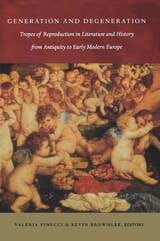
Generation and Degeneration
Tropes of Reproduction in Literature and History from Antiquity through Early Modern EuropeValeria Finucci and Kevin Brownlee, eds.
Duke University Press, 2001
The discourses on reproduction, biology, degeneration, legacy, and lineage that this book broaches not only bring to the forefront concepts of sexual identity and gender politics but also show how they were culturally constructed and reconstructed through the centuries by medicine, philosophy, the visual arts, law, religion, and literature. The contributors reflect on a wide range of topics—from what makes men “manly” to the identity of Christ’s father, from what kinds of erotic practices went on among women in sixteenth-century seraglios to how men’s hemorrhoids can be variously labeled. Essays scrutinize stories of menstruating males and early writings on the presumed inferiority of female bodily functions. Others investigate a psychomorphology of the clitoris that challenges Freud’s account of lesbianism as an infantile stage of sexual development and such topics as the geographical origins of medicine and the materialization of genealogy in the presence of Renaissance theatrical ghosts.
This collection will engage those in English, comparative, Italian, Spanish, and French studies, as well as in history, history of medicine, and ancient and early modern religious studies.
Contributors. Kevin Brownlee, Marina Scordilis Brownlee, Elizabeth Clark, Valeria Finucci, Dale Martin, Gianna Pomata, Maureen Quilligan, Nancy Siraisi, Peter Stallybrass,Valerie Traub

Gestating Judaism
The Corporeal Technologies of American Jewish ReligionCara Rock-Singer
University of Chicago Press, 2026
An ethnography of how people use reproductive practices to transmit and reinvent American Judaism.
In Gestating Judaism, Cara Rock-Singer develops a new analytic technique called ethnodrashy (a combination of rabbinical midrash and sociological ethnography) to explore the centrality of reproductive bodies to the intellectual, political, and spiritual life of American Judaism. She considers how, in reproduction, religious practices like the mikveh combine with secular practices like fertility treatments in ways that challenge the popular idea that religion occupies a separate sphere of life from politics or science. In fact, Rock-Singer shows how Jewish feminists have leveraged the work of reproduction to intervene in important conversations about both politics and theology. Drawing together religious studies, gender studies, and science and technology studies, Gestating Judaism shows how Jewish tradition is transmitted and reinvented through the ongoing labor of reproduction.

Grandmotherhood
The Evolutionary Significance of the Second Half of Female LifeVoland, Eckart
Rutgers University Press, 2014
By the year 2030, the average life expectancy of women in industrialized countries could reach ninety—exceeding that of men by about ten years. At the present time, postmenopausal women represent more than fifteen percent of the world’s population and this figure is likely to grow.
From an evolutionary perspective, these demographic numbers pose some intriguing questions. Darwinian theory holds that a successful life is measured in terms of reproduction. How is it, then, that a woman’s lifespan can greatly exceed her childbearing and childrearing years? Is this phenomenon simply a byproduct of improved standards of living, or do older women—grandmothers in particular—play a measurable role in increasing their family members’ biological success?
Until now, these questions have not been examined in a thorough and comprehensive manner. Bringing togethertheoretical and empirical work byinternationally recognized scholars in anthropology, psychology, ethnography, and the social sciences, Grandmotherhood explores the evolutionary purpose and possibilities of female post-generative life. Students and scholars of human evolution, anthropology, and even gerontology will look to this volume as a major contribution to the current literature in evolutionary studies.
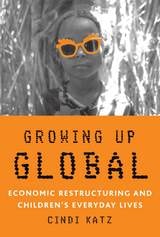
Growing Up Global
Economic Restructuring and Children’s Everyday LivesCindi Katz
University of Minnesota Press, 2004
Growing Up Global examines the processes of development and global change through the perspective of children’s lives in two seemingly disparate places: New York City and a village in northern Sudan. At the book’s core is a longitudinal ethnographic study of children growing up in a Sudanese village that was included in a large state-sponsored agricultural program in the year they were born. It follows a small number of children intermittently from ten years of age to early adulthood, concentrating particularly on their work and play, which together trained the children for an agrarian life centered around the family, a life that was quickly becoming obsolete.
Shifting her focus to largely working-class families in New York City in the 1980s and 1990s, Katz is able to expose unsuspected connections with the Sudanese experience in the effects on children of a constantly changing, capitalist environment—the decline of manufacturing jobs and the increase in knowledge-based jobs—in which young people with few skills and stunted educations face bleak employment prospects. In teasing out how “development” transforms the grounds on which these young people come of age, Cindi Katz provides a textured analysis of the importance of knowledge in the ability of people, families, and communities to reproduce themselves and their material social practices over time.
Homeland Maternity
US Security Culture and the New Reproductive RegimeNatalie Fixmer-Oraiz
University of Illinois Press, 2019

Images of Bliss
Ejaculation, Masculinity, MeaningMurat Aydemir
University of Minnesota Press, 2007
Aristotle believed semen to be the purest of all bodily secretions, a vehicle for the spirit or psyche that gives form to substance. For Proust’s narrator in Swann’s Way, waking to find he has experienced a nocturnal emission, it is the product of “some misplacing of my thigh.” The heavy metal band Metallica used it to adorn an album cover. Beyond its biological function, semen has been applied with surprising frequency to metaphorical and narratological purposes.
In Images of Bliss, Murat Aydemir undertakes an original and extensive analysis of images of male orgasm and semen. In a series of detailed case studies—Aristotle’s On the Generation of Animals; Andres Serrano’s use of bodily fluids in his art; paintings by Holbein and Leonardo; Proust’s In Search of Lost Time; hard-core pornography (both straight and gay); and key texts from the poststructuralist canon, including Lacan on the phallus, Bataille on expenditure, Barthes on bliss, and Derrida on dissemination—Aydemir traces the complex and often contradictory possibilities for imagination, description, and cognition that both the idea and the reality of semen make available. In particular, he foregrounds the significance of male ejaculation for masculine subjectivity. More often than not, Aydemir argues, the event or object of ejaculation emerges as the instance through which identity, meaning, and gender are not so much affirmed as they are relentlessly and productively questioned, complicated, and displaced.
Combining close readings of diverse works with subtle theoretical elaboration and a keen eye for the cultural ideals and anxieties attached to sexuality, Images of Bliss offers a convincing and long overdue critical exploration of ejaculation in Western culture.
Murat Aydemir is assistant professor of comparative literature at the University of Amsterdam.

LITIGATION AS LOBBYING
REPRODUCTIVE HAZARDS & INTEREST AGGREGATIONJULIANNA S. GONEN
The Ohio State University Press, 2003

Plundered Kitchens, Empty Wombs
Threatened Reproduction and Identity in the Cameroon GrassfieldsPamela Feldman-Savelsberg
University of Michigan Press, 1999
In the Cameroon grassfields, an area of high fertility, women hold a paradoxical fear of infertility. By combining symbolic, political-economic, and historical analyses, Pamela Feldman-Savelsberg traces the way reproductive threat is invoked in struggles over gender and ethnic identities. Women's fears of reproductive disorders, she finds, are an important mode of expression for their worries about much larger issues, such as rural poverty, brought about or exacerbated by political and economic changes in this century.
A lively case study of an infertile queen who flees the palace sets the stage for discussions of the ethnographic and historical setting, the symbolism of fertility and infertility, and the development and interaction of cosmopolitan and ethno-gynecologies. The book concludes with an analysis of the links between women's role in human reproduction and the divine king's role in social reproduction, both occurring in the rapidly changing context of a multiethnic African nation.
Plundered Kitchens, Empty Wombs underscores the relevance of medical anthropology to other anthropological specializations, as well as to epidemiologists, population specialists, and development planners. It should reach a broad audience in medical anthropology, public health, and women's studies.
Pamela Feldman-Savelsberg is Assistant Professor of Anthropology, Carleton College.

Reproduction, Globalization, and the State
New Theoretical and Ethnographic PerspectivesCarole H. Browner and Carolyn F. Sargent, eds.
Duke University Press, 2011
Contributors. Aditya Bharadwaj, Caroline H. Bledsoe, Carole H. Browner, Junjie Chen, Aimee R. Eden, Susan L. Erikson, Didier Fassin, Claudia Lee Williams Fonseca, Ellen Gruenbaum, Matthew Gutmann, Marcia C. Inhorn, Mark B. Padilla, Rayna Rapp, Lisa Ann Richey, Carolyn Sargent, Papa Sow, Cecilia Van Hollen, Linda Whiteford

Reproductive Justice
The Politics of Health Care for Native American WomenGurr, Barbara
Rutgers University Press, 2015

Reproductive Labor and Innovation
Against the Tech Fix in an Era of HypeJennifer Denbow
Duke University Press, 2024

The Afterlife of Reproductive Slavery
Biocapitalism and Black Feminism’s Philosophy of HistoryAlys Eve Weinbaum
Duke University Press, 2019

The Political Geographies of Pregnancy
Laura R. Woliver
University of Illinois Press, 2002
A searing study of how modern reproductive politics shapes women's bodily agency
Pregnancy indisputably takes place within a woman's body. But as reproductive power finds its way into the hands of medical professionals, lobbyists, and policymakers, the geographies of pregnancy are shifting, and the boundaries need to be redrawn, argues Laura R. Woliver. The Political Geographies of Pregnancy is a vigorous analysis of the ways modern reproductive politics are shaped by long-standing debates on abortion and adoption, surrogacy arrangements, new reproductive technologies, medical surveillance, and the mapping of the human genome.
Across a politically charged backdrop of reproductive issues, Woliver exposes strategies that claim to uphold the best interests of children, families, and women but in reality complicate women's struggles to have control over their own bodies. Utilizing feminist standpoint theory and promoting a feminist ethic of care, Woliver looks at abortion politics, modern adoption laws that cater to male-headed families, regulations that allow the state to monitor pregnant women but not always provide care for them, and the power structures behind the seemingly benign world of egg-selling and surrogate parenting. She also considers the potentially staggering political implications of mapping the human genome, and the exclusion of women's perspectives in discussions about legislation and advancements in reproductive technologies.
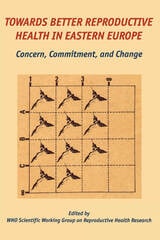
Towards Better Reproductive Health in Eastern Europe
Concern, Commitment, and ChangeWHO Scientific Working Group WHO Scientific Working Group
Central European University Press, 1998
Documenting the latest statistical data on current problems related to reproductive health issues in Central and Eastern Europe, this text explores the reasons for these problems and recommends action based on the scientific evidence for improving reproductive health.
The main issues covered are: declining standards of reproductive health care; rising trends in the incidence of sexually transmitted diseases; low rates of use of modern contraceptives; high rates of induced abortion; high prevalence of infertility; and the needs of adolescents with regard to reproductive health.

Wayward Reproductions
Genealogies of Race and Nation in Transatlantic Modern ThoughtAlys Eve Weinbaum
Duke University Press, 2004
Gracefully traversing a wide range of discourses––including literature, evolutionary theory, early anthropology, Marxism, feminism, and psychoanalysis––Weinbaum traces a genealogy of the race/reproduction bind within key intellectual formations of the late nineteenth and twentieth centuries. She examines two major theorists of genealogical thinking—Friedrich Nietzsche and Michel Foucault—and unearths the unacknowledged ways their formulations link race and reproduction. She explores notions of kinship and the replication of racial difference that run through Charlotte Perkins Gilman’s work; Marxist thinking based on Friedrich Engel’s The Origin of the Family; Charles Darwin’s theory of sexual selection; and Sigmund Freud’s early studies on hysteria. She also describes W. E. B. Du Bois’s efforts to transcend ideas about the reproduction of race that underwrite citizenship and belonging within the United States. In a coda, Weinbaum brings the foregoing analysis to bear on recent genomic and biotechnological innovations.