Results by title

9 books match the query 'Human skin color'

cover of Beneath the Surface: A Transnational History of Skin Lighteners

Beneath the Surface

A Transnational History of Skin Lighteners

Lynn M. Thomas

Duke University Press, 2020

For more than a century, skin lighteners have been a ubiquitous feature of global popular culture—embraced by consumers even as they were fiercely opposed by medical professionals, consumer health advocates, and antiracist thinkers and activists. In Beneath the Surface, Lynn M. Thomas constructs a transnational history of skin lighteners in South Africa and beyond. Analyzing a wide range of archival, popular culture, and oral history sources, Thomas traces the changing meanings of skin color from precolonial times to the postcolonial present. From indigenous skin-brightening practices and the rapid spread of lighteners in South African consumer culture during the 1940s and 1950s to the growth of a billion-dollar global lightener industry, Thomas shows how the use of skin lighteners and experiences of skin color have been shaped by slavery, colonialism, and segregation as well as by consumer capitalism, visual media, notions of beauty, and protest politics. In teasing out lighteners’ layered history, Thomas theorizes skin as a site for antiracist struggle and lighteners as a technology of visibility that both challenges and entrenches racial and gender hierarchies.
[more]
cover of Domesticating Brown: Movements of Racial Imagination

Domesticating Brown

Movements of Racial Imagination

Christopher B. Patterson

Duke University Press, 2026

Domesticating Brown interrogates the slippery senses that brownness as a racial form has manifested over time, charting its transitions across historical colonial contexts and into the transpacific dynamics of contemporary empire. Christopher B. Patterson rethinks universalist definitions of race to consider the constant movements in racial contexts, meanings, and practices that “brownness” reveals: as a site for the ungovernable brown mass, as peoples marked for domestication through strategies of colonial containment, and as the complex shades that reveal troubling genealogies and shameful intimacies. Tracing the emergences and transformations of brownness in various contexts of transpacific encounter—from the Mongol Empire to Filipino plantation migration in Hawaiʻi, from the imperial management of Hong Kong to contemporary brown authorship—Domesticating Brown explores how colonial subjects and other marginalized peoples have strategized ways of resisting and reversing dominating notions of brownness through art, story, and embodied difference.
[more]
cover of From Dessalines to Duvalier: Race, Colour and National Independence in Haiti

From Dessalines to Duvalier

Race, Colour and National Independence in Haiti

Nicholls, David

Rutgers University Press, 1996

In this lively, provocative, and well-documented history, David Nicholls discusses the impact of "color" on the political relationship between the black majority and the mulatto elite during almost two hundred years of Haitian history. The divisive factor impeding harmony in Haitian culture, argues Nicholls, has not been race, but color. Identifying themselves as non-white, blacks and mulattos acknowledge racial unity. But color divisions, reinforced by religious, regional, and class differences, have nonetheless prevented the two groups from achieving poltitical and ideological unity. Nicholls grounds this sophisticated analysis in great historical detail and engaging, witty prose. Students and general readers alike will delight in this insightful and informative history of Haiti.
[more]
cover of From Dessalines to Duvalier: Race, Colour and National Independence in Haiti

From Dessalines to Duvalier

Race, Colour and National Independence in Haiti

Nicholls, David

Rutgers University Press, 1996
In this lively, provocative, and well-documented history, David Nicholls discusses the impact of "color" on the political relationship between the black majority and the mulatto elite during almost two hundred years of Haitian history. The divisive factor impeding harmony in Haitian culture, argues Nicholls, has not been race, but color. Identifying themselves as non-white, blacks and mulattos acknowledge racial unity. But color divisions, reinforced by religious, regional, and class differences, have nonetheless prevented the two groups from achieving poltitical and ideological unity. Nicholls grounds this sophisticated analysis in great historical detail and engaging, witty prose. Students and general readers alike will delight in this insightful and informative history of Haiti.
[more]
cover of Skin Acts: Race, Psychoanalysis, and the Black Male Performer

Skin Acts

Race, Psychoanalysis, and the Black Male Performer

Michelle Ann Stephens

Duke University Press, 2014
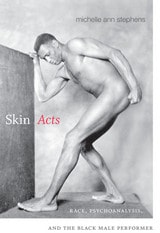
In Skin Acts, Michelle Ann Stephens explores the work of four iconic twentieth-century black male performers—Bert Williams, Paul Robeson, Harry Belafonte, and Bob Marley—to reveal how racial and sexual difference is both marked by and experienced in the skin. She situates each figure within his cultural moment, examining his performance in the context of contemporary race relations and visual regimes. Drawing on Lacanian psychoanalysis and performance theory, Stephens contends that while black skin is subject to what Frantz Fanon called the epidermalizing and hardening effects of the gaze, it is in the flesh that other—intersubjective, pre-discursive, and sensuous—forms of knowing take place between artist and audience. Analyzing a wide range of visual, musical, and textual sources, Stephens shows that black subjectivity and performativity are structured by the tension between skin and flesh, sight and touch, difference and sameness.
[more]
cover of Skin Color, Power, and Politics in America

Skin Color, Power, and Politics in America

Mara Cecilia Ostfeld

Russell Sage Foundation, 2022

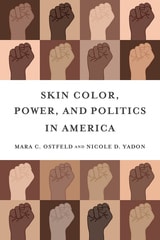
A person’s skin color affects their life experiences including income, educational attainment, health outcomes, exposure to discrimination, interactions with the criminal justice system and one’s sense of ethnoracial group belonging. But, do these disparate experiences affect the relationship between skin color and political views? In Skin Color, Power, and Politics in America, political scientists Mara Ostfeld and Nicole Yadon explore the relationship between skin color and political views in the U.S. among Latino, Black, and White Americans. They examine how skin color influences an individual’s politics and whether a person’s political views influence how they assess their own skin color.
 
Ostfeld and Yadon surveyed over 1,300 people about their political views, including party affiliation, their opinions on welfare, and the importance of speaking English in the U.S. The authors created a matrix grounded in their “Roots of Race” framework, which predicts the relationship between skin color and political attitudes for each ethnoracial group based on the blurriness of the group’s boundaries and historical levels of privilege. They draw upon three distinct measures of skin color to conceptualize the relationship between skin color and political views: “Machine-Rated Skin Color,” measured with a light-reflectance meter; “Self-Assessed Skin Color,” using the Yadon-Ostfeld Skin Color Scale; and “Skin Color Discrepancy,” the difference between one’s Machine-Rated and Self-Assessed Skin Color. 
 
Ostfeld and Yadon examine patterns that emerge among these measures, and their relationships with life experiences and political stances. Among Latinos, a group with relatively blurry group boundaries and low levels of historical privilege, the authors find a robust relationship between political views and Self-Assessed Skin Color. Latinos who overestimate the lightness of their skin color are more likely to hold conservative views on current racialized political issues, such as policing. Latinos who overestimate the darkness of their skin color, on the other hand, are more likely to hold liberal political views. As America’s major political parties remain divided on issues of race, this suggests that for Latinos, self-reported skin color is used as a means of aligning oneself with valued political coalitions. 
 
African Americans, another group with low levels of historical privilege but with more clearly defined group boundaries, demonstrated no significant relationship between skin color and political attitudes. Thus, the lived experiences associated with being African American appeared to supersede the differences in life experiences due to skin color.
 
Whites, a group with more historical privilege and increasingly blurry group boundaries, showed a clear relationship between machine-assessed skin color and attitudes on political issues. Those with darker Machine-Rated Skin Color are more likely to hold conservative views, suggesting that they are responding to the threat of losing their privilege in a multicultural society.
 
At a time when the U.S. is both more diverse and politically divided, Skin Color, Power, and Politics in Americais a timely account of the ways in which skin color and politics are intertwined.
 
 
[more]
cover of The Color of Paper: Representing Race in the Comics Medium

The Color of Paper

Representing Race in the Comics Medium

Chris Gavaler

The Ohio State University Press, 2026
How does a comics reader understand that a certain race is assigned to a character? In The Color of Paper, Chris Gavaler establishes a formal approach for analyzing racial representations in comics, demonstrating that the ink-on-paper materiality of comics reveals the illogic of metaphorical colors as racial categorizations. Analyzing images by a wide range of comics artists and colorists, including Emilee Denich, Jaime Hernandez, George Herriman, Jack Kirby, and Ben Passmore, Gavaler goes beyond pigment and gradient to explore the formal and material elements of page backgrounds and the negative space of gutters that literally frame race in comics. He surveys major and independent publishers to assess how industry trends and evolving coloring techniques affect racial representation. And, breaking from subjective and overgeneralized analytical norms, Gavaler grounds his analysis in quantitative research on viewers’ responses. The centuries-old relationships between drawn racial markers and assumptions about their meanings continue in a white-dominated culture that benefits from and therefore preserves illusions of their natural accuracy. Denaturalizing racial depictions through formal visual analysis potentially alters racial thinking in ways that extend beyond works on paper and into daily lives.
[more]
cover of The Politics of Skin Tone: African American Experiences, Identity, and Attitudes

The Politics of Skin Tone

African American Experiences, Identity, and Attitudes

Nicole D. Yadon

University of Chicago Press, 2025

A nuanced examination of the salience of skin tone within African American politics.

Research shows that skin tone is associated with significant differences in life experiences. On average, African Americans with darker skin earn lower wages, suffer worse health outcomes, and endure more negative criminal justice experiences than lighter-skinned African Americans. Nicole D. Yadon conceptualizes skin tone as one facet of the multidimensional construct of race that powerfully influences racialized experiences which, in turn, can influence political identities and attitudes.

Drawing on evidence from one hundred in-depth interviews, multiple surveys, and a survey experiment, The Politics of Skin Tone investigates the political associations of skin tone. Yadon finds that skin tone correlates with political attitudes, particularly on issues where color-based disparities are especially pronounced such as criminal justice. Moreover, a sizable number of African Americans adopt a skin tone-based identity. In an era of shifting racial boundaries and growing color-based discrimination, The Politics of Skin Tone examines the implications for both scholars and policymakers.
[more]
cover of The White African American Body

The White African American Body

Martin, Charles D.

Rutgers University Press, 2002

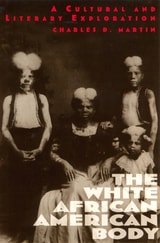
Blacks with white skin. Since colonial times, showmen have exhibited the bodies of African Americans with white or gradually whitening skin in taverns, dime museums, and circus sideshows. The term "white Negro" has served to describe an individual born with albinism as well as those who have vitiligo, a disorder that robs the skin of its pigment in ever-growing patches. In The White African American Body, Charles D. Martin examines the proliferation of the image of the white Negro in American popular culture, from the late eighteenth century to the present day.

This enigmatic figure highlights the folly of the belief in immutable racial differences. If skin is a race marker, what does it mean for blacks literally to be white? What does this say not only about blacks but also about whites? Scientists have probed this mystery, philosophers have pondered its meaning, and artists have profited from the sale of images of these puzzling figures.

Lavishly illustratedwith many rarely seen photographsThe White African American Body shows how the white Negro occupied, and still occupies, the precarious position between white and black, and how this figure remains resilient in American culture.

[more]